Navigating Tokyo Station with huge suitcases or a stroller, or rushing to catch a tight connection, can be really overwhelming. It is so huge and complex that even locals get lost, not just tourists! This guide covers everything you need to know based on real on-site visits. You’ll find tips on finding empty lockers, quiet locker spots, luggage storage services, step-free elevator routes, realistic transfer times for major lines (Shinkansen, N’EX, and Keiyo Line), and easy directions to Character Street. Read on for a hassle-free experience at Tokyo Station! や Read on to navigate Tokyo Station with ease!
【Quick Navigation: What is your situation?】
Lockers are FULL? ➔ Head to “Rail Go Service (B2F)” or “JR EAST Travel Service(1F)”
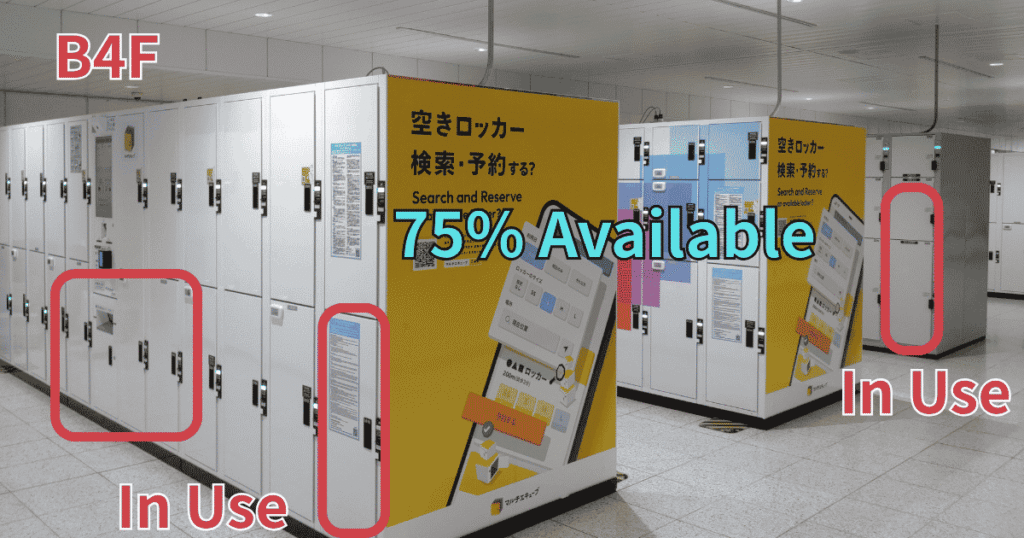
Want guaranteed empty lockers? ➔ Go to “B4F Sobu Line Area” (75% free)
Overnight / Multi-day storage? ➔ Use “Counters inside/outside gates” (Up to 15-30 days)
Taking the Shinkansen soon? ➔ Use “Shinkansen South Gate Counter (1F)” or “Sagawa (1F)”
1. The Basics: Tokyo Station’s Structure and 2 Main Areas
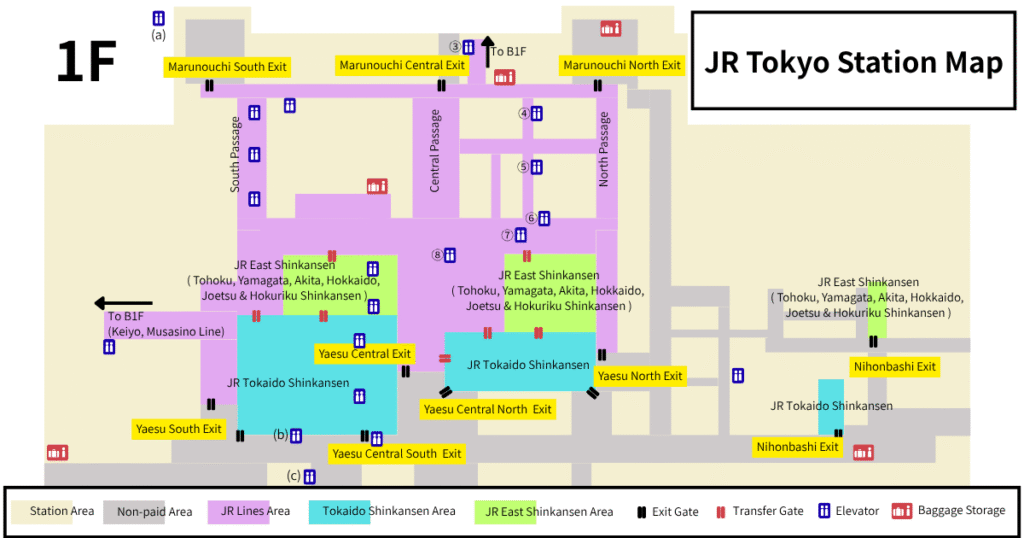
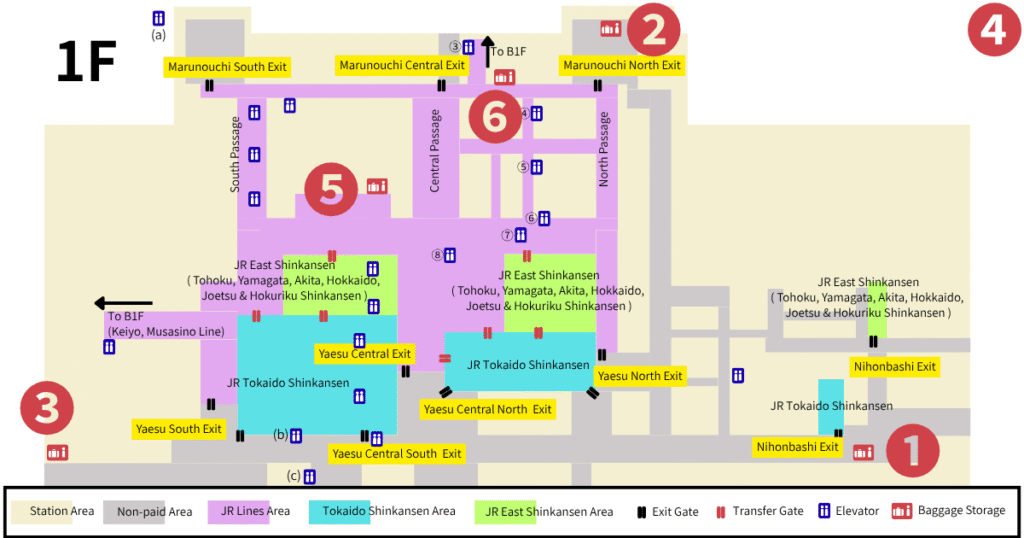
Tokyo Station 1F Map: Key walkways connecting the Marunouchi and Yaesu sides inside the ticket gates.
The most important rule to keep from getting lost at Tokyo Station is understanding the difference between the Marunouchi and Yaesu sides, as well as whether you are inside or outside the ticket gates.
To move between the Marunouchi and Yaesu sides, you can use three main walkways inside the station: the North, Central, and South Passages.
While the Shinkansen and standard train platforms are up on the 2nd floor, keep in mind that the Sobu Rapid/Yokosuka Line (for Narita Airport and Kamakura) is on Basement Level 5 (B5F), and the Keiyo Line (for Tokyo Disney Resort) is on Basement Level 4 (B4F).
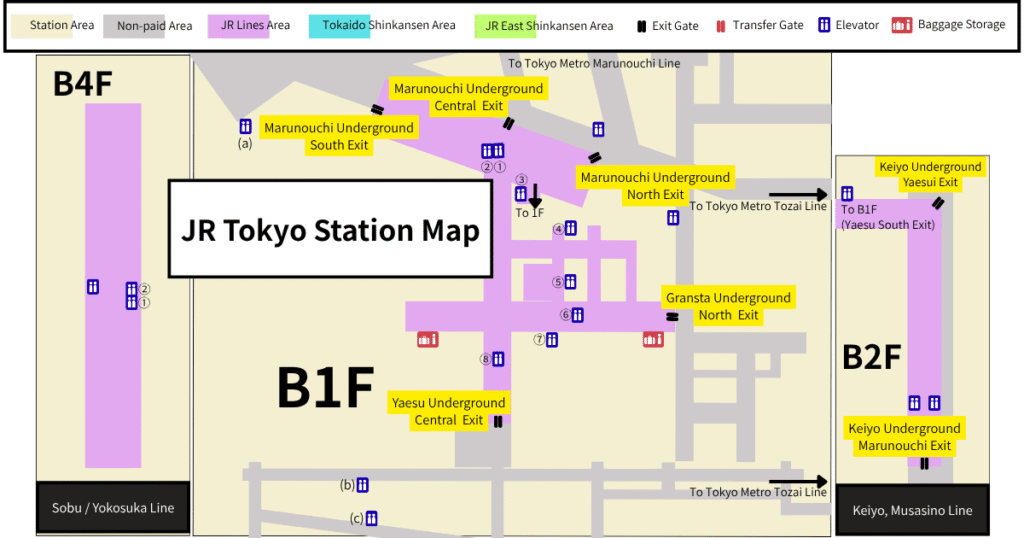
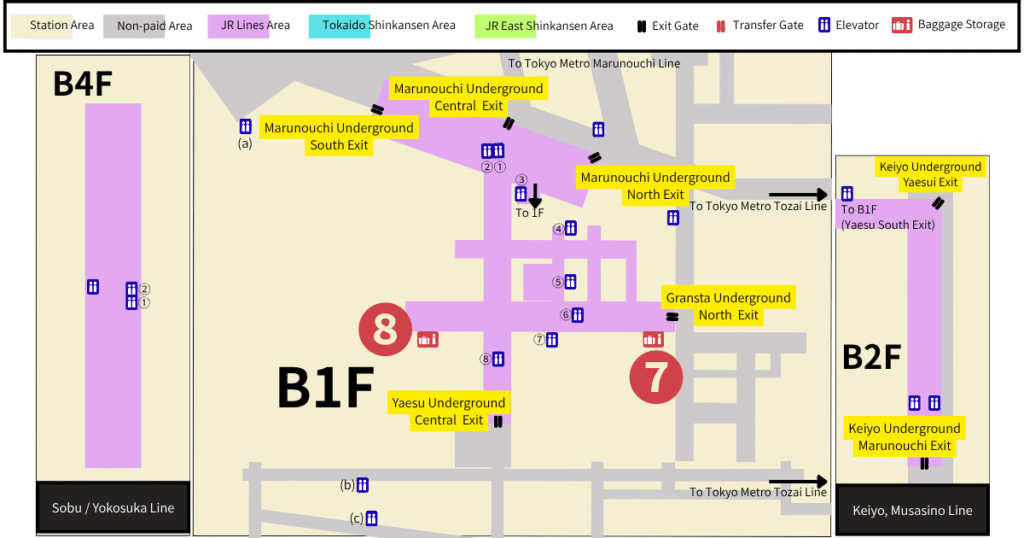
Tokyo Station B1 Map: Shop and restaurant layout featuring bento and souvenir areas across the underground concourse.
You’ll also find plenty of shops and restaurants selling bento boxes and souvenirs on the 1st floor concourse and Basement Level 1.
The Key Difference Between the Marunouchi and Yaesu Sides (The Most Important Rule)
Tokyo Station is mainly split into two areas: East and West.
Marunouchi Side (West): Easy to recognize by its iconic red brick station building. This side is convenient for visiting the Imperial Palace, luxury hotels, and taking the Marunouchi Subway Line. The Sobu Rapid/Yokosuka Line for Narita Airport is located on Basement Level 5 (B5F) on this side. You’ll also find the Chuo Line for Shinjuku, Yamanashi, and Nagano up on the 3rd floor (elevated platforms).
Yaesu Side (East): A modern area surrounded by skyscrapers. Head here if you’re taking any bullet train (Shinkansen)—including the Tokaido Shinkansen to Kyoto and Osaka—or if you’re using the express bus terminal or visiting the Yaechika underground shopping center. To reach the Keiyo Line (for Tokyo Disneyland/DisneySea and Makuhari Messe), head underground from the Yaesu side and walk about 500 meters along the moving walkways.
Quick Tip
If you want to walk between the Marunouchi and Yaesu sides outside the ticket gates, you can use the North Underground Passage (Kita-Chika Jiyu Tsuuro) for free.
If you go through the paid area inside the gates, you will need a valid train ticket or an admission ticket. An admission ticket (160 yen) allows you to enter the ticket gates to use inside services, such as coin lockers and luggage storage counters. Please note that the ticket becomes invalid once you exit, and it is valid for up to 2 hours.
Inside vs. Outside the Ticket Gates (Paid vs. Unpaid Areas)
Inside the Gates (Paid Area): Train platforms, Shinkansen transfer gates, in-station shopping areas (like Ecute and Gransta), and coin lockers inside the gates.
Outside the Gates (Unpaid Area): Luggage storage counters (Sagawa, Yamato, etc.), main street exits, and shopping areas like Yaechika (Yaesu Underground Shopping Mall) and Character Street.
2. Complete Guide to Coin Lockers and Luggage Storage Services
Tokyo Station has coin lockers all over the place, both inside and outside the ticket gates. In fact, there are said to be over 4,000 lockers in total! However, finding a large locker after 10:00 AM becomes extremely difficult, and by around noon, even small ones are hard to find.
Based on our on-site research, here are the exact steps you should follow to make sure you get a spot for your bags.
Coin Locker Sizes, Prices, and Payment Methods
Locker Size
Estimated Dimensions (H x W x D)
Fits Best
Estimated Daily Fee
Small
Approx. 35cm x 34cm x 57cm
Backpacks, daypacks
¥400–¥500
Medium
Approx. 50cm x 34cm x 57cm
Carry-on suitcases (20 inches)
¥600–¥700
Large
Approx. 84cm x 34cm x 57cm
Standard suitcases (24–26 inches)
¥800–¥900
Extra Large
Approx. 103cm x 34cm x 57cm
Large suitcases (28–30 inches)
¥1,000–¥1,200
Payment Methods
Most modern lockers feature touchscreen displays and accept IC transportation cards (such as Suica, PASMO, or ICOCA) or cash (100-yen coins).
If you pay with cash, your receipt will contain a PIN code that serves as your key—be sure not to lose it! If you pay with an IC card, the card itself works as your key.
Main Locker Areas and Hidden Gem Spots
Busy Locker Area: Most lockers near major exits are fully occupied by midday.
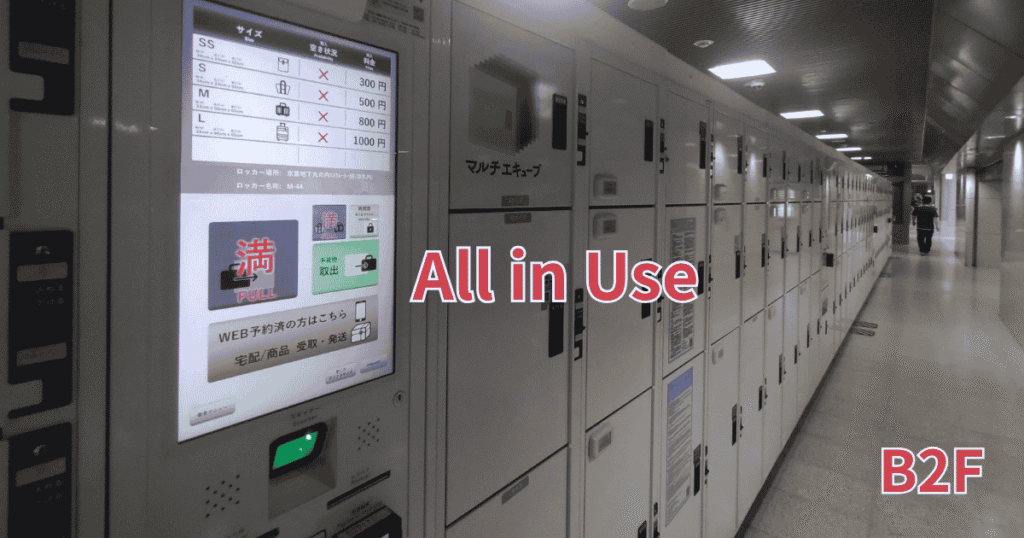
High-Traffic Areas: Locker locations near the Marunouchi Underground Central Exit and Yaesu Central Exit are usually very crowded. Even on weekdays, almost all lockers inside and outside the ticket gates are completely full by around noon.
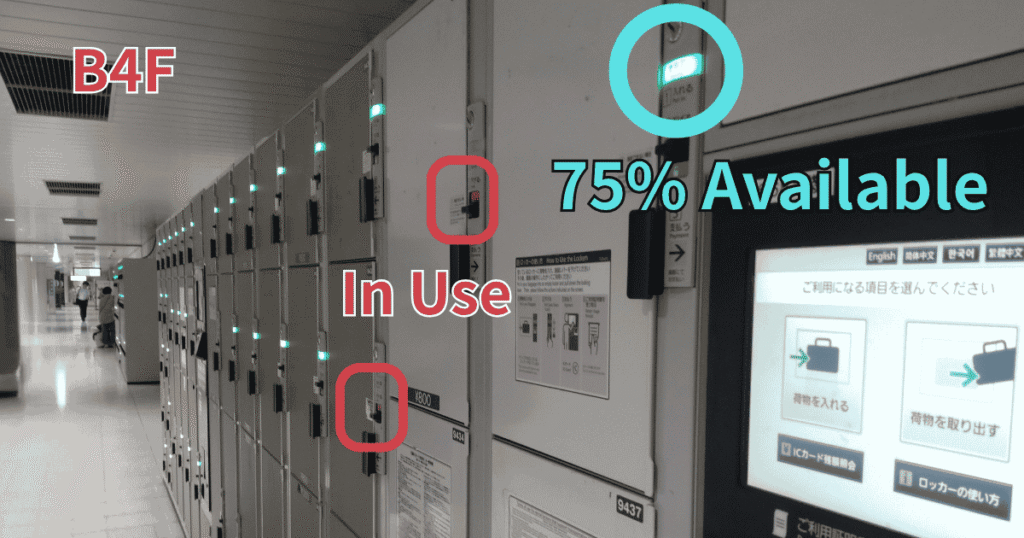
75% Availability Rate: Most coin lockers on Basement Level 4 (B4F) remain open, even when upper-level lockers are full.
A Reliable Alternative: The quiet B4F locker area near the Sobu/Yokosuka Line offers plenty of open spaces during peak hours.
Quiet “Hidden Gem” Lockers: While most lockers throughout the station are fully occupied, about 75% of the lockers for the Sobu Rapid/Yokosuka Line remain available! The train platforms are on Basement Level 5 (B5F), and the lockers are located right above them on Basement Level 4 (B4F). Getting there is super easy: from the 1st floor, take the elevator down one level to the Marunouchi Underground Central Exit, walk a few meters to another set of two elevators, and take them down one more floor.
What to Do When All Lockers Are Full: Manned Luggage Storage Counters
If the locker search screens show “FULL” in red, stop walking around looking for an open locker! The best option is to head straight to a manned luggage storage counter, where staff will keep your bags safely in a storage room.
Below are the details based on our visit around noon on a weekday. The numbers in the headings match the numbers on the map above.
Tokyo Station 1F Luggage Map: Locations of manned luggage storage counters on the 1st floor.
Tokyo Station B1 Luggage Map: Locations of manned luggage storage counters on Basement Level 1.
Main Luggage Storage Counters Outside the Ticket Gates
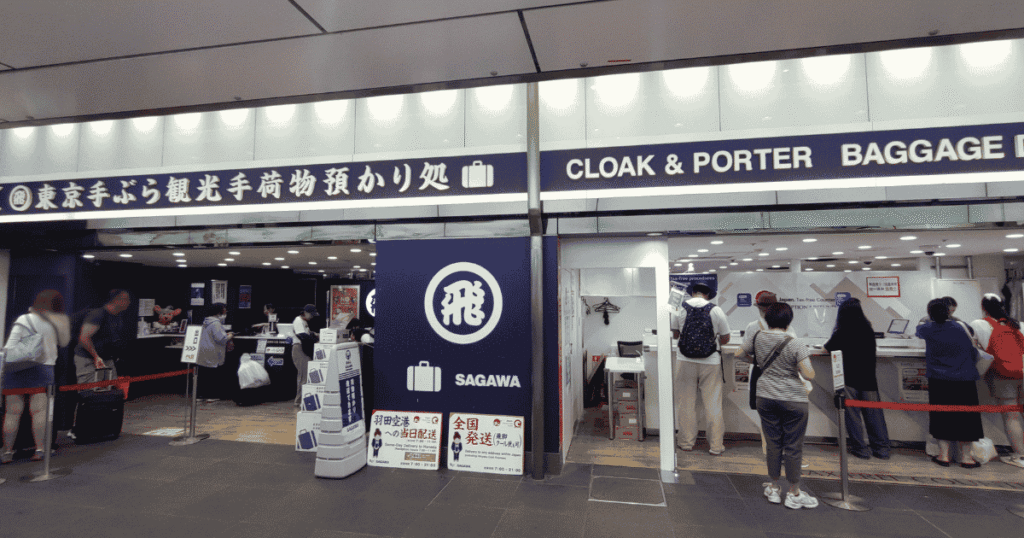
1. Sagawa Express Tokyo Service Center
Sagawa Express Tokyo Service Center: Located on 1F (Yaesu North Exit / right by Shinkansen Nihombashi Gate). Great for same-day delivery and storage, though it can get slightly crowded due to high demand.
Location: 1F, outside the ticket gates near Yaesu North Exit (Local Lines) / Nihombashi Exit (Tokaido Shinkansen)
Hours: 7:00 AM – 9:00 PM
Key Features: Temporary storage, plus same-day luggage delivery to hotels or airports (Narita and Haneda).
Our Visit: There was a short line, but it moved quickly.
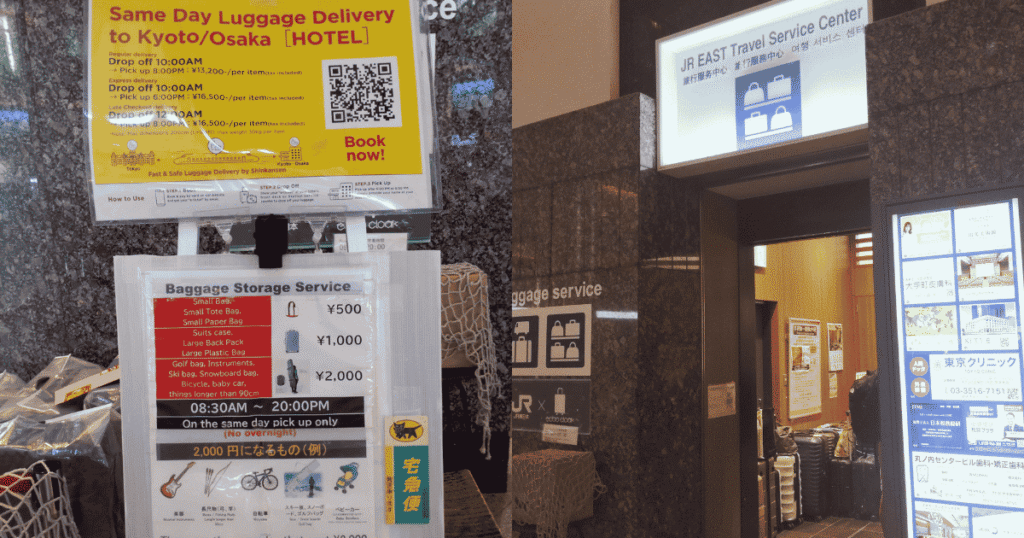
2. JR EAST Travel Service Center (Yamato Transport Storage)
JR EAST Travel Service Center: Located 1F outside Marunouchi North Exit (great access to the Imperial Palace). Very quiet and fast during our visit compared to other major counters.
Location: 1F, outside the ticket gates near Marunouchi North Exit
Hours: 8:30 AM – 8:00 PM
Key Features: Same-day luggage storage, domestic delivery (to hotels or airports), and international shipping.
Our Visit: No line at all, and staff helped us right away.
3. Shinkansen Parcel Service & Baggage Storage
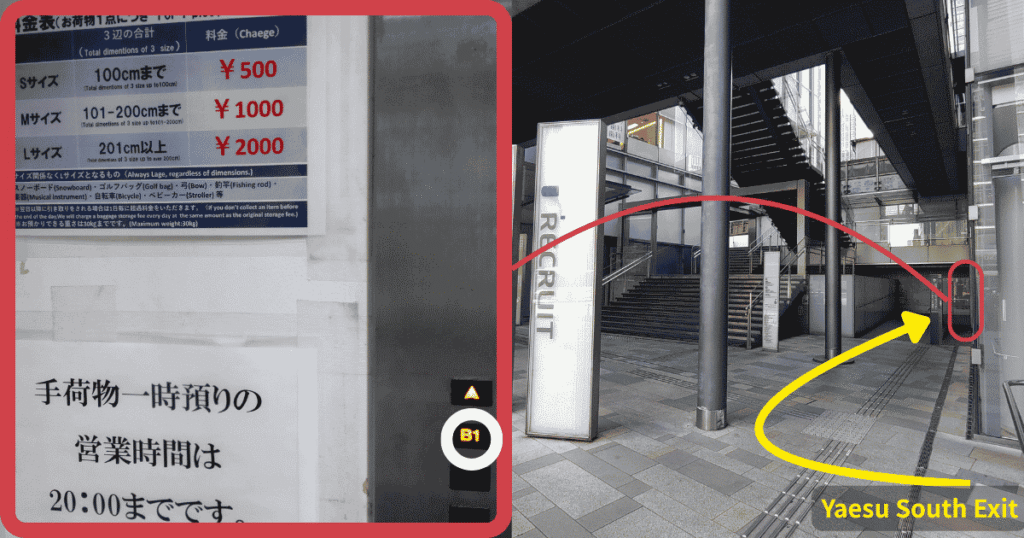
Shinkansen Parcel Service & Baggage Storage (B2F): Recommended by staff as a quiet alternative to crowded lockers! Located on B2F off Yaesu South Exit, offering hassle-free storage for up to 15 days.
Location: Exit through the Yaesu South Exit, walk past the Express Bus Terminal, and take the elevator down to Basement Level 1 (B1F) right around the corner. Transfer to another elevator there to reach Basement Level 2 (B2F), where you’ll find the counter.
Hours: 8:00 AM – 8:00 PM
Key Features: Storage available for up to 15 days. It is rarely crowded because it is a bit hard to find.
Our Visit: Both service counters were open with no customers waiting. Staff confirmed it is usually quiet here. If you want to guarantee a spot for your bags, this is your best choice!
Location: Outside Tokyo Station inside an office building near Otemachi Station. It is about a 10-minute walk from the Marunouchi Exit, on the 4th floor of the Shin-Otemachi Building (Map).
Hours: Weekdays 8:00 AM – 9:00 PM / Saturdays 8:00 AM – 8:00 PM (Closed Sundays & Public Holidays)
Key Features: They accept oversized bags without size issues, and reports show it is rarely crowded.
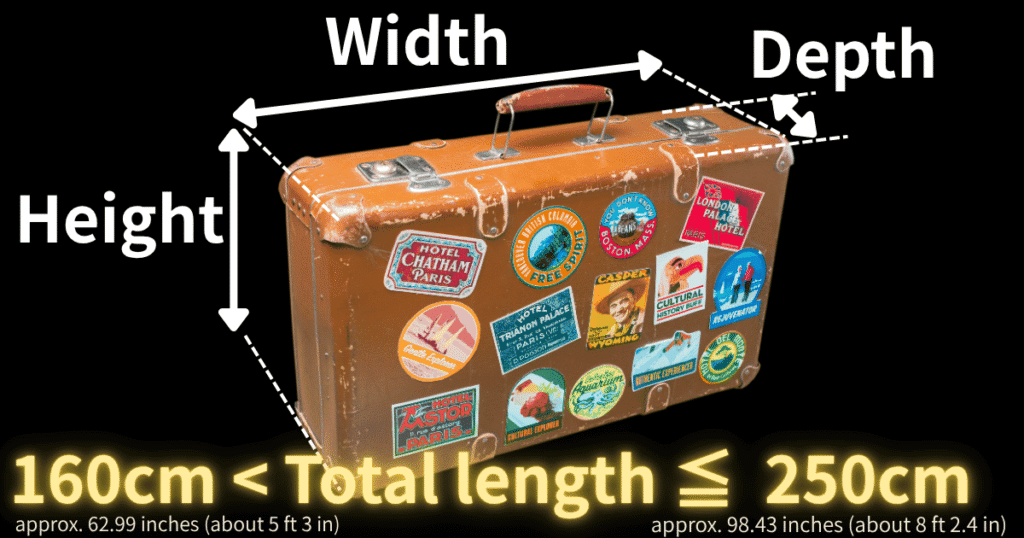
Bags are categorized into three sizes: S (total dimensions up to 100cm), M (up to 200cm), and L (over 200cm). Please note that oversized or extremely heavy bags may be declined at the staff’s discretion.
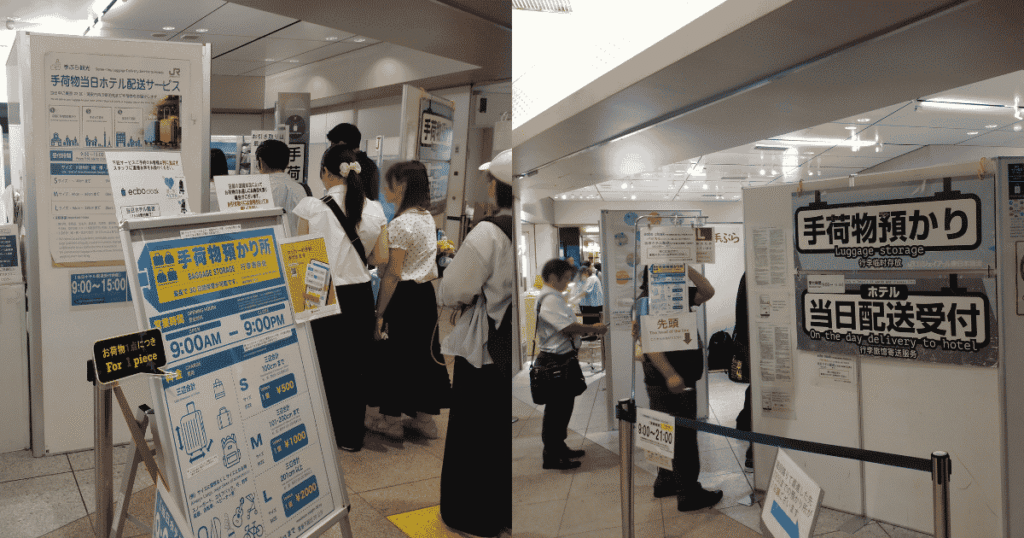
5. In Front of Shinkansen South Transfer Gate
Shinkansen South Gate Counter (1F): Super convenient drop-off point right in front of the Shinkansen gates. However, it gets quite busy, so expect a queue during peak times.
Location: 1F (Local line side), directly in front of the Shinkansen South Transfer Gate
Hours: 9:00 AM – 9:00 PM
Key Features: Storage available for up to 30 days.
Our Visit: There was a line of about 10 people. It’s convenient if you want to avoid walking too far before taking the Shinkansen, but be prepared for a short wait.
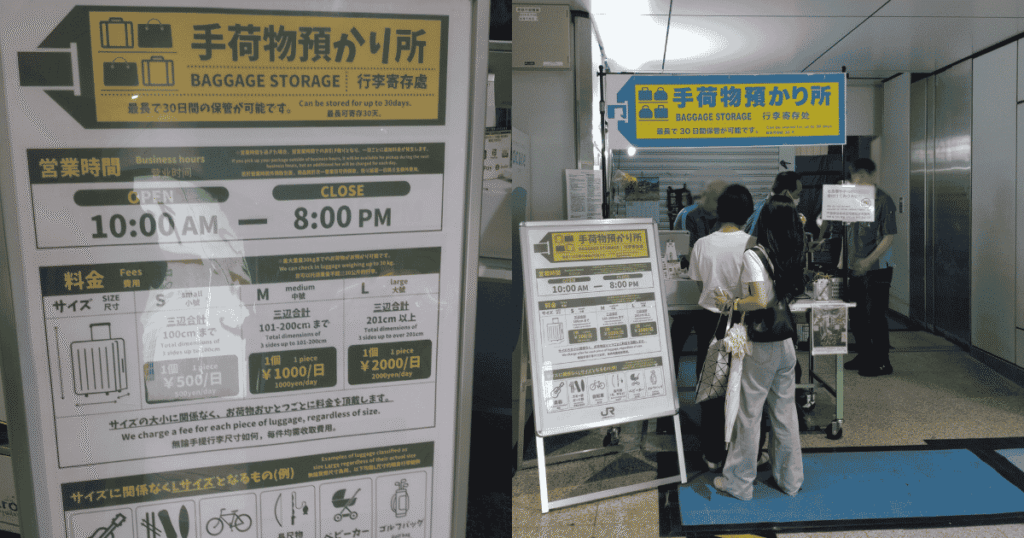
6. North-South Passage Luggage Storage
North-South Passage Storage (1F): Located inside Marunouchi Central Gate. Highly accessible, but quite busy with constant queues during peak hours. Plan for extra waiting time!
Location: 1F, inside the Marunouchi Central Ticket Gate
Hours: 10:00 AM – 8:00 PM
Key Features: Storage available for up to 30 days.
Our Visit: A line of around 10 people had formed here as well. Its 1F location inside the gates makes it very accessible, but you should expect to wait a bit.
7. BAGGAGE STORAGE+
BAGGAGE STORAGE+ (B1F): Small counter inside Gransta Underground North Gate, but fast service with minimal wait time during our visit. Supports storage up to 30 days.
Location: Basement Level 1 (B1F), inside the Gransta Underground North Ticket Gate
Hours: 9:30 AM – 8:00 PM
Key Features: Storage available for up to 30 days.
Our Visit: Staff were helping one group when we arrived, but our turn came almost immediately. Despite being close to the gates, this was the least crowded spot inside the paid area.
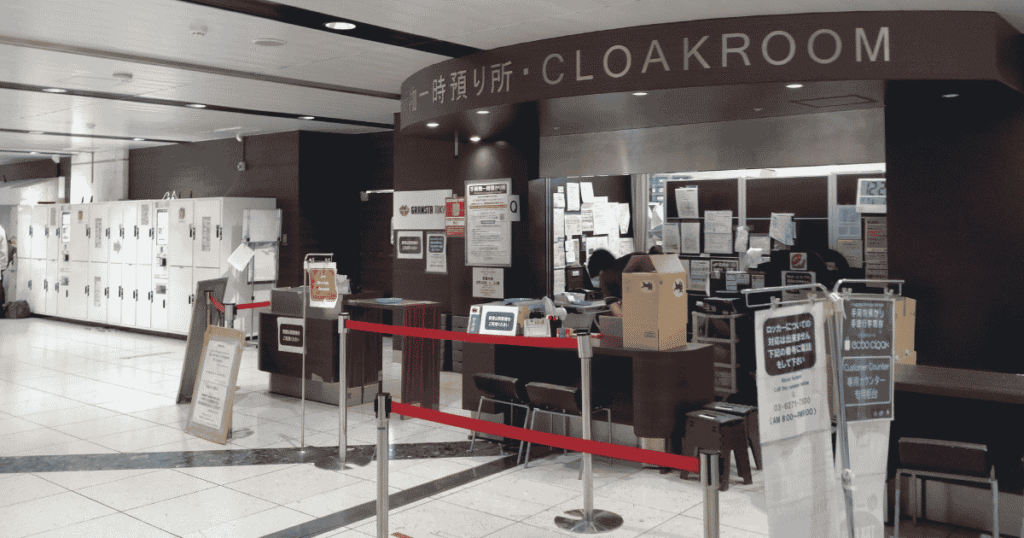
B1F Gransta Cloak Counter: Photo taken around noon on a weekday showing the counter fully occupied. Arrive early in the morning if you want to use this spot.
Location: Basement Level 1 (B1F), Gransta Underground area
Hours: 8:30 AM – 9:00 PM
Key Features: Same-day storage only (pick up by 8:30 PM). Max dimensions: total length under 250cm (longest side under 2m). Max weight: under 30kg per item.
Our Visit: When we visited around noon, this was the only counter that had already reached full capacity and temporarily suspended accepting new luggage.
Quick Tip: Reserve Luggage Storage in Advance (ecbo cloak)
If you want to guarantee a storage spot before you arrive, we recommend using ecbo cloak, a smartphone app that lets you reserve empty space in local shops and cafes as temporary luggage storage.
160 cm–250 cm Rule: Bags exceeding 160 cm in total size require an oversized baggage seat reservation to avoid a ¥1,000 carry-on fee.
If you are bringing a large suitcase with total dimensions (length + width + height) between 160cm and 250cm on the Tokaido, Sanyo, Kyushu, or Nishi-Kyushu Shinkansen (heading toward Nagoya, Kyoto, Osaka, Hiroshima, or Kyushu):
Advance reservation is required for seats with an oversized baggage area or compartment.
Using the official JR English booking service, you can easily reserve seats with an oversized baggage area online, even from overseas:
If you purchase a Japan Rail Pass through the official website, you can reserve these oversized baggage seats for free (details are available on their official website).
If you bring oversized baggage without a prior reservation, you will be charged a ¥1,000 fee, and train staff will move your bag to a designated area.
3. Accessible & Elevator Routes (For Strollers, Wheelchairs, and Heavy Luggage)
Tokyo Station has numerous stairs and escalators, so extra care is needed when traveling with large suitcases or strollers.
Use Marunouchi Underground Central Exit for Subways
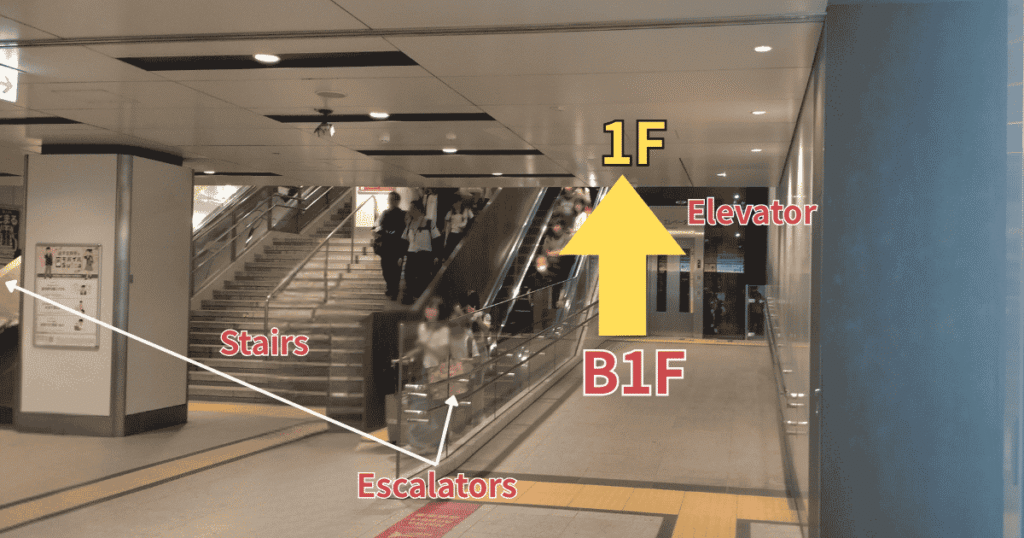
Marunouchi Underground Central Area: Stairs, escalators, and elevators connecting Basement Level 1 (B1F) to the 1st Floor (1F). Look for the elevator nearby if you are traveling with heavy luggage or a stroller.
This is a smooth and recommended route to get from the subway (Tokyo Metro / Toei Subway) gates up to the JR Tokyo Station 1F concourse. Right after entering the Marunouchi Underground Central Ticket Gate, take the elevator located next to the escalator leading up to the 1F concourse.
Just to your right inside the gate, there is also an elevator going down to Basement Level 5 (B5F) for the Sobu Rapid/Yokosuka Line (toward Narita Airport and Kamakura).
Smooth Elevator Routes Connecting Marunouchi Underground Central Exit to Train Lines
Tokyo Station has elevators connecting the 1F concourse with the platforms on various floors— 2F (elevated), Basement Level 4 (B4F), and Basement Level 5 (B5F). Here are the smoothest routes for each line:
Tokaido Shinkansen: An elevator connects the 1F South Transfer Gate to the 2F platforms near Car 7.
Tohoku, Yamagata, Akita, Hokkaido, Joetsu & Hokuriku Shinkansen: Elevators are available at both the North and South Transfer Gates on the 1F, giving you easy access to the 2F platforms.
Regular JR Lines (excluding Keiyo and Sobu Rapid/Yokosuka Lines): Elevators run between the 1F concourse (South Passage) and the platforms on the 2F/3F (toward the Shimbashi/Yurakucho station side).
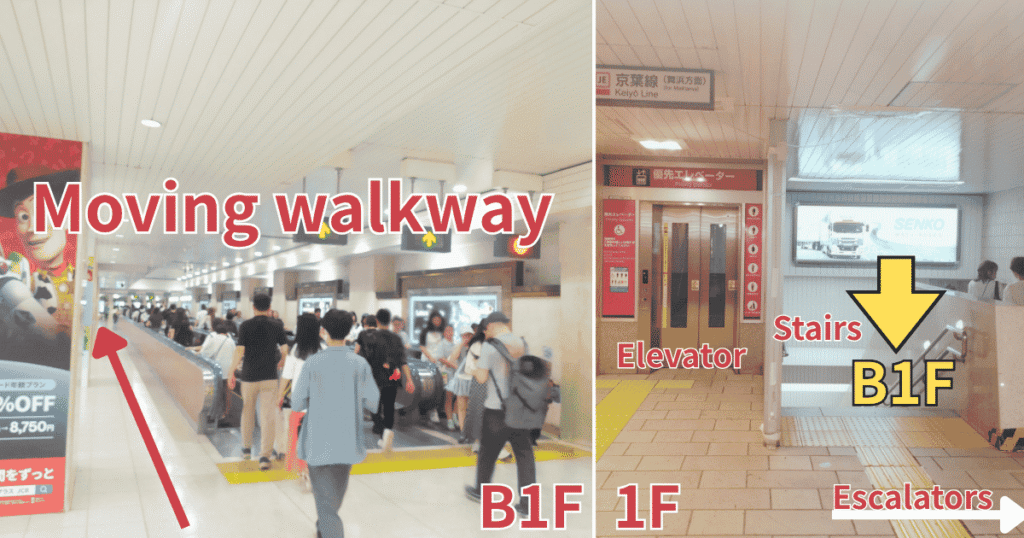
Keiyo Line: The elevator located near the middle of the B4F platform goes to B2F. From B2F, take another elevator to the B1F connecting passage. On the other end of this passage (past the moving walkways), you’ll find an elevator leading up to the 1F concourse near the Yaesu South Exit.
Sobu Rapid / Yokosuka Line: Platforms for both Narita Express (N’EX) and other local/limited express trains are on Basement Level 5 (B5F), with elevators located near the middle of the platforms.
The local/limited express elevator goes up to B1F (Marunouchi Underground Central Exit area) via B4F.
The N’EX elevator goes up only to B4F, so you will need to transfer to another elevator on B4F to reach B1F.
From B1F, take a separate elevator to reach the 1F concourse.
4. Complete Transfer Guide: Shinkansen, N'EX, Keiyo Line & Airport Access
Transfers inside Tokyo Station involve walking quite long distances. Here is a breakdown of the realistic transfer times you should expect when traveling with luggage.
Realistic Transfer Times (With Heavy Luggage)
Transfer Route
Realistic Time
Important Notes & Tips
N'EX (Narita Express) ➔ Ground Floor (1F)
10–15 mins
The N'EX platform is located deep underground on Basement Level 5 (B5F) on the Marunouchi side. You can use elevators or escalators, but if you take the elevators, you will need to transfer at B4F and B1F, so be sure to factor in waiting time.
Marunouchi Gates ➔ Shinkansen
10 mins
The Marunouchi side houses subways and the Sobu Rapid/Yokosuka Line underground, the Chuo Line on 3F (elevated), and regular lines like the Yamanote Line on 2F (elevated). The Shinkansen is on the opposite side (Yaesu 2F elevated). Walkways get very crowded during peak hours, so give yourself extra time.
Regular JR Lines ➔ Keiyo Line (for Disney)
15–20 mins
The Keiyo Line platforms are on Basement Level 4 (B4F), requiring a 500-meter walk through an underground passage—make good use of the moving walkways! Transferring from the Marunouchi side (Chuo Line on 3F or Sobu/Yokosuka Line on B5F) takes even longer, so allow plenty of time.
Shinkansen ➔ Marunouchi Line (Subway)
12–15 mins
You need to move from the Yaesu side (2F elevated) all the way to the Marunouchi side (B1F). Passages get extremely congested during peak hours, so it is best to plan for extra time.
The Shinkansen Gate Trap: Transfer Gates vs. Exit Gates
Not all Shinkansen gates are the same—some keep you inside the station, while others send you completely outside:
Shinkansen Transfer Gates: Use these gates if you are changing directly between regular JR lines (or the N’EX) and the Shinkansen without exiting the station.
Shinkansen Exit Gates: Use these gates if you want to leave the station area before taking your Shinkansen—for example, to visit a luggage storage counter outside the gates, check into a hotel, or explore the town.
Smooth Transfer Guide: N'EX (Narita Express) to Shinkansen
Arrive at the Platform: Arrive at the Sobu/Yokosuka Line platform on Basement Level 5 (B5F).
Go Up to B4F: Take the elevator or escalator near the center of the platform up to Basement Level 4 (B4F).
Head Up to B1F: If you are taking the elevators, transfer to the B1F elevator at B4F to reach Basement Level 1 (B1F).
Follow Signs to 1F: Follow the signs for “Shinkansen Transfer Gate” to head up to the 1F concourse. (Escalators and elevators from B1F to 1F are located next to each other.)
Pass Through the Transfer Gate: At the transfer gate between regular lines and the Shinkansen, insert both your N’EX ticket and Shinkansen ticket together (or tap your IC card and insert your ticket).
Why the Keiyo Line (for Disney) Is So Far Away & How to Get There Easily
Moving Walkways to Keiyo Line: Located along the 500-meter underground passage to help ease the 15-to-20-minute walk.
How to Reach the Sobu/Yokosuka Line & Keiyo Line Without Getting Lost
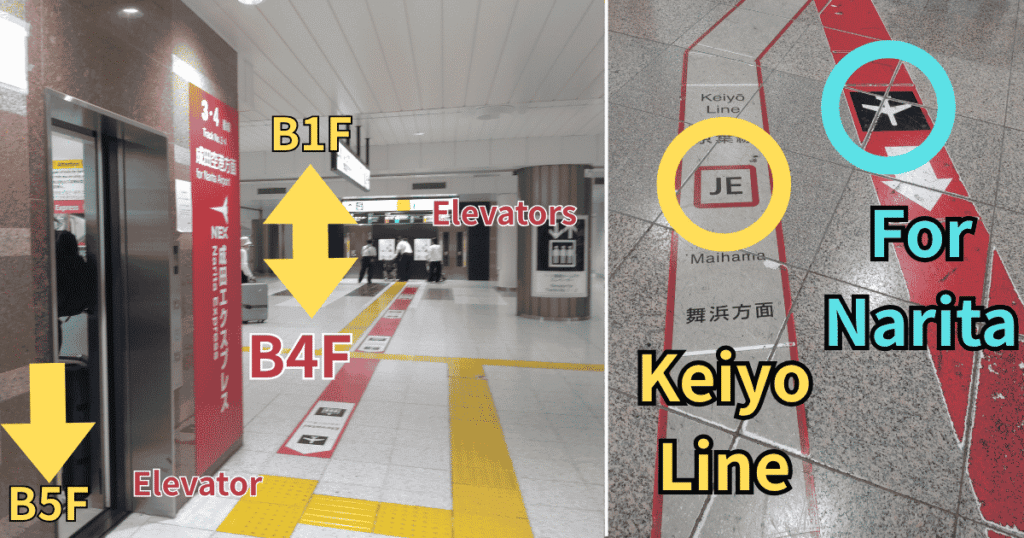
Tokyo Station Underground Navigation: Floor signs (right) direct you to the Keiyo and Sobu/Yokosuka Lines. A smooth barrier-free route is available at the Sobu Line platforms (left), connecting B4F to the platforms via elevator.
There is a simple way to get to the N’EX (Narita Express) and the Keiyo Line (for Tokyo Disney Resort) without getting lost: just follow the colored lines painted on the floor! Look for the markings shown in the photo during your walk through the station.
Line with the Airplane Icon: Leads to the Sobu/Yokosuka Line platforms (where the N’EX arrives and departs).
Other Colored Line: Leads directly to the Keiyo Line platforms.
(Note: Trains on the Sobu/Yokosuka Line heading in the opposite direction of Narita Airport will take you toward Yokohama and Kamakura.)
5. Directions to Popular Spots & Underground Shopping Streets
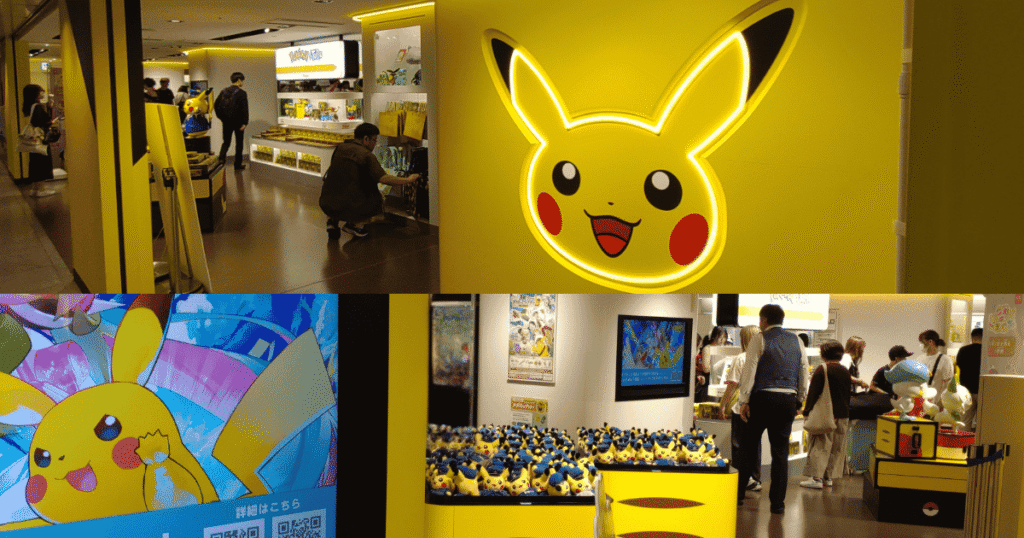
Pokémon Store Tokyo Station: Located on the 1st floor (ground floor) on the Yaesu side, separate from the B1F character shops.
Tokyo Character Street (Rain-Free Route)
Located on the Yaesu side of Tokyo Station, Tokyo Character Street brings together official TV station shops and iconic character stores like Pokémon, Rilakkuma, Ultraman, and Pretty Cure. Note that the Pokémon Store is on the ground floor, while the other shops are located on Basement Level 1 (B1F) in First Avenue Tokyo Station (Tokyo Eki Ichibangai).
Nearest Gate: Yaesu Underground Central Exit
How to Get There: Exit the Yaesu Underground Central Exit and turn left. You will arrive in about 1 minute. You can reach the Pokémon Store, Ghibli Donguri Republic, Jump Shop, and more without going outside on rainy days!
Tokyo Ramen Street & Yaechika (Yaesu Underground Mall)
Tokyo Ramen Street: Located right on your right after exiting the Yaesu Underground Central Exit (same exit as Character Street).
Yaechika (Yaesu Underground Mall): Walk straight after exiting the Yaesu Underground Central Exit. You will see a massive underground shopping mall featuring around 180 shops right in front of you.
Which Exit Should You Use? (Destination Guide)
Marunouchi Side
Marunouchi North Exit: Otemachi Business District, JR EAST Travel Service Center (Yamato Transport Storage)
Marunouchi Central Exit: Sightseeing around the Imperial Palace
Marunouchi South Exit: KITTE, The Tokyo Station Hotel
Marunouchi Underground Central / North Exit: Subway lines (Tokyo Metro / Toei Subway)
Yaesu South Exit: Shinkansen Parcel Service & Baggage Storage, Highway Bus Terminal
Yaesu Underground Central Exit: Character Street, Tokyo Ramen Street, Yaechika Underground Mall
6. Frequently Asked Questions (FAQ)
Q1: Can I leave my luggage in a coin locker overnight?
A: Yes, you can. However, an extra day’s fee will be charged—either when the station gates close after the last train (for lockers inside the gates) or at 2:00 AM (for lockers outside the gates). You will pay the additional fee when picking up your luggage (most lockers allow storage for up to 3 days).
Q2: Can I send my luggage directly from Tokyo Station to my hotel or the airport?
A: Yes! You can arrange same-day hotel delivery (usually requires drop-off before 11:00 AM) or shipping to Narita and Haneda airports at the Yamato Transport counter (Marunouchi North Exit) and Sagawa Express counter (Yaesu North Exit).
Q3: What is the easiest way to travel from Narita Airport to Tokyo Station with heavy luggage?
A: We recommend taking either the N’EX (Narita Express) or the Airport Bus Tokyo-Narita (TYO-NRT). Taking the bus is particularly easy because it arrives directly on the ground level at the Yaesu South Exit, allowing you to completely avoid the deep underground elevator transfers required when arriving by N’EX!
Q4: How many days can I store my luggage at Tokyo Station?
A: Coin lockers allow storage for up to 3 days (including the first day, with daily fees added). For luggage storage counters, the maximum duration depends on the location, but some counters accept bags for up to 30 days.
Tokyo Station Tips: Quick Summary
Final Thoughts: Navigate Tokyo Station Like a Local
Tokyo Station may feel like a giant labyrinth, but navigating it smoothly comes down to a few key rules:
Know Your Sides: Remember the difference between the Marunouchi Side (West) and Yaesu Side (East).
Smart Luggage Strategy: If main lockers are full, head straight to the B4F Sobu Line lockers or use manned counters like Sagawa or Shinkansen Parcel Service & Baggage Storage.
Plan Extra Transfer Time: Allow 15–20 minutes for deep-underground lines like the Keiyo Line or Narita Express (N’EX).
Follow Floor Markings: When in doubt, look down and follow the colored floor lines and overhead signs!
With a little preparation, you can easily drop off your bags, make your train connections on time, and enjoy shopping at Character Street or Yaechika without the stress. Safe travels and enjoy your time in Tokyo!