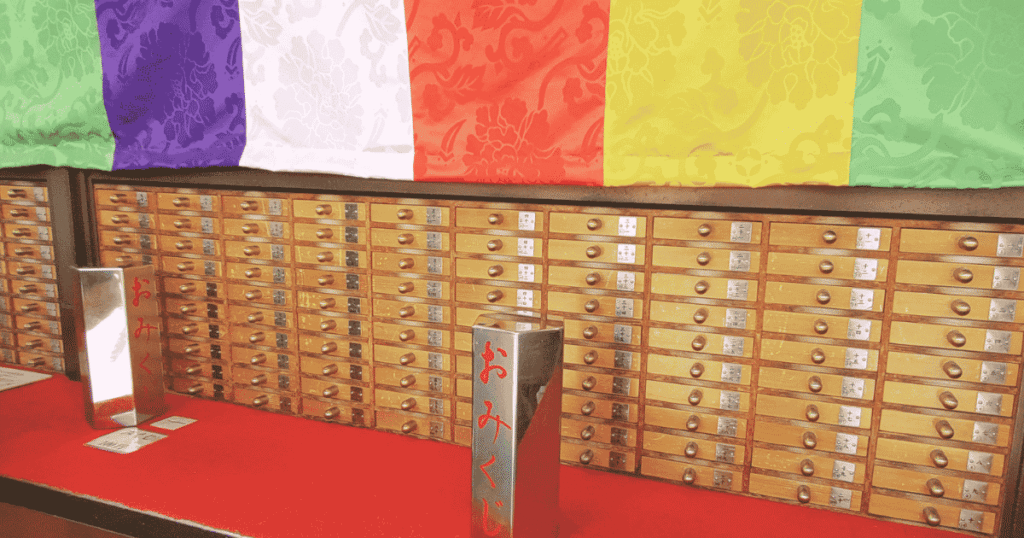
If you are planning a trip to Asakusa in Tokyo, visiting Sensoji Temple is an absolute must. When you walk around the temple grounds, you will see many people shaking metal boxes and looking closely at small pieces of paper. This is called omikuji, a traditional Japanese fortune telling experience.
But what is the true sensoji temple omikuji meaning? Is it true that you will get a sensoji temple bad fortune? In this blog post, we will share some fresh, insider information and secrets about getting a fortune at Sensoji Temple that you won’t find in standard guidebooks!
Quick Tip: Sensoji Temple and Asakusa Shrine are always packed with tourists, and the main paths can be super crowded. However, the omikuji areas are surprisingly quiet and rarely have long lines, so you can easily try it anytime during the day!
Table of Contents
Toggle1. What is Omikuji? (General Knowledge & Manners)
Omikuji is a paper fortune that you can buy at Japanese Shinto shrines and Buddhist temples to check your personal luck and future. It is not just a random game. Japanese people consider it a “message from the gods or Buddha” and “advice for your daily life.”
Note: While “Buddha” is used as a general term, at Sensoji Temple, you are actually receiving a message from Kannon, the Bodhisattva of Mercy.
The advice written on the paper is actually the most important part. You should think about the message and apply it to your current life.
So, even if you get a bad fortune, don’t worry! It is just a friendly warning about what to watch out for. If you take the message seriously and improve your behavior, your luck will turn into a sensoji temple good fortunesen (good fortune).
General Levels of Fortune
At most Japanese shrines and temples, fortunes are ranked in 7 basic levels from the best luck to the worst:
- Great Good Fortune (Dai-Kichi / 大吉) — The absolute best luck!
- Good Fortune (Kichi / 吉)
- Middle Good Fortune (Chu-Kichi / 中吉)
- Small Good Fortune (Sho-Kichi / 小吉)
- Ending Good Fortune (Sue-Kichi / 末吉) — The lowest level of good luck.
- Bad Fortune (Kyo / 凶) — This is where bad luck begins.
- Great Bad Fortune (Dai-Kyo / 大凶) — The worst possible luck.
What to do with fortune at Japanese temple?
After reading your fortune, you usually have two choices:
- Keep it with you: Put it in your wallet or notebook so you can read the omikuji fortune translation whenever you need a reminder.
- Tie it up: You can tie the paper to a designated rack at the temple or shrine before you leave.
Note: Sensoji has its own strict rule about this, which we will explain in Chapter 2!
Step-by-Step Manners Before Drawing an Omikuji
To show respect, you should follow the correct manners. Actually, praying and making a wish before drawing an omikuji is the most important part. Drawing a fortune without praying makes no sense, because the fortune is supposed to be the answer to your prayer!
Step 1:
The Gate: Bow once at the main gate or Torii. Walk on the side of the path, not the middle.
Step 2:
Purify Your Body at the water fountain: Go to the water purification fountain (Chozuya) to clean your hands and mouth. At Sensoji Temple, it is on the right side of the main hall. At Asakusa Shrine, it is on the left side of the main hall.
- Scoop water with the ladle using your right hand and wash your left hand.
- Switch hands and wash your right hand.
- Hold the ladle with your right hand again, pour some water into your left palm, and rinse your mouth. Never put the ladle directly to your mouth!
- Tilt the ladle vertically so the remaining water washes down the handle.
Step 3: Offering (Osaisen):
Toss a coin into the wooden offering box. Any amount is fine; it’s the thought that counts.
Step 4: Hands and Prayer:
Put your hands together.
Crucial Rule: At a Shinto shrine, you clap your hands twice to greet the gods. At a Buddhist temple (like Sensoji), do NOT clap your hands. Just put your hands together silently.
Step 5:
Intro and Wish: In your mind, say your name and address, and then make your wish silently. The answer to this wish will appear on your fortune paper later.
2. Secrets of Regular Fortune Sensoji (Asakusa Temple)
Now, let’s look at the unique rules for the regular fortune Sensoji offers. Getting a sensoji omikuji is very famous, but it has some special features.
- How much is fortune at Sensoji?: It costs exactly 100 yen.
- Opening Hours: You can try it 24 hours a day at the outdoor stands!
Unique Luck Levels at Sensoji (No Great Bad Fortune!)
At Sensoji Temple, there are 7 levels, but there is NO Great Bad Fortune (Dai-Kyo):
- Great Good Fortune (Dai-Kichi / 大吉) — This is the sensoji temple best fortune!
- Good Fortune (Kichi / 吉)
- Half Good Fortune (Han-Kichi / 半吉) — Unique to Sensoji!
- Small Good Fortune (Sho-Kichi / 小吉)
- Future Small Good Fortune (Sue-Sho-Kichi / 末小吉) — Unique to Sensoji!
- Ending Good Fortune (Sue-Kichi / 末吉) — The lowest level of good luck.
- Bad Fortune (Kyo / 凶) — Bad luck.
Why does Sensoji temple bad fortune happen so often?
Many people say, “I got a sensoji bad fortune! This temple has too many bad fortunes!”
It is true that about 30% of the fortunes at Sensoji are Bad Fortune (Kyo). However, based on our research, this is because Sensoji strictly keeps the traditional, ancient style of omikuji from old times.
They do not reduce the bad fortunes just to make tourists happy. This makes your fortune at sensoji temple very honest and authentic.
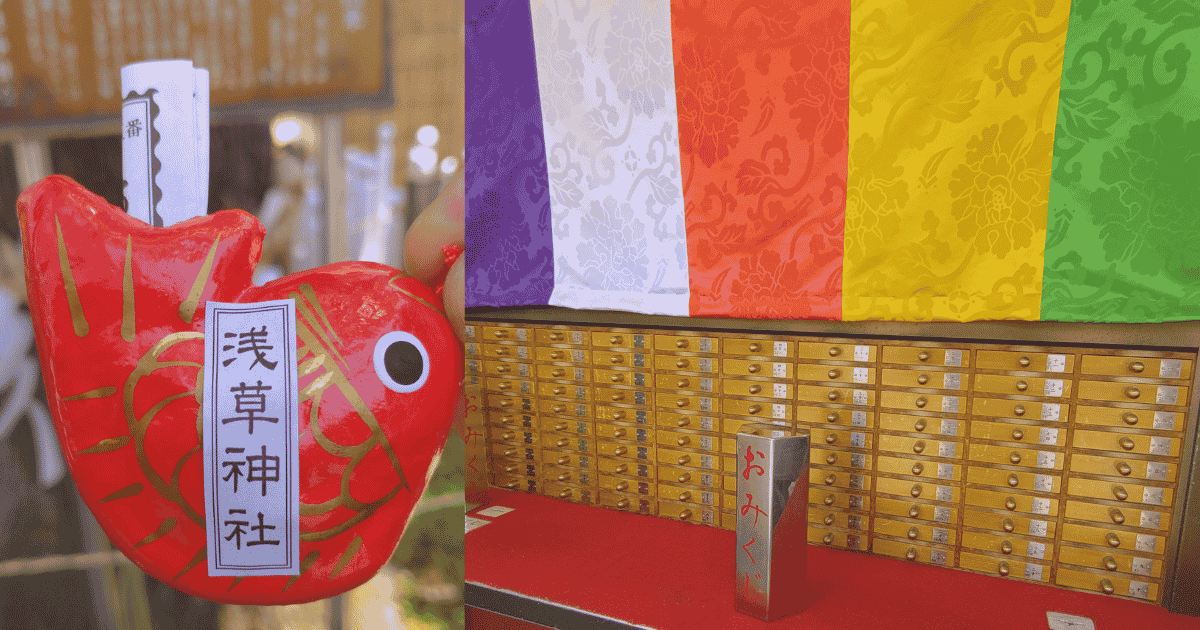
Insider Discovery: English Numbers are Printed on Sticks and Drawers!
In older guidebooks or photos online, you might see only Japanese Kanji characters written on the sticks and drawers. You might worry, “Can I do this if I don’t read Japanese?”
Good news! We visited the temple and found a fantastic update.
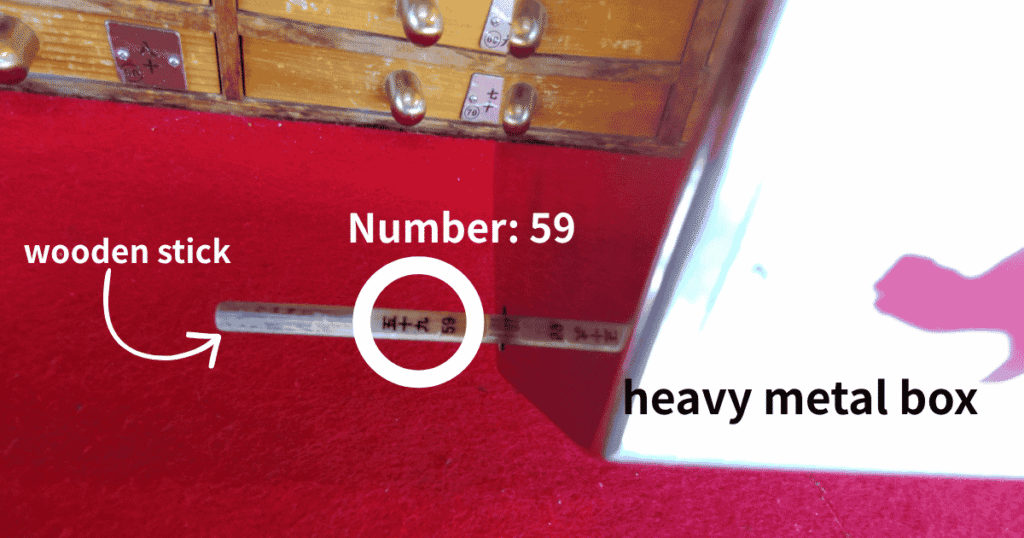
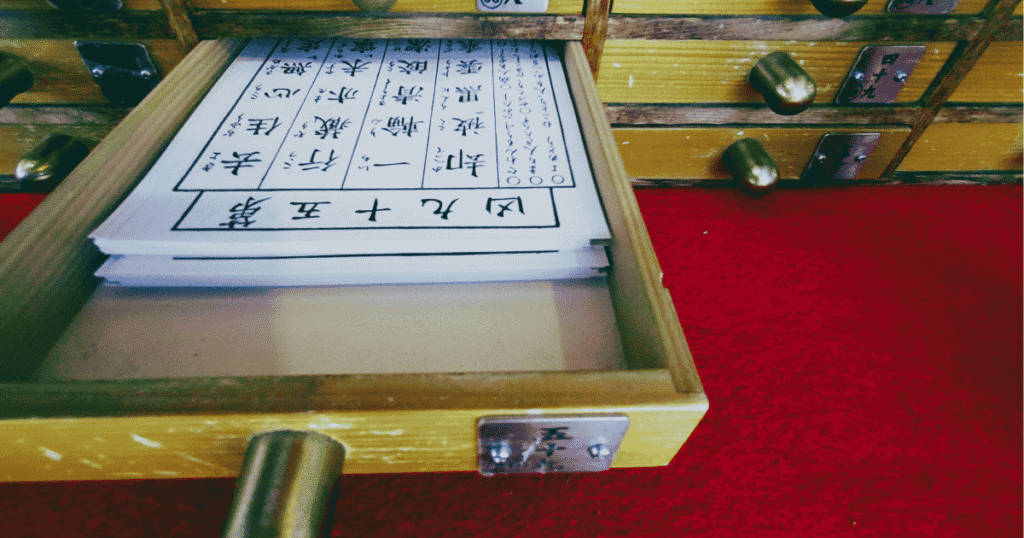
Now, Sensoji Temple has English numbers printed right next to the Japanese Kanji on both the sticks and the drawers! You don’t need to learn any Kanji to find your fortune.
However, we noticed one important thing during our visit: the metal fortune boxes are surprisingly heavy! Even a strong adult needs to hold the box firmly with both hands to shake it, so be careful not to drop it.
The process is super simple:
- Drop your 100 yen coin into the slot.
- Hold the heavy metal box with both hands, shake it, and let one wooden stick slide out of the small hole.
- Check the English number on the stick (then put the stick back into the box).
- Find the drawer with the matching English number, open it, and take your sensoji temple omikuji.
Sensoji's Local Rule: What to Do If You Get a Bad Fortune (Kyo)
Generally in Japan, it is okay to take bad fortunes home as a lesson. However, Sensoji has a specific local rule for bad luck.
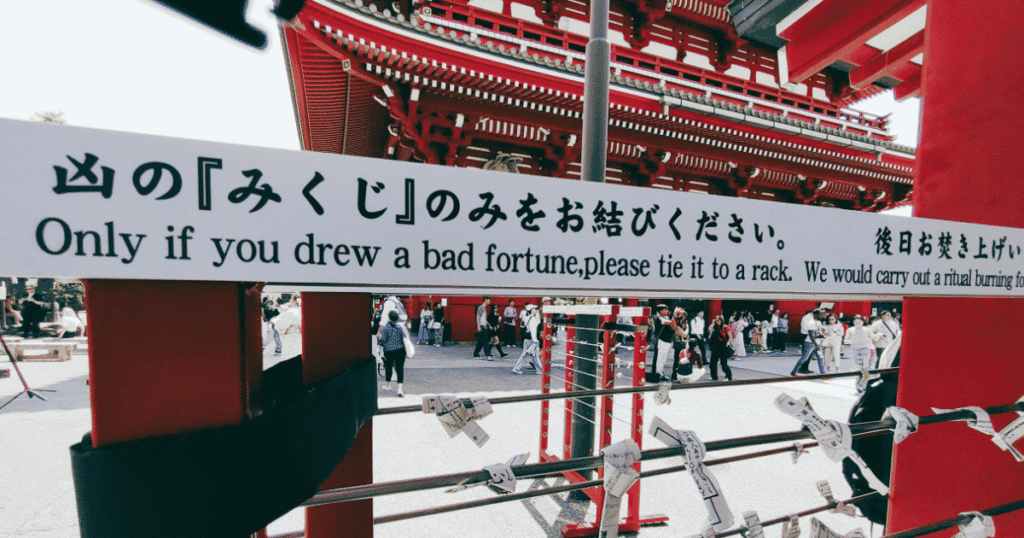
Right next to the fortune-telling stands, Sensoji has set up a special metal rack with an official sign that reads: “Only if you drew a bad fortune, please tie it to a rack.”
If you get a sensoji temple bad fortune, do not bring it home. Tie the paper tightly to this designated metal bar. By doing this, you leave the bad luck behind at the temple, and the temple’s spirit will protect you and change your luck. If you get any level of good fortune, you can safely take it home with you!
3. Bonus Tip: Check Out Asakusa Shrine (Asakusa Jinja)
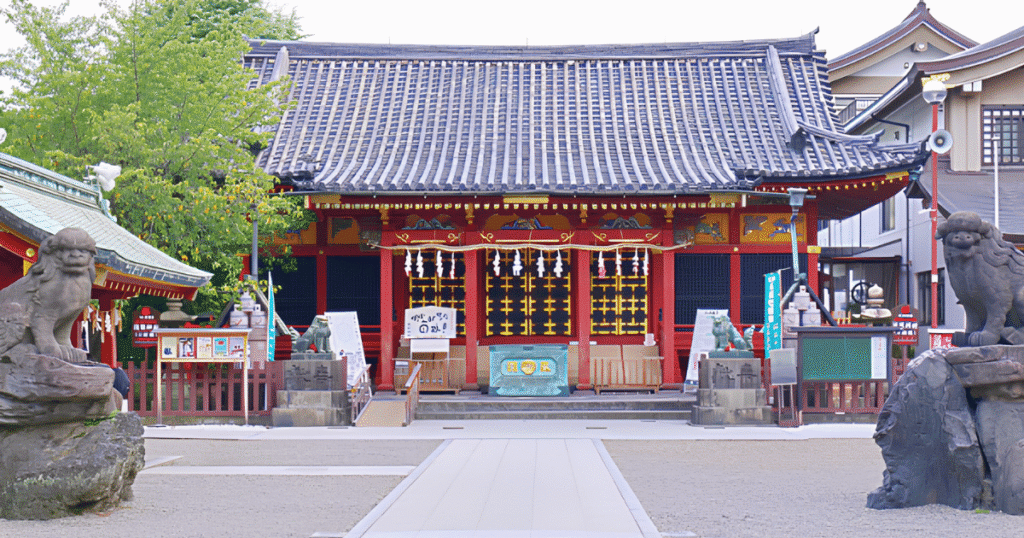
Right next to the main hall of Sensoji Temple (on the left side), there is a Shinto shrine called Asakusa Shrine. Please remember that Asakusa Shrine and Sensoji Temple are completely different places with different religions!
- Hours: 9:00 AM – 4:30 PM
- Price: 300 yen
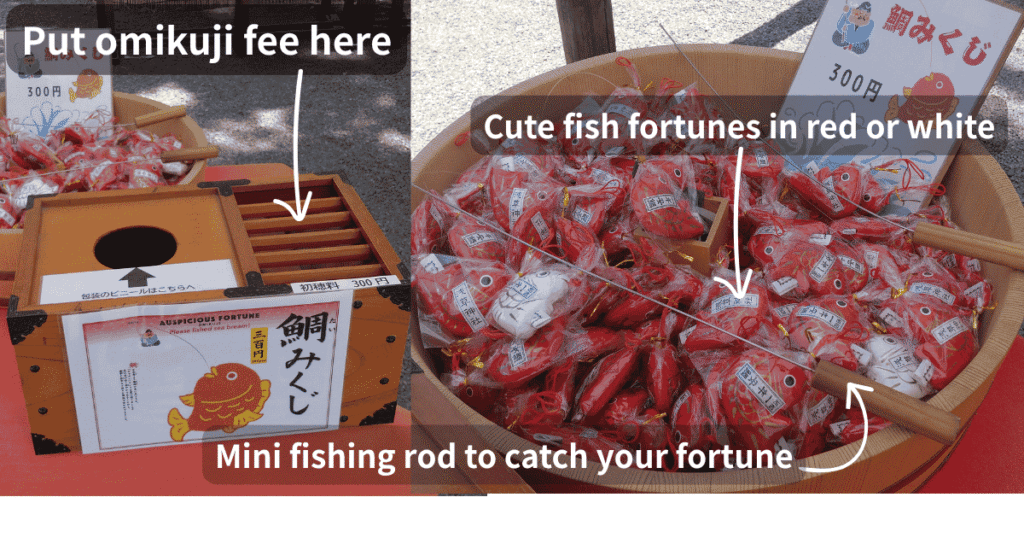
Fish for a "Tai Mikuji" (Sea Bream Fortune)
The fortune station is located under a tent on the right side of the shrine’s main hall. There are no staff members here, so it runs on the honor system. Drop your 300 yen into the coin box, grab a mini fishing rod, and fish for your fortune from the basket!
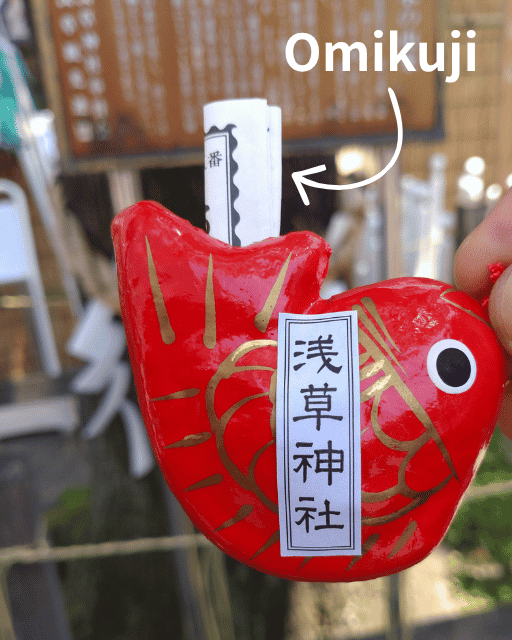
Most of the fortunes are shaped like cute red fish (sea bream), but there are also white ones mixed in. You can choose whichever color you like best! They make great souvenirs to decorate your room back home.
Important Caution:
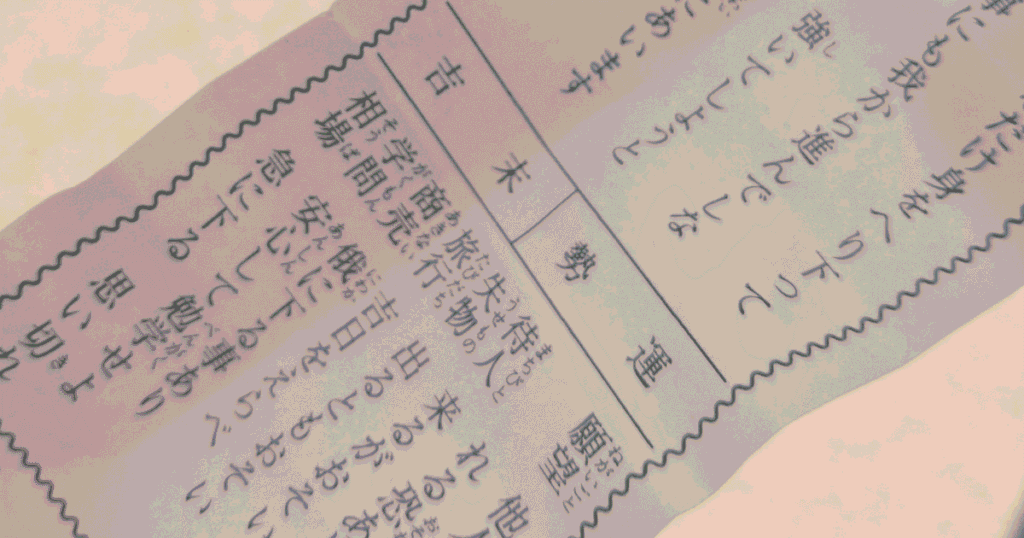
Asakusa Shrine Fortunes are 100% in Japanese! (But Here is a Perfect Fix)
While Sensoji Temple has embraced international travelers with English friendly numbers, Asakusa Shrine remains strictly traditional—meaning all the fortunes inside these cute fish are written entirely in Japanese. There is no English printed on the slip at all.
But please do not worry! You don’t have to miss out on this super fun fishing experience. I tested a perfect solution using smartphone AI during our visit, and it worked beautifully.
Here is my step-by-step guide to perfectly translating your Asakusa Shrine fortune in seconds:
Step 1: Flatten and Photograph
Take the paper fortune out of the fish and flatten it out with your fingers to remove any wrinkles. Take a clear, high-quality photo with your smartphone so the Japanese characters are easy to read.
Step 2: Open Google Gemini
Open the Google Gemini app (or website) on your smartphone.
Step 3: Upload the Photo
Tap the “+” (plus) button in the chat box and select the photo of your fortune that you just took.
Step 4: Copy and Paste This Exact Prompt
To get a perfectly structured translation, copy the English text below and paste it into the Gemini chat bar before hitting send:
|
Please translate the attached Omikuji (fortune slip) into English, keeping the following layout in mind:
Top Section (Two-Tier Vertical Text):
Bottom Section: |
By using this specific prompt, Gemini will perfectly decode the layout and give you an incredibly accurate, easy-to-read translation of your destiny!
💡 My Insider Test: Gemini vs. ChatGPT
I actually tested this with both major AI tools to see which one performs better for travelers.
While ChatGPT was able to translate the basic luck categories in the bottom section into a bulleted list, it really struggled with the complex, traditional poetic messages in the top section.
On the other hand, Google Gemini successfully decoded the tricky two-tier vertical text and provided a perfect, complete translation from top to bottom. So, when you fish for your cute Tai Mikuji at Asakusa Shrine, make sure to have Gemini ready on your phone!
Sensoji Temple omamori
Also, don’t forget to check out the protective amulets (omamori) for health, safety, and luck. Sensoji Temple’s amulets are sold at the staffed counters on the right side of the temple’s main hall. Since one is a temple and the other is a shrine, the amulets have different spiritual meanings!
Summary
Trying an omikuji sensoji is a beautiful way to experience Japanese culture. Thanks to Sensoji’s new English number system, it is easier than ever for global travelers. The metal box might be heavier than you expect, but that’s all part of the fun!
Whether you receive the sensoji temple best fortune or a sensoji temple bad fortune, the most important thing is to accept the message as the “answer” to your prayer. If it’s bad, just tie it to the special rack nearby and stay positive. Next time you visit Asakusa, use our insider tips to enjoy this authentic experience!
Complete Sensoji Temple Guide Series
Explore our expert guides to master your Asakusa trip:
- [Part 1] Sensoji Overview: History and basic charms of Tokyo’s oldest temple.
- [Part 2] The Best Time to Visit: A seasonal and hourly matrix. Why 6:00 AM is the “Golden Hour,” and why a rainy night is actually the best for photos.
- [Part 3] Photo Spot Guide: How to find the perfect angle for the Five-Story Pagoda and how to take the best “Skytree x Temple” collaboration shots.
- [Part 4] The Truth About Omikuji : How to draw your fortune correctly and what to do with the paper after you read it.
- [Part 5] Nakamise Street Directory (Coming Soon): A complete list of over 80 shops, from the best street food to traditional crafts.