Sensoji is the most “living” place in Tokyo. With over 150,000 temples and shrines in Japan, what makes this one so special? It is not just about being old. It is the unique mix of everything:
The Legend: A sacred statue found by local fishermen.
The Freedom: Massive gates that never close.
The Energy: A bustling market right inside the temple grounds.
For 1,400 years, Senso-ji has never stopped. It is a place where history and modern life meet every single day.
If you are looking for a quiet, zen-style temple like in Kyoto, Sensoji might surprise you. But if you want to feel the real heartbeat of Japan, you cannot miss it. This article will show you the “real” way to enjoy Sensoji that most guidebooks don’t tell you.
⏱️ Quick Information: What You Will Learn
If you are in a hurry, here is what this guide covers:
The 4 Secrets: Why Sensoji is unique—discover its “Bottom-up” history started by two fishermen and its rare layout with a market inside the temple grounds.
The Sanctuary that Never Sleeps: Everything you need to know about its 24-hour accessibility, including the night light-up until 11:00 PM and early morning visits.
Symbolism & High-Tech: Learn about the hidden dragon carvings and why this ancient-looking temple actually uses a high-tech titanium roof.
Must-See Landmarks: A deep dive into the Kaminarimon Gate, the “Giant Sandals” of Hozomon, and the 400-year-old Denpo-in Garden.
Travel Strategy: Clear access info from major stations and airports, plus a “First Train” arrival guide to beat the crowds.
Expert FAQ: Important tips on clothing, weather, and a comparison of Sensoji vs. Meiji Jingu (Lively energy vs. Silent nature).
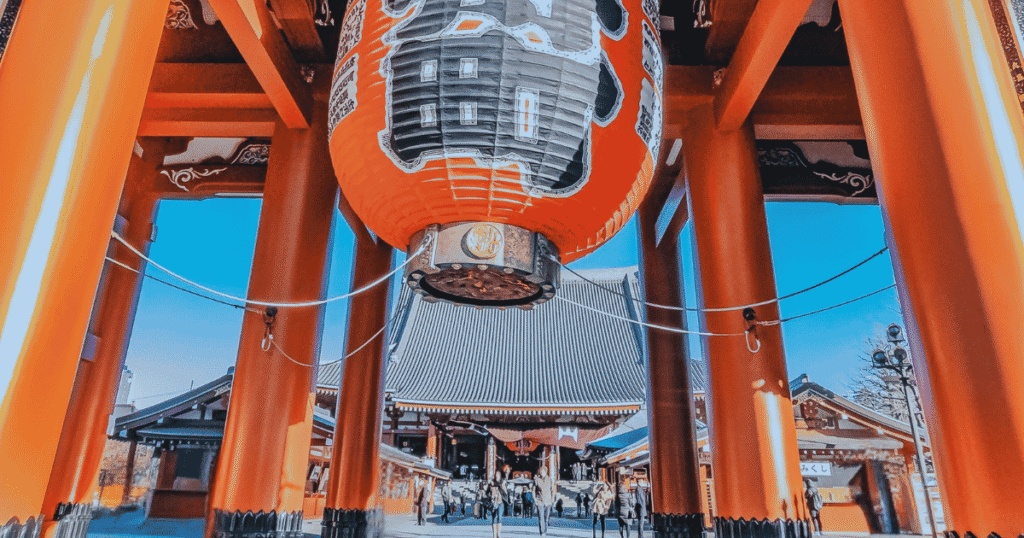
View of the Main Hall with its titanium roof from the Hozomon Gate.
There are thousands of temples in Japan, but Sensoji is truly special. This is because of four unique reasons that you won’t find anywhere else.
⚓ [1] A "Bottom-Up" History Started by Workers
Most famous temples in Japan were built by powerful people like Emperors or Shoguns. However, Sensoji is different. Its story began with two fishermen who found a statue in their net in the Sumida River.
This temple was not made by the government; it was protected and loved by the local people. Even after the temple was destroyed in World War II, the local community worked together to rebuild it in 1958. It is a temple “of the people, by the people.”
🛍️ [2] Japan's Oldest Market Inside the Temple
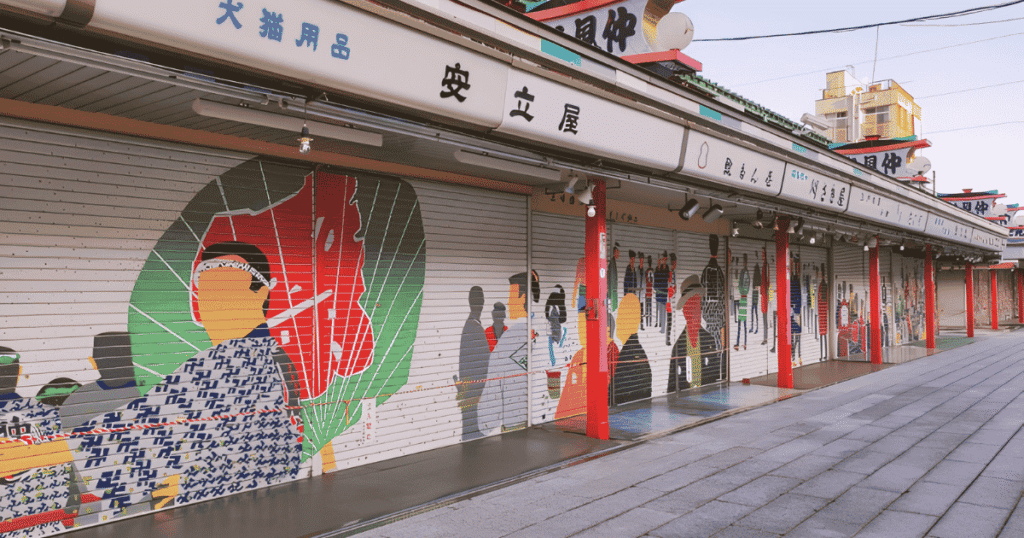
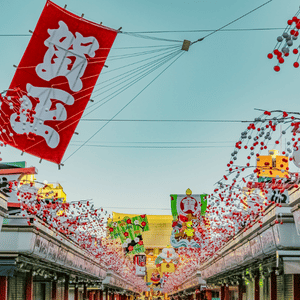
Nakamise shopping street with painted shutter art inside the Sensoji Temple gates.
In many other cities like Narita or Kamakura, the shopping street (Sando) is on a public road outside the temple. But at Sensoji, the Nakamise shopping street is actually inside the temple grounds.
There is no boundary between the holy area and the marketplace.
Tip: After the shops close, look at the shutters! They are painted with beautiful scenes of Asakusa’s history. It becomes a “Night Art Gallery” that you can only see when the shops are closed.
🌙 [3] 24-Hour Access: A Temple That Never Sleeps
Most historical temples in Japan close their gates at 5:00 PM and keep people away. But Sensoji has no closing time.
You can walk through the famous Kaminarimon and Hozomon gates at 2:00 AM or even on a rainy night. The temple is lit up until 11:00 PM, making the huge buildings glow in the dark. It is designed to be a part of the city’s daily life, not to block it. And don’t worry—even though it’s a big city, Asakusa is very safe.
🗼 [4] A "Vertical View" from the Terrace
At most temples, you can only see the view from the ground. But at Sensoji, you can see it from above!
Go to the Asakusa Culture Tourist Information Center ( Official Web Site ) right across the street from Kaminarimon Gate (Open 9:00 AM – 8:00 PM, Free Entry).
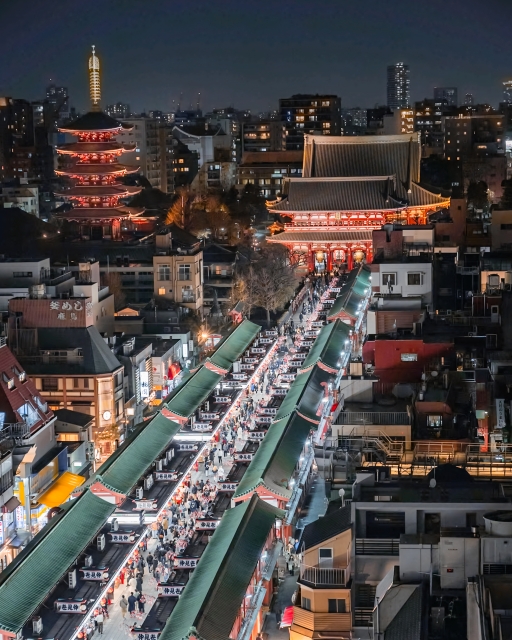
From the 8th-floor terrace, you can look down at the long line of lights in the temple grounds. This gives you a unique “vertical perspective.” You can enjoy the beautiful view from above, and just a few minutes later, you can dive right back into the energy of the crowds below. It is a wonderful way to switch your point of view!
Bird's-eye view of Sensoji Temple grounds and Nakamise street from the 8th floor.
2. Essential Information: Opening & Closing Hours
Even though Sensoji is “open,” different areas have different hours. Use the table below to plan your visit.
Area / Service
Hours
Notes
Temple Grounds
24 Hours
Free entry. Walking and photos are always possible.
Main Hall (Hondo)
6:00 - 17:00
Opens at 6:30 AM from Oct. to Mar.
Large Incense Burner
6:00 - 17:00
You can buy incense (100 yen) nearby to offer here.
Nakamise Street
9:00 - 19:00
Most shops close by 7:00 PM.
Omikuji (Fortune)
24 Hours
Self-service boxes are available even at night.
Goshuin (Stamps)
8:00 - 16:30
Available at "Yogodo," to the left of the Main Hall.
3 History and Design: Decoding the "Symbols" of Edo
Don’t just take a photo! Look for these special details that tell a 1,400-year-old story.
🐉 The Sleeping Dragon Under the Lantern
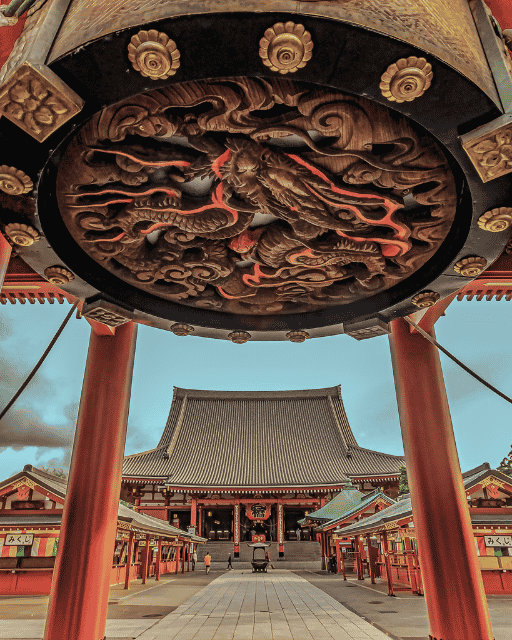
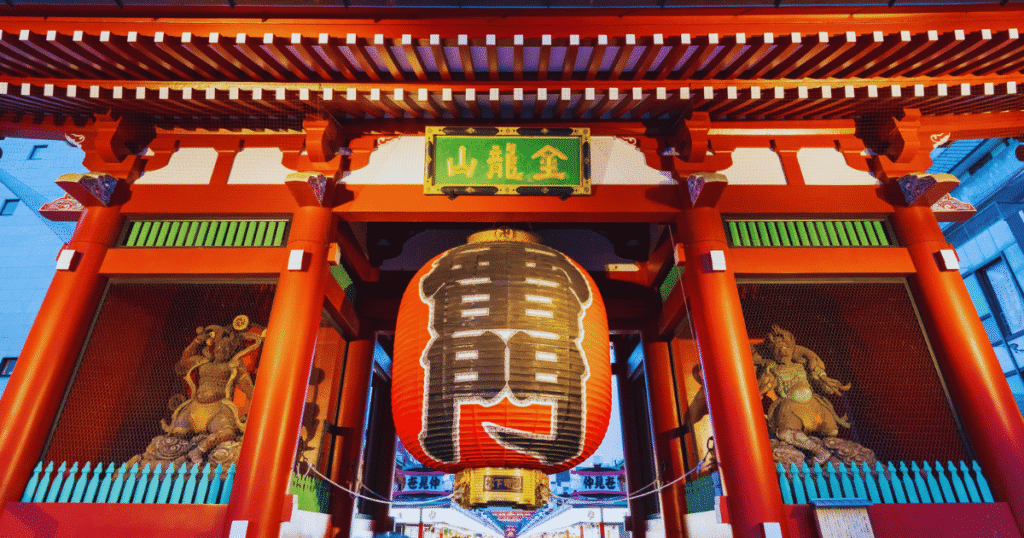
Kaminarimon Gate has a giant red lantern weighing 700 kg. If you look directly at the bottom of the lantern, you will see a beautiful wood carving of a Dragon.
The Legend: The sacred statue of Sensoji was found on the “Day of the Dragon.”
The Meaning: Dragons are gods of water. They are here to protect the temple from fire.
Dragon carving on the bottom of the giant lantern at Sensoji Temple.
🛡️ Traditional Beauty meets Modern Tech (Titanium and Concrete)
At first glance, the roof of the Main Hall looks like old clay tiles. However, it is actually made of high-tech titanium.
The Roof: In 2010, the temple switched to titanium because it is very light. This helps protect the building during earthquakes.
The Structure: Unlike old wooden temples, the Main Hall is made of concrete.
The Reason: To overcome the fear of fire. After the original building was lost in the war, the people of Asakusa chose concrete to make sure the temple would never burn again.
This is the “Edo Spirit”—using the newest technology to protect tradition.
4. Must-See Buildings and Their Features
⚡ Kaminarimon Gate (Thunder Gate)
The iconic Kaminarimon Gate with its giant red lantern at the entrance.
This is the symbol of Asakusa.
The Guardians: On the right is Fujin (God of Wind), and on the left is Raijin (God of Thunder).
The Meaning: People have prayed to them for centuries for good harvests. They also act as powerful protectors, guarding the temple from disasters.
🥾 Hozomon Gate (Treasure House Gate)
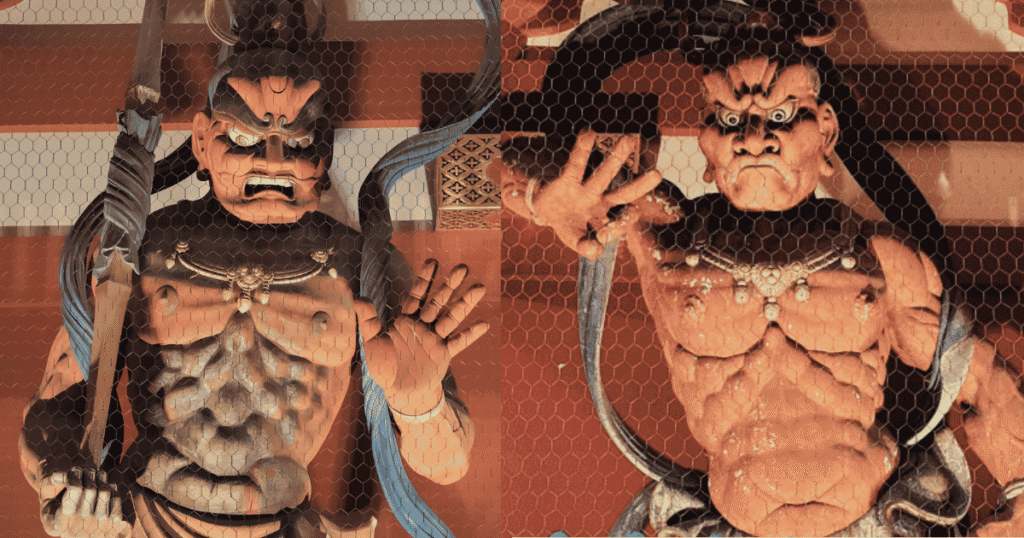
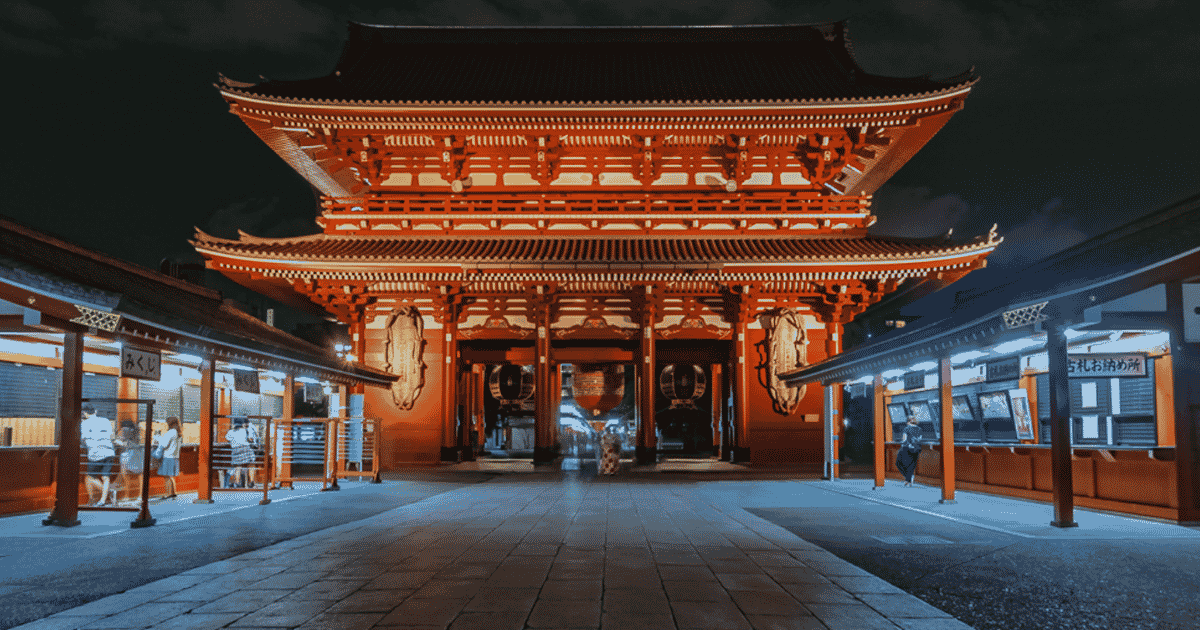
A pair of Nio guardian deities protecting the temple at Hozomon Gate.
This is the second large gate. You will see two fierce-looking Nio Guardians.
The Pair: One has an open mouth and the other has a closed mouth. Together, they block evil spirits from entering.
Giant Sandals (O-waraji): Look at the back of the gate! You will see giant straw sandals, 4.5 meters long. They are a message to monsters: “The giant who wears these lives here!” This scares evil away.
🏮 Main Hall (Hondo)
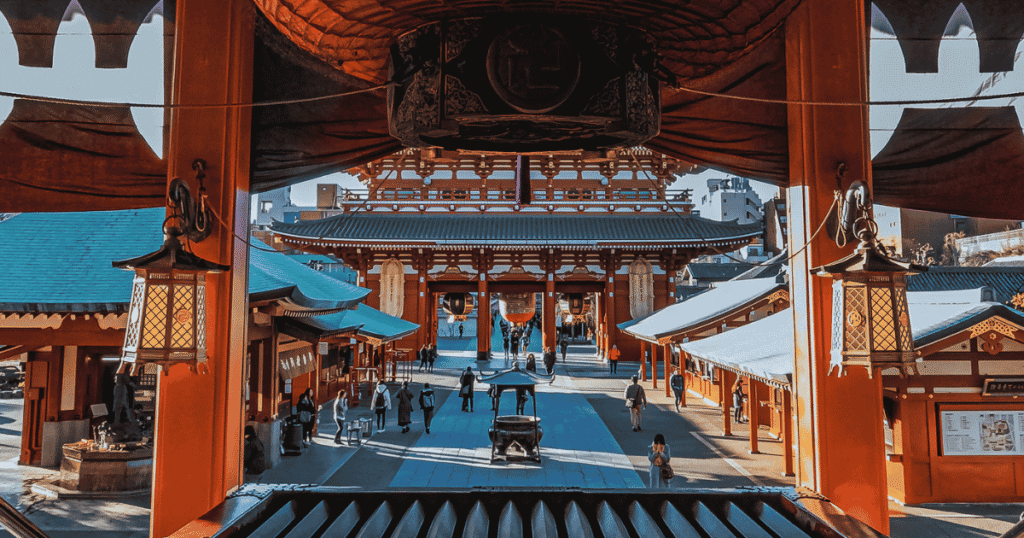
View of the Sensoji Temple grounds from the Main Hall, looking towards the gates.
This is the heart of Sensoji, dedicated to the Kannon Bosatsu (Goddess of Mercy).
The Sacred Statue: The main statue is hidden and never shown to the public. However, the hall is always filled with the energy of people seeking her kindness and help.
🌫️ Jokoro (Incense Burner)
You will see people waving smoke toward themselves.
The Tradition: It is said that the smoke can heal your body. People wave it toward their head to become smarter, or toward their shoulders for good health.
🗼 Five-Story Pagoda (Gojunoto)
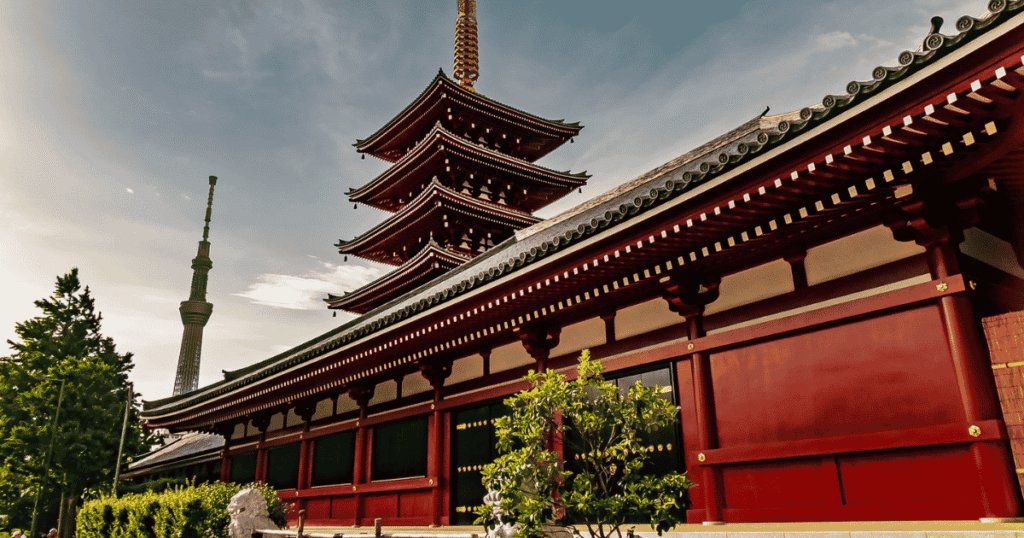
Five-Story Pagoda with Tokyo Skytree visible from Sensoji grounds.
This beautiful tower holds sacred ashes of the Buddha at the top. The view at night is amazing, especially when it is lit up until 11:00 PM.
🌸 Dempo-in Garden
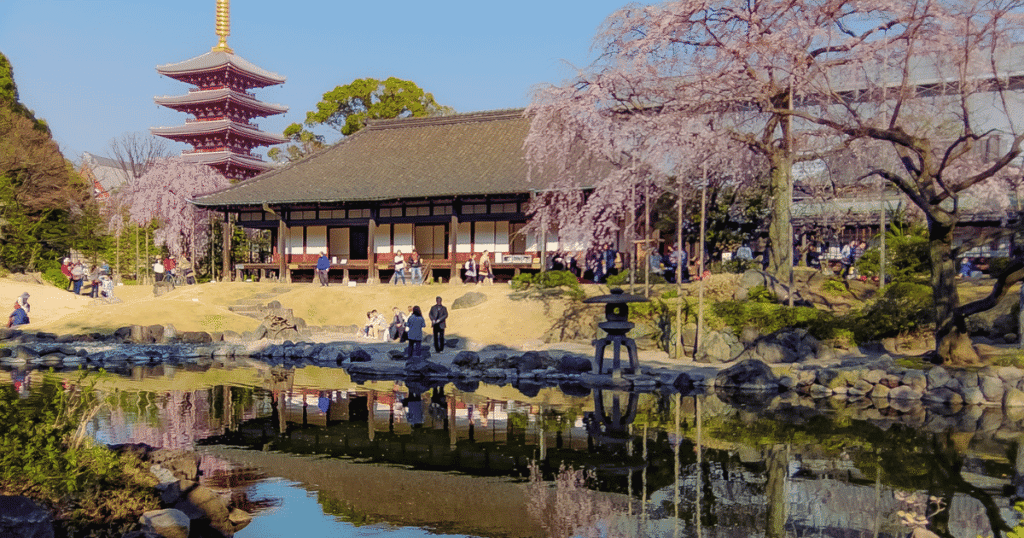
Japanese garden at Dempo-in, Sensoji Temple, during its special public opening.
This is a large, traditional garden built in the 1600s.
Special Entry: It is usually closed to the public, but it opens for a limited time during special seasons like spring (cherry blossoms). If it is open when you visit, you should definitely go inside!
5. How to Get There: Access from Major Stations
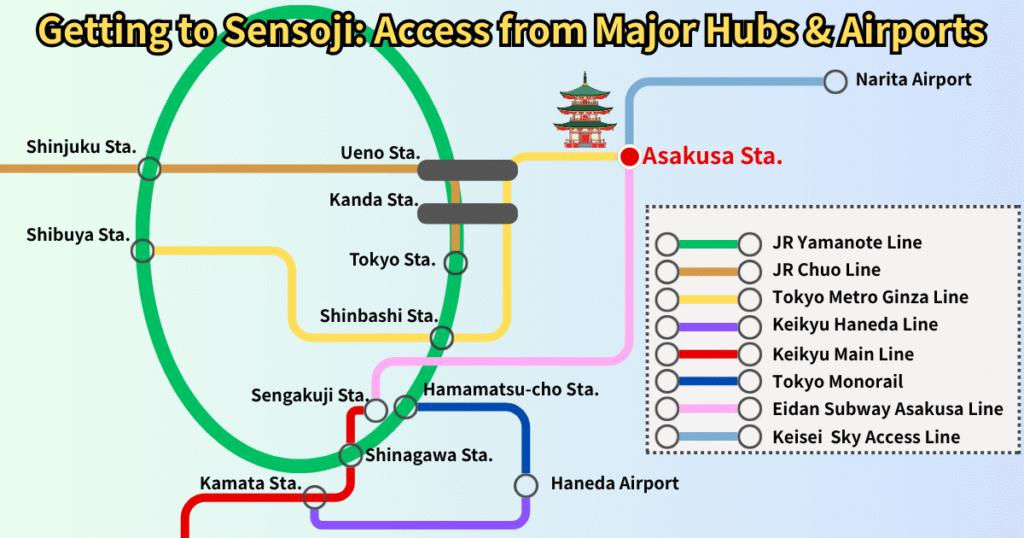
Sensoji is located in a very convenient area. Most people take the Ginza Line (Tokyo Metro) or the Asakusa Line (Toei Subway) to Asakusa Station. (Google Map)
The temple is also a 5 to 15-minute walk from other famous spots like Kappabashi (Kitchen Town), Tokyo Skytree, and Sumida Park.
📍 Nearest Station & Exit
Asakusa Station (Tokyo Metro Ginza Line, Eidan Subway Asakusa Line, Tobu Sky tree Line)
Best Exit: Take Exit 1. It is the shortest walk to Kaminarimon Gate (only 1 minute!).
⏱️ Travel Time from Major Hubs
Route map showing train access to Sensoji from Shinjuku, Shibuya, Haneda Airport, and Narita Airport.
Tokyo’s train network is amazing but can be complex. Pro Tip: Always use Google Maps to find the fastest route in real-time.
Here are the estimated travel times:
Tokyo’s train network is amazing but can be complex. Pro Tip: Always use Google Maps to find the fastest route in real-time.
From
Time
Route / Notes
Tokyo Station
20 mins
JR Yamanote Line → Transfer at Kanda to Ginza Line
Shibuya Station
40 mins
Direct via Tokyo Metro Ginza Line
Shinjuku Station
40 mins
JR Chuo Line → Transfer at Kanda to Ginza Line
Shinagawa Station
30 mins
Direct via Keikyu Line / Toei Asakusa Line
Haneda Airport
40 mins
Direct via Keikyu Line / Toei Asakusa Line
Narita Airport
80 mins
Direct via Keisei Narita Skyaccess Line
🚉 First and Last Train (Ginza Line)
If you are traveling between Shibuya and Asakusa, here are the general times:
Train Type
From
Departure
To
Arrival
First Train
Shibuya
05:01
Asakusa
05:34
Last Train
Asakusa
23:55
Shibuya
00:28
Note: For early or late trains to/from Haneda or Narita Airport, please check the Toei Asakusa Line timetable.
6. Frequently Asked Questions (FAQ)
Q: Is there a dress code? (Sensoji Temple clothing)
A: There is no strict dress code, but please remember it is a sacred place.
What to wear: Casual clothes are fine, especially if you are just walking through. Many tourists enjoy visiting in rented Kimonos.
Shoes: Comfortable walking shoes are recommended. This is especially important if you visit the Dempo-in Garden (when open), as the paths around the pond can be uneven.
Winter Tip: Tokyo’s winter mornings are very cold, dry, and windy. If you come for an early morning visit, bring a warm coat.
Manners: It is polite to remove your hat when you enter the Main Hall.
Q: Is there an entrance fee?
A: No, entering the temple grounds and praying at the temple is completely free.
Q: How much is a Goshuin (temple stamp)?
A: There are two types of Goshuin available. Each one costs 500 yen.
Q: What is the difference between Sensoji and Meiji Jingu?
A: It depends on the experience you want:
Sensoji Temple (The “Active” Vibe): Choose this for “Life, Culture, and History.” It is perfect for street food, fortune-telling, and colorful, photogenic buildings.
Meiji Jingu Shrine (The “Quiet” Vibe): Choose this for “Nature, Peace, and Spirituality.” It is so quiet that you will forget you are in Tokyo. You can enjoy the forest, wooden architecture, and maybe see a traditional Japanese wedding procession.
7. Sensoji Deep-Dive Series: Make Your Visit Perfect
Want to know more? Check out our expert guides to master your Asakusa trip:
[Part 2] The Best Time to Visit : A seasonal and hourly matrix. Why 6:00 AM is the “Golden Hour,” and why a rainy night is actually the best for photos.
[Part 3] Photo Spot Guide : How to find the perfect angle for the Five-Story Pagoda and how to take the best “Skytree x Temple” collaboration shots.
[Part 5] Nakamise Street Directory (Coming Soon): A complete list of over 80 shops, from the best street food to traditional crafts.
Festive Sensoji Temple grounds decorated for the New Year.
Conclusion
Sensoji is more than just a tourist spot; it is a “Time Machine” that shows a different face every time you visit.
Will you listen to the temple bells at dawn, or look up at the glowing red lanterns in the silence of midnight? We hope this guide becomes the map for your own special Asakusa experience.