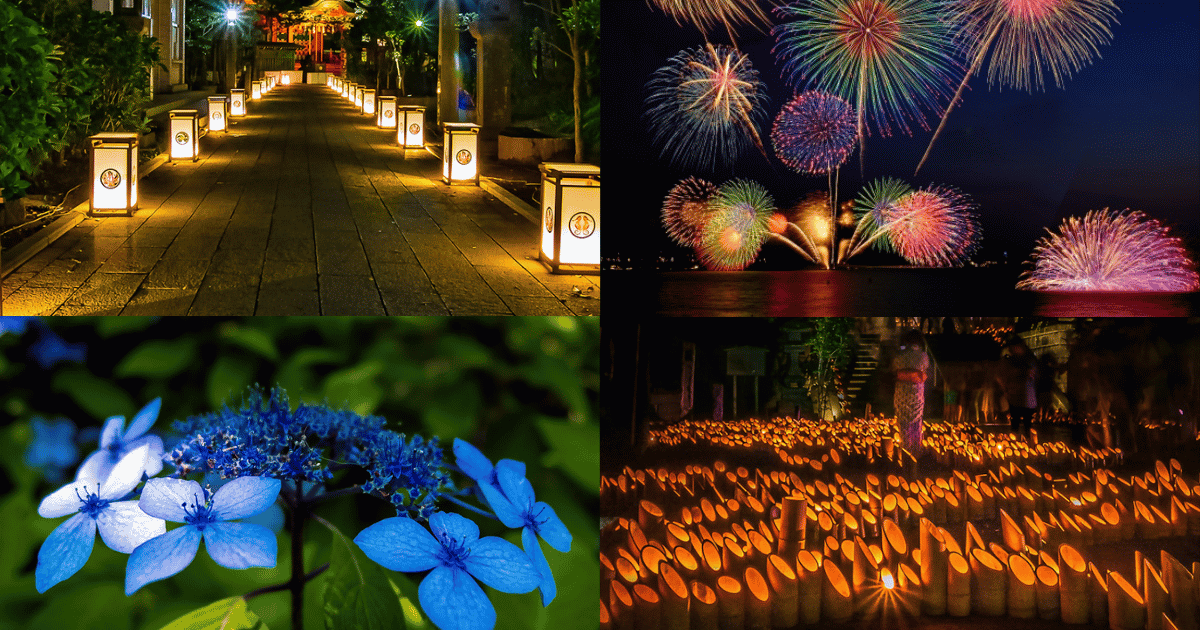
Kamakura is a historic coastal town located just one hour south of Tokyo. As the weather warms up, this town shows a completely different side of its beauty. Visiting Kamakura in summer allows you to enjoy a magical experience woven with timeless traditions, beautiful beach scenery, and breathtaking seasonal flowers.
Many people planning a Kamakura summer trip are wondering about the best time to visit, what the Kamakura June weather is like, or how intense the summer heat gets in July and August.
As a local insider who has explored every corner of this beautiful town, I have curated this guide based on my real, firsthand experiences and honest advice, steering you away from the generic tourist traps. Please use this month-by-month complete guide to plan your perfect summer getaway!
Which Summer Month is Best for You?
Choose June if… You love vibrant nature photography, historic temple paths, and want to experience Japan’s original hydrangeas during a quieter, holiday-free month.
Choose July if… You want the energetic vibe of Japanese beach culture, romantic star festival decorations, and want to feel the powerful vibrations of seaside fireworks.
Choose August if… You prefer exploring in the cooler evenings, immersing yourself in local cultural traditions, and walking through thousands of softly glowing paper and bamboo lanterns.
June: Experiencing the Magical Kamakura Hydrangea Season
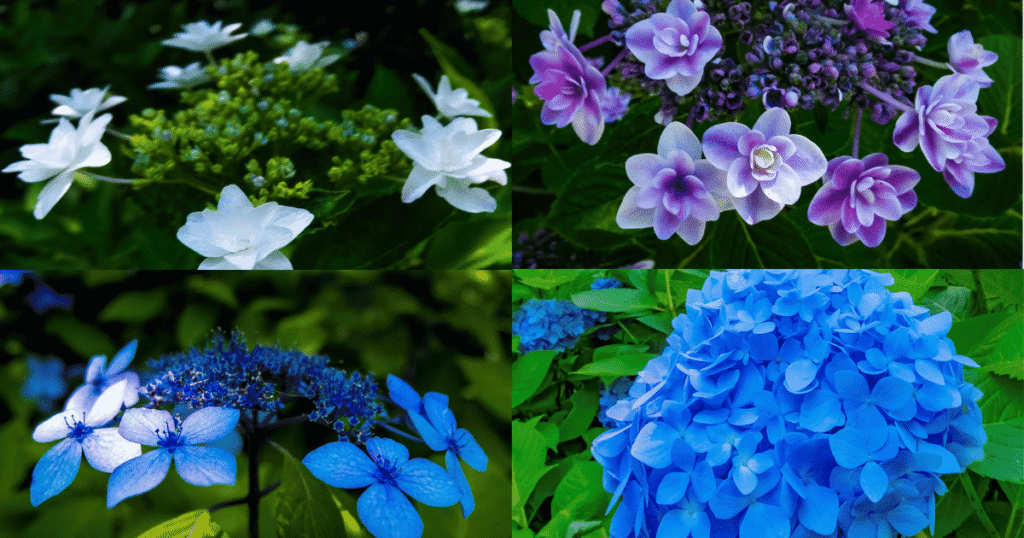
Hydrangeas painted in beautiful summer colors at Kamakura’s shrines and temples.
June is a very unique time to visit Japan. Many people might think that June is too rainy and humid, making it a bad season for traveling.
However, this is actually the only time of the year when you can experience the breathtakingly beautiful hydrangeas. In addition, because there are no official Japanese national holidays in June, you do not have to worry about huge crowds of local tourists.
If you are researching June events in Japan, you absolutely cannot miss the incredible scenery of these flowers that only bloom during the rainy season.
Are Hydrangeas Native to Japan? The Story Behind the Flower
By the way, you might wonder, “Why should I go out of my way to see hydrangeas during a trip to Japan?” The answer is very simple: Japan is actually the original home of hydrangeas.
When looking at internet articles, I often see questions like, “Are hydrangeas native to Japan?” or “Are hortensia and hydrangea the same thing?” — Yes, exactly!
The original species native to Japan is called Gaku-ajisai (lacecap hydrangea), and the Japanese name for this flower is “Ajisai.” Also, “Hortensia” is simply the European name for the exact same family of plants.
Looking back at history, these hydrangeas native to Japan traveled to Europe, where botanists bred them to create more than 300 beautiful varieties today.
By the way, the hydrangea meaning in Japan today symbolizes changing emotions, gratitude, and the inner strength to beautifully overcome the rainy season. Please use this article to visit beautiful hydrangea spots and make your rainy season trip to Japan a wonderful memory!
The Best Spots for the Kamakura Hydrangea Season
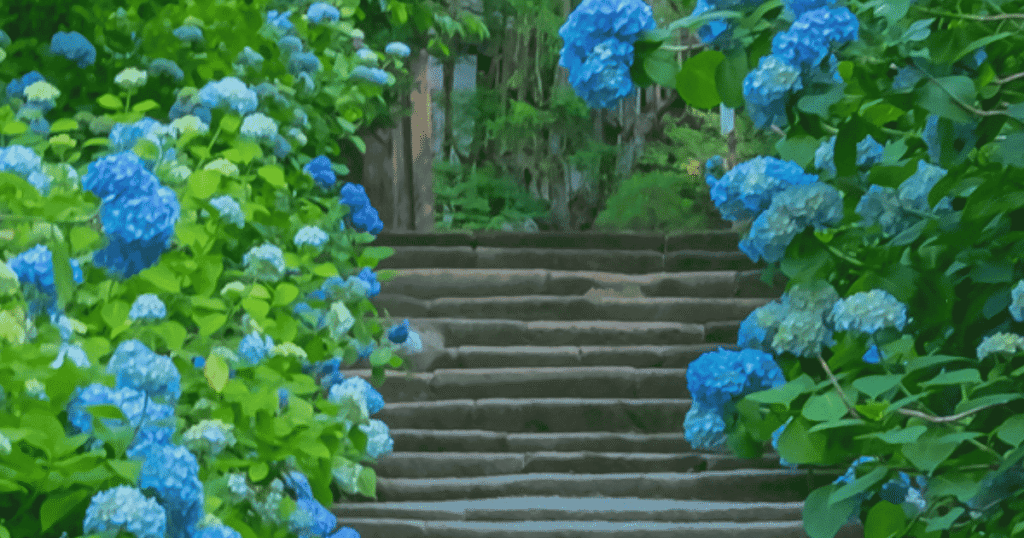
Kamakura’s iconic Meigetsu-in approach, completely covered in deep blue hydrangeas.
Hydrangeas bloom in many different places across Kamakura, and many of them are listed as “best spots” online. However, in reality, some of these tourist sites only have a small number of flowers.
Therefore, after visiting many tourist spots myself, I have selected only the absolute best places for you. Here are the top spots you cannot miss to experience the Kamakura hydrangea season!
1. Meigetsu-in: The Famous Kamakura Hydrangea Temple
Known widely as the “hydrangea temple,” Kamakura’s famous Meigetsu-in (or simply Ajisai-dera) is the most iconic spot in the region.
The View: The approach to the temple features around 2,500 hydrangea bushes. The flowers here are famous for a unique, deep blue shade known as “Meigetsu-in Blue.” Walking up the path makes you feel like you are floating in a beautiful sea of blue flowers.
Peak Season & Hours: The best time to visit is from mid-to-late June. To accommodate the crowds, the temple extends its hours for the 2026 season (June 1st to June 30th), opening from 8:30 AM to 5:00 PM (last entry at 4:30 PM).
Admission: 500 yen.
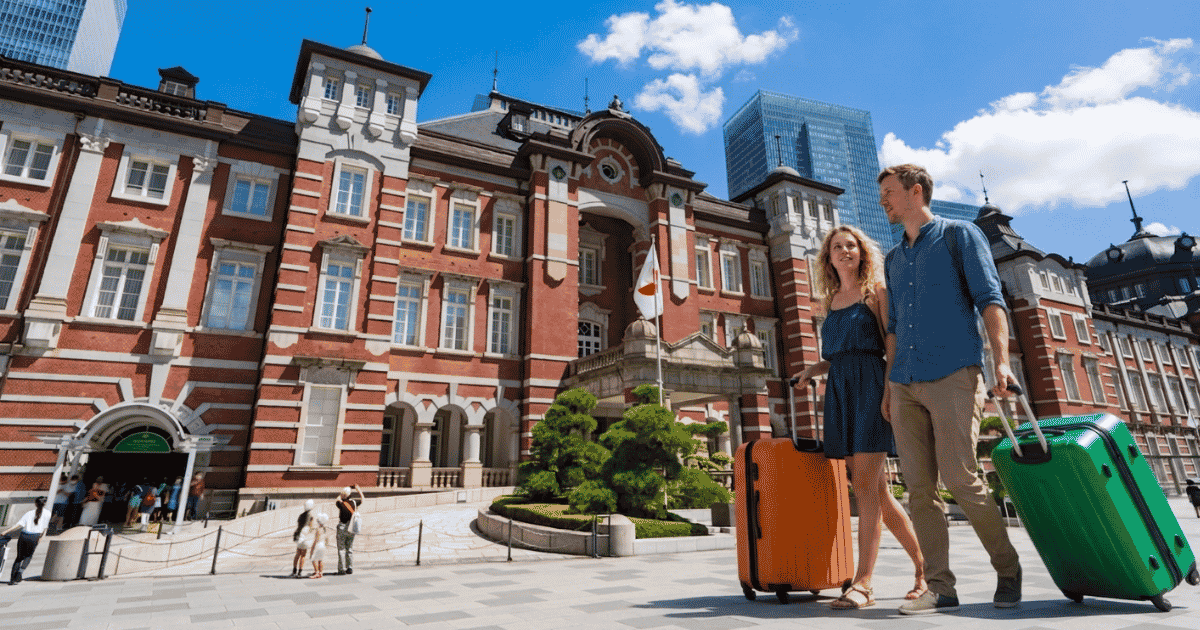
How to Get There:Take the JR Yokosuka Line and get off at Kita-Kamakura Station (one stop before Kamakura Station). From there, it is a pleasant 10-minute walk along a narrow, green road nestled between hills. If you are coming from Tokyo Station, please check out our guide, [The Ultimate Route: Train to Kamakura from Tokyo], for the best way to travel.
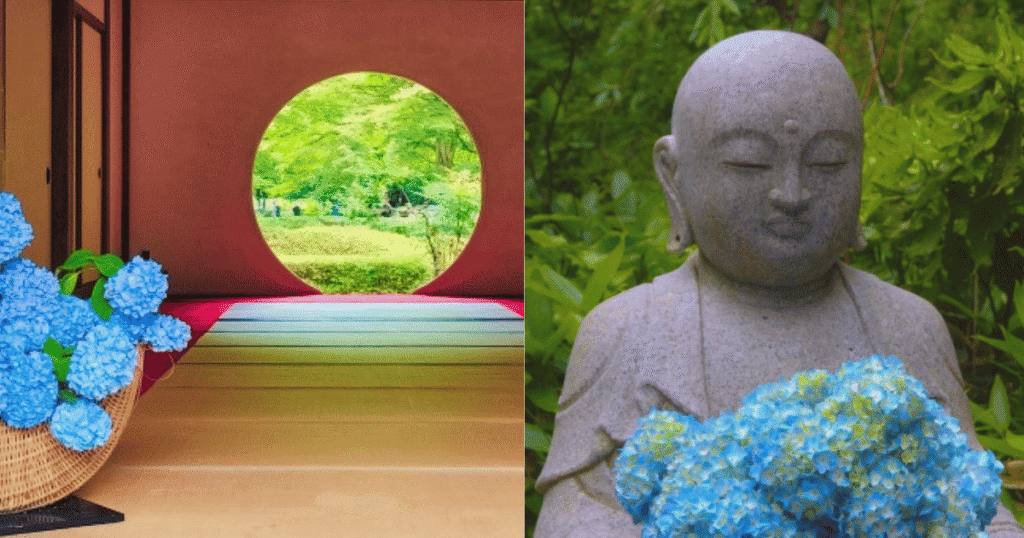
The famous circular window & The adorable Jizo stone statue
📷Local Insider Photo Tip for Meigetsu-in:
You have probably seen beautiful, empty photos of the famous Kamakura hydrangea path on Instagram . If you want to take that exact photo without any tourists, you have only two choices: line up several hours before the gates open, or stay until the absolute last minute before closing.
However, many other tourists with cameras think the exact same thing, and they will rush to the path at those same times. Because of this, it is very hard to guarantee a clear view.
If you are on a limited holiday schedule, I recommend skipping that main path photo. Instead, you should focus on the following two highly rewarding spots where it is much easier to wait for your turn:
The adorable Jizo stone statue holding a small basket of hydrangeas.
The famous circular window inside the traditional tatami room, which frames the outer garden beautifully like a real painting.
Bonus Tip: Keep an eye out for the temple’s squirrel feeding station! It’s a delightful, relaxing sight you won’t easily find elsewhere in Kamakura, so make sure to check it out.
2. Hasedera Temple: The Panoramic Hydrangea Path
Vibrant June blossoms covering the iconic Hasedera hydrangea path.
For a completely different atmosphere, head to the beautiful Hasedera Temple, famous for the iconic Kamakura hydrangea trail.
The View:
Hasedera features over 40 different varieties and about 2,500 individual plants. While the flowers start blooming in late May, the absolute best time to visit is between June 10th and the end of the month.
Please make sure to visit in June—as soon as July begins, the temple staff and gardeners prune all the bushes to prepare for next year!
The Experience:
This famous hydrangea path is a beautifully designed, one-way walking trail built into the hillside behind the lower temple grounds. Because the path is one-way, make sure to take photos as you go. You cannot walk backward!
The Path Entrance: Stunning walls of flowers climb up the steep slopes near the start of the trail.
The Climbing Steps: You will walk up stairs completely surrounded by a dense, colorful variety of hydrangeas.
The Summit: At the top of the trail, you get a sweeping panoramic view of the Yuigahama coastline framed by blossoms. Look closely around this area—can you spot one of the three hidden, smiling mini-Jizo statues?
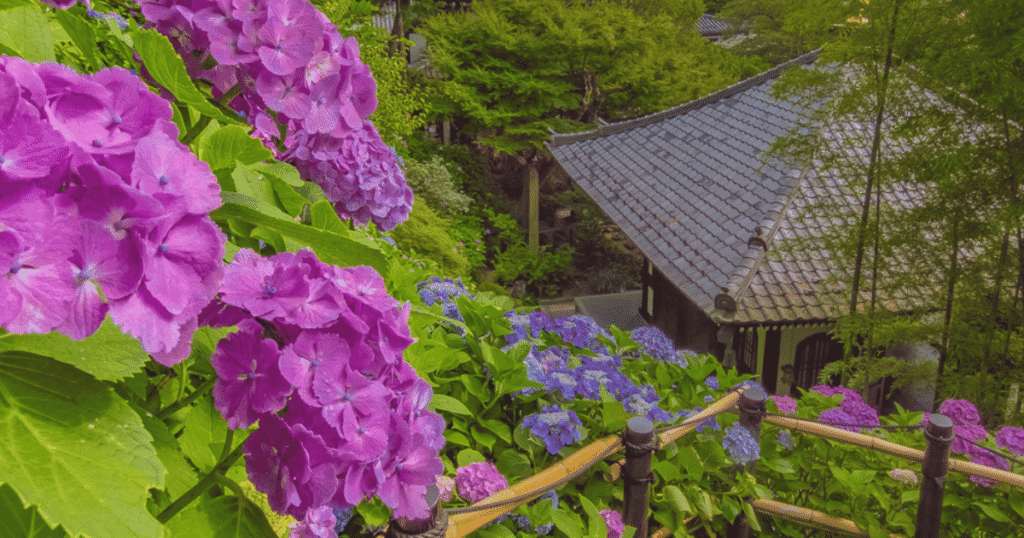
The Descent: As you walk down the hydrangea-covered slope, you get a classic view of the temple roofs peeking through the flowers. It is the perfect, postcard-like composition.
Admission & Tickets:
Temple entry is 400 yen, plus an additional 500 yen for the Kamakura hydrangea path ticket. To prevent overcrowding, the temple uses a timed-entry system. I highly recommend booking your entry slot online in advance to secure your spot. If you change your plans, you can cancel your online ticket until the day before.
You can take the retro Enoden train and get off at Hase Station. From there, it is just a 5-minute walk through a lovely coastal residential neighborhood.
💧 Local Insider Comfort Tip for Hasedera:
June falls during the Japanese rainy season. Even if the Kamakura June weather feels cool or rainy, the humidity is very high. Climbing up and down the steep steps of the trail will make you sweat quickly.
I recommend wearing layers you can easily take off (like a short-sleeve shirt under a light jacket) and wearing sturdy, comfortable shoes because the wet stone steps can be very slippery.
Also, if you want to take your time finding the perfect, crowd-free spots for photos without feeling rushed, make sure to allow at least 2 hours for your visit.
More Instagram-Worthy Spots for a Kamakura Hydrangea Tour
If you want to capture a different perspective of the hydrangea season in Kamakura, consider adding these unique locations to your itinerary.
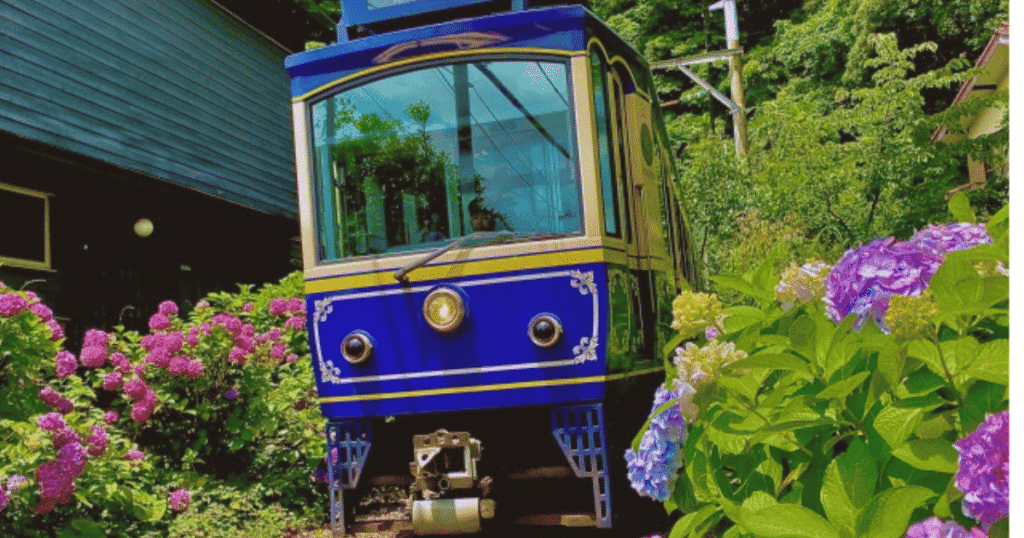
Kamakura’s famous Enoden train rushing past seasonal hydrangeas at Goryo Shrine.
Goryo Shrine (Hase)
Located just a 5-to-10-minute walk from Hase Station (heading in the opposite direction of Hasedera Temple), this is a very small, charming shrine nested in a quiet neighborhood. It is completely free to enter, has no gates or entry fees, and is open 24/7.
The location is truly unique—an Enoden train crossing sits at the end of a narrow path right in front of the entrance to the shrine grounds. This spot is highly popular on Instagram, and photographers flock here to capture the classic shot of the retro train passing closely by the colorful rows of hydrangeas with the shrine in the background.
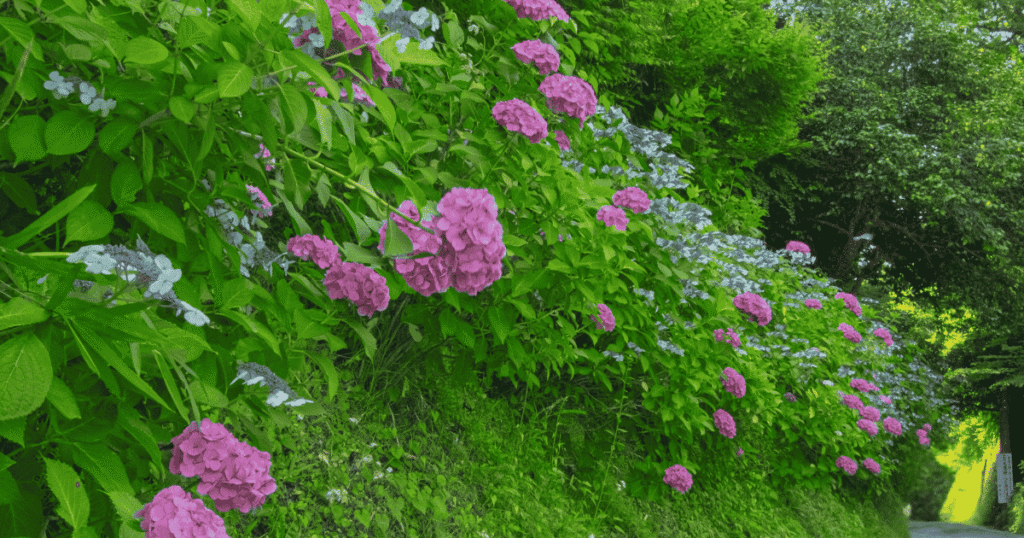
Seasonal hydrangeas framing the historic slopes of Kamakura’s Kamegayatsuzaka Pass.
Choju-ji Temple is famous for its stunningly beautiful green moss garden and peaceful, traditional atmosphere. In June, the temple is only open from Wednesday to Sunday (10:00 AM to 3:00 PM; admission is 300 yen) and will close on rainy days.
⚠️ Important Note: The temple staff takes great care of their delicate moss gardens. If you step on the moss while focusing on your camera, you will be strictly warned, so please watch your step.
💡 Insider Tip: I highly recommend stepping inside the temple building. Viewing the beautiful garden framed through the traditional tatami room windows will be a very fresh, memorable experience for international visitors.
Kamegayatsuzaka Pass:
Running right beside this temple is the Kamegayatsuzaka Pass (Kamegayatsuzaka Kiridoushi). This historic pass was a core road back when Kamakura was the capital of Japan.
Today, it is a hidden gem where plenty of rare hydrangea varieties bloom along the path, and they tend to bloom a bit earlier than other spots in Kamakura (from late May to mid-June). Because the path is not heavily crowded, you can enjoy a peaceful, relaxing walk while admiring the early flowers.
Late June Bonus: The Traditional Purification Ritual
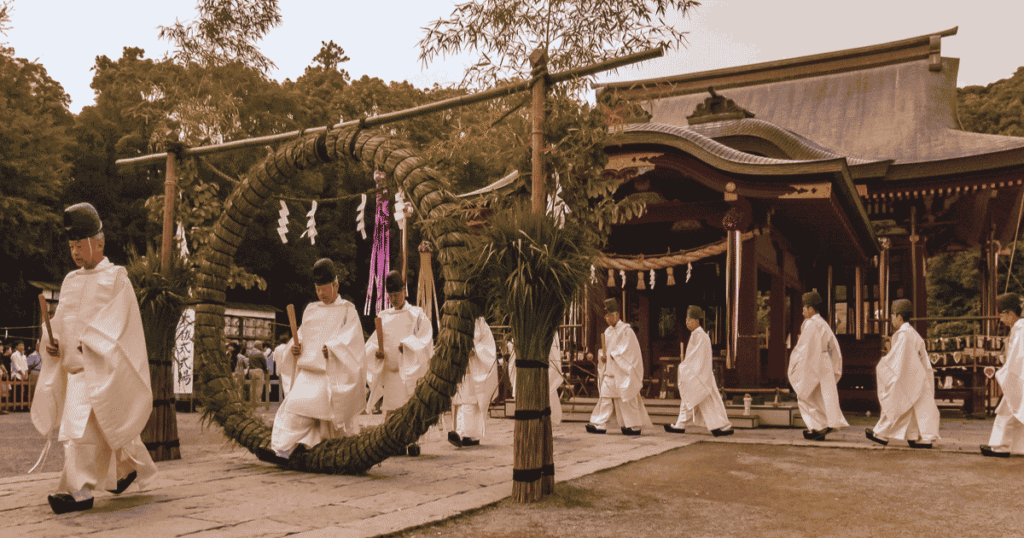
The traditional Chinowa-kuguri ritual for health and purification at Kamakura’s Tsurugaoka Hachimangu
If you happen to be in town on the very last day of June, you can witness a wonderful traditional cultural event. On June 30th, Tsurugaoka Hachimangu Shrine holds a special ritual called “Nagoshi no Oharae” (the summer purification ceremony).
During this event, a huge ring made of sacred thatch grass, called “Chinowa,” is set up on the shrine grounds. Walking through this loop in a specific figure-eight pattern is an ancient tradition called “Chinowa-kuguri.” It is believed to wash away the hidden sins and impurities accumulated over the past six months, while praying for good health for the rest of the year.
The purification ritual at a major shrine like Tsurugaoka Hachimangu is highly impressive to watch because many priests dressed in formal, traditional robes lead the ceremony. In past years, the rituals were held at 11:00 AM, 1:00 PM, 3:00 PM, and 5:00 PM.
As the time approaches, a large crowd forms around the Chinowa ring, making it very hard to see from the back or take photos. I highly recommend arriving at least 15 minutes early so you can secure a spot near the front.
Please note that the grounds of Tsurugaoka Hachimangu Shrine are free to enter and open 24/7.
During summer in Enoshima, the entire island is lined with beautiful traditional lanterns.
Until around the middle of the month, the Kamakura July weather continues to bring the rainy season, just like in June. However, by late July, the town completely transforms into a season of bright, glowing sunshine, marking the exciting start of beach days and lively night festivals.
What to See in Kamakura in July
Tanabata (Star Festival) at Tsurugaoka Hachimangu:
From early July until July 7th, beautiful and colorful Tanabata (Star Festival) decorations are displayed on the shrine grounds. Tanabata is a traditional Japanese event where people write their wishes on small paper strips, hang them on bamboo branches, and remember the romantic legend of Orihime and Hikoboshi (the weaver star and cowherd star).
While it is not a massive event, a romantic atmosphere fills the grounds during this time. If you are visiting Kamakura in early July, it is highly worth stopping by. Please note that all decorations are completely removed on July 8th, so you must visit by July 7th!
The Spectacular Kamakura Fireworks Display:
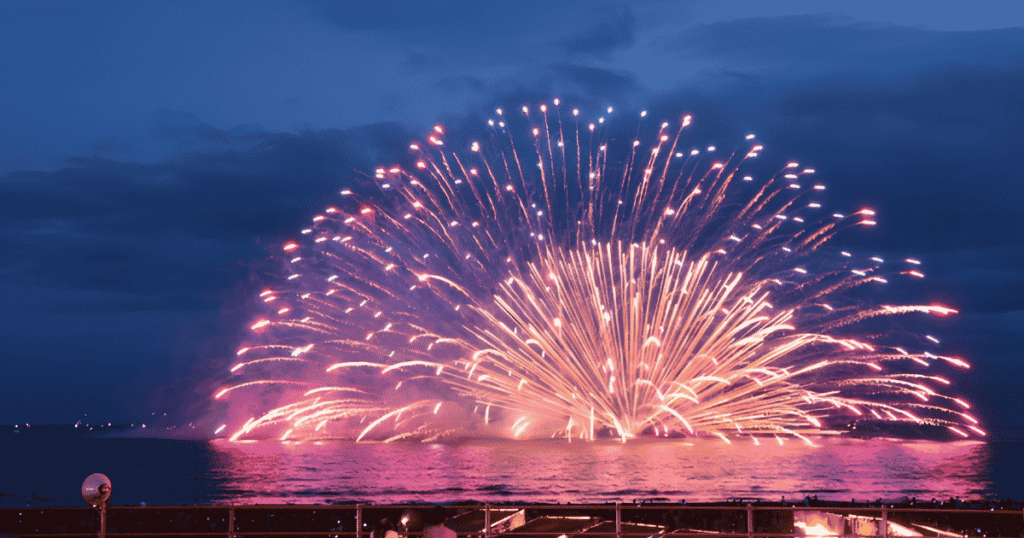
Spectacular fireworks forming a giant fan shape right on the water in Kamakura.
The highlight of the Kamakura July festivals is the fireworks festival, which will be held at Yuigahama and Zaimokuza beaches on July 10th, 2026. While regular fireworks are launched high into the sky, Kamakura is famous for its “underwater fireworks,” which are thrown into the ocean from a moving boat.
As they explode and spread into a giant fan shape across the water’s surface, the powerful sound and vibrations echo directly across the beach, creating an unbelievable experience.
🎆 Local Insider Spot:
If you want to fully experience the powerful sound and vibrations, you should definitely watch the fireworks right on the beach. However, many people secure their spots during the daytime, so you need to plan your schedule with plenty of time.
If you want to avoid the crowds, I recommend watching from the observation deck on the hill behind Komyo-ji Temple. Space is limited, so you still need to arrive early, but the view looking down at the fireworks with the whole bay in sight is amazing.
💡 Travel Tip:
The temperature and humidity will stay very high even after the fireworks end and people start heading home. Because everyone walks toward the station at the same time, the crowds move very slowly, and you will get very sweaty. The best plan is to book a hotel close to the beach where you watch the event.
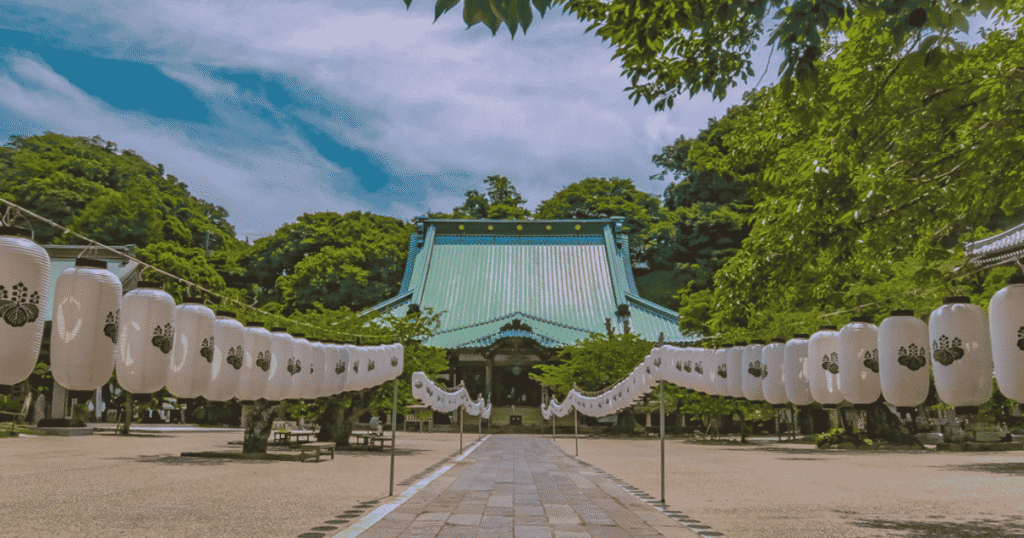
Two rows of paper lanterns lining Komyoji Temple’s approach, waiting for the evening festival.
The Lotus Festival (Kanren-kai) at Komyo-ji:
On July 25th and 26th, this beautiful temple hosts a morning viewing of the grand pink lotus flowers blooming in its ancient pond. At the same time, the main courtyard is decorated with two long rows of traditional lanterns. Even during the day, walking between these hanging lanterns feels magical and makes for incredible, vibrant photos.
August: The Peak of the Kamakura Summer Festival Season
August brings the absolute peak of the Kamakura in summer festival experience, focusing on soft light and historic evening atmospheres.
Must-Visit August Night Festivals in Kamakura
If you want to experience the magical side of Japanese summer evenings, August is the absolute best time to visit. The hot daytime temperatures drop, and the town comes alive with traditional lantern festivals. Here are three nighttime events you cannot miss!
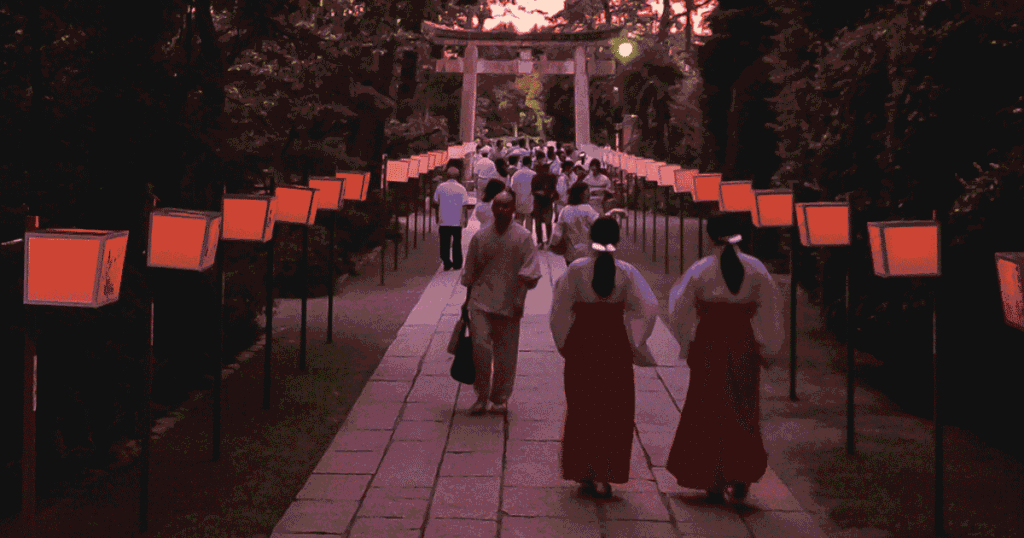
The magical transition into night, as rows of lanterns begin to glow at dusk.
This spectacular festival is held at Tsurugaoka Hachimangu Shrine from the day before the first day of autumn (August 6th to August 9th, 2026).
Throughout the shrine grounds, hundreds of bonbori (paper lanterns) feature beautiful drawings and calligraphy created by local celebrities and artists. At night, these lanterns are lit all at once, transforming the shrine into a glowing gallery.
While international travelers rarely get the chance to visit a Japanese shrine late at night, this festival is highly popular and draws a vibrant crowd. It offers a wonderful opportunity to immerse yourself in the true essence of Japanese cultural traditions.
🪙 Admission: Completely free
💡 Travel Tip: The grounds are open to everyone, but to fully experience the magical atmosphere, make sure to plan your schedule so you can stay until a bit later in the evening.
Ryukoji Temple Bamboo Lantern Festival (Take-Toro)
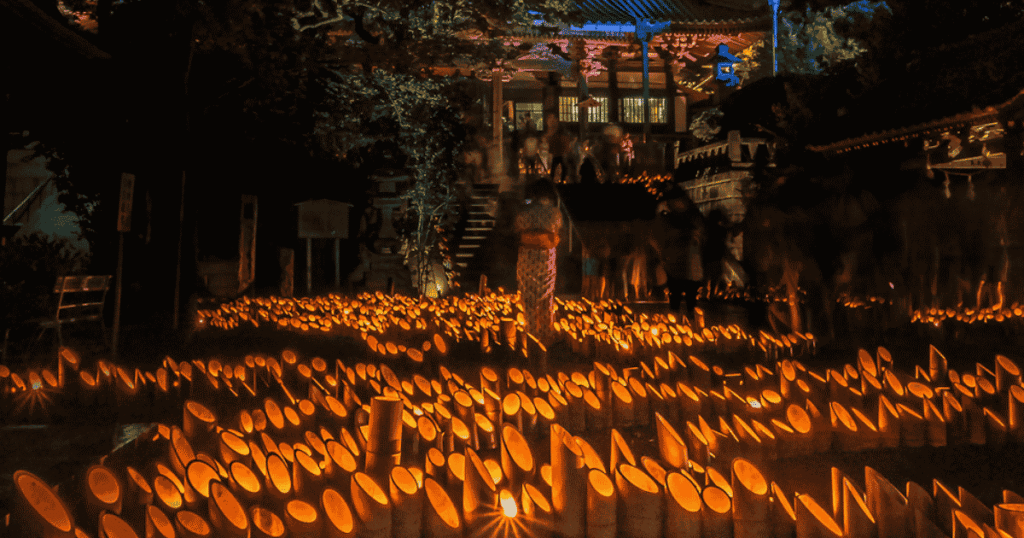
Ryukoji Temple Bamboo Lantern Festival
Located very close to Enoshima, Ryukoji Temple hosts this stunning event on the first Saturday and Sunday of August. Countless lanterns crafted from cut bamboo are lined up across the temple grounds, illuminated by the warm, flickering light of real candles.
💡 Local Insider Crowd Tip:
Right after it gets dark, the temple becomes incredibly crowded, and it can be very hard to move around. However, as the evening progresses, the crowds gradually thin out. I highly recommend allowing plenty of time and arriving a bit later in the evening. This allows you to slowly enjoy the quiet, mystical world of softly swaying lights without the heavy rush.
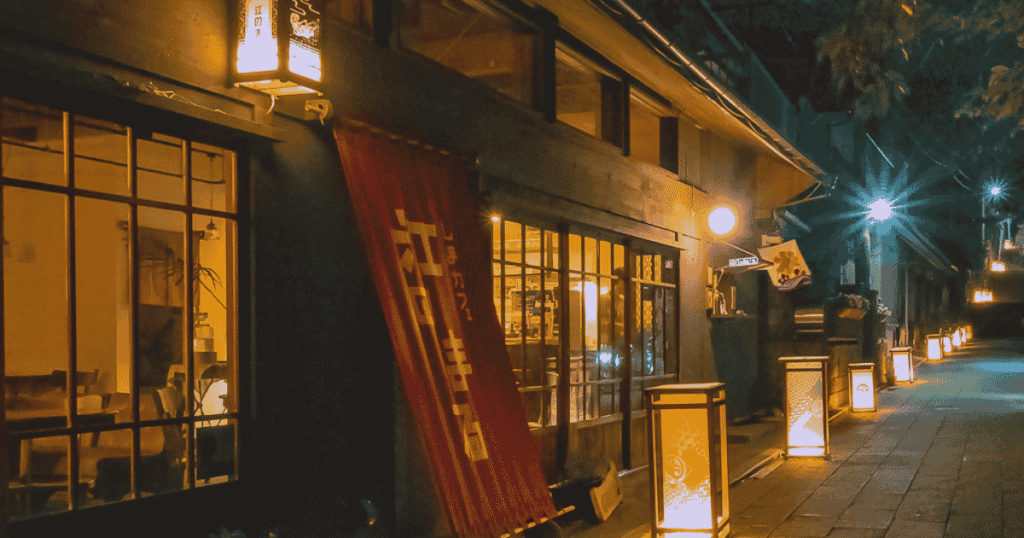
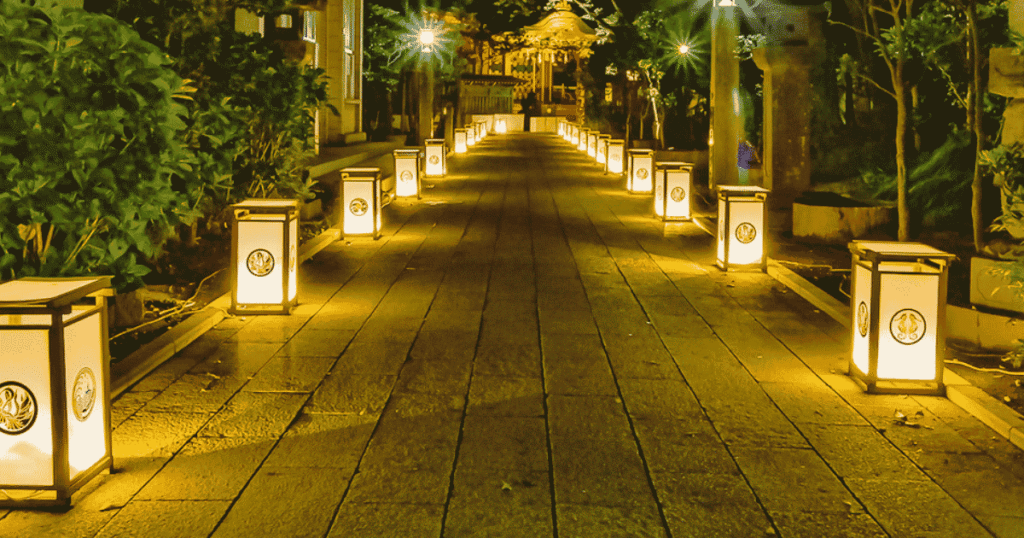
Summer nights in Enoshima, glowing with hundreds of traditional lanterns across the island.
Running from mid-July to the end of August, this massive summer illumination takes place across the entire neighboring island of Enoshima. The island’s narrow walking alleys, traditional shrines, and botanical gardens are lit up with gentle, Japanese-style lanterns.
It is the perfect, relaxing activity to combine with a late-afternoon coastal walk to catch the cool summer ocean breeze.
Whether you want to catch the peak of the Kamakura hydrangea 2026 season in June, stand on the beach watching fireworks reflect off the ocean in July, or experience the traditional night festivals of Kamakura in August, the surrounding summer months offer an unforgettable experience.
Pack light, breathable clothing, stay hydrated, and get ready to experience the deep history and stunning seasonal beauty of Japan’s premier coastal retreat!