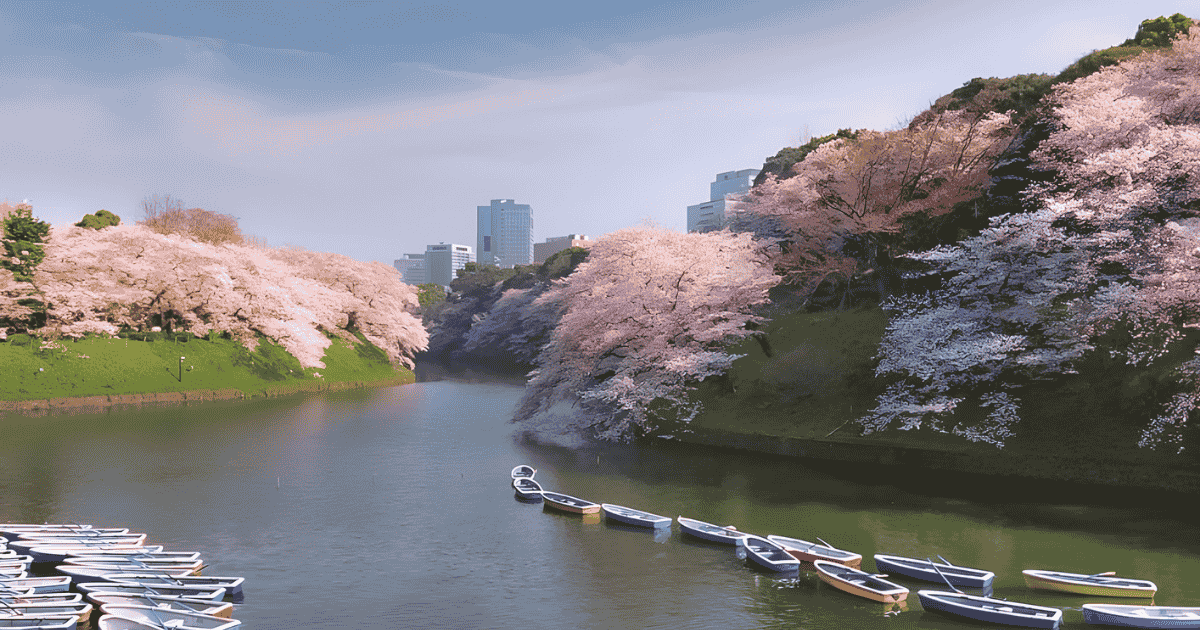
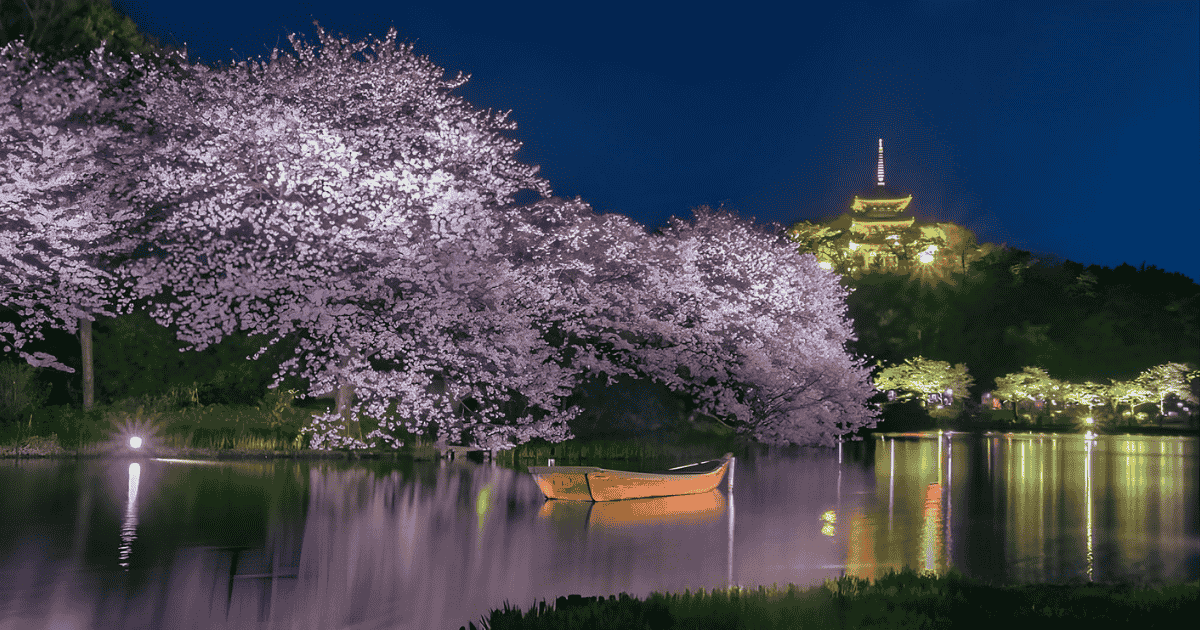
If you are searching for “Where is cherry blossom in Japan now?”, the answer depends on the month of your visit. Japan’s sakura season spans from winter in Okinawa to late spring in Hokkaido. This guide provides the definitive list of 50 spots, categorized by their blooming periods and unique themes, so you can find exactly where to go right now.
Important Tip: Prioritize the Sakura Right in Front of You!
In Japan, you can find cherry blossoms in almost every town, no matter how small. Even the place where you are staying right now likely has a hidden spot with dozens of trees in full bloom.
While this guide introduces 50 world-class locations, please remember that cherry blossoms are incredibly fragile. Their peak lasts only a few days, and a single night of strong wind or rain can scatter the petals. If today is a beautiful sunny day, don’t worry about reaching the 50 spots in this guide—just find the nearest park or riverside and go outside immediately. Don’t hesitate, as you won’t want to miss the best moment of the year.
How We Selected These 50 Spots To ensure the highest quality of your sakura journey, we selected these locations based on two strict criteria:
Magnificence: Each spot showcases ancient trees over 200 years old or a massive scale of at least 1,000 cherry trees.
Accessibility: Locations are reachable within 2 hours from a major airport, Shinkansen station, or regional city center.
Note: A few exceptionally unique locations that offer a one-of-a-kind experience have also been included even if they fall outside these specific criteria.
Essential Resources for Your Trip To maximize your sakura experience, we recommend checking these two essential guides alongside this list of locations:
[Best Time to Go to Japan for Cherry Blossoms 2026: The Ultimate Master Guide] — Plan your arrival with the latest 2026 regional forecasts.
[How Long Do Japan’s Cherry Blossoms Last? 2026 Ultimate Guide] — Understand the sakura lifecycle to ensure you don’t arrive too late.
Table of Contents
Toggle1. November to March: Rare Winter and Early Spring Blooms (#1–#4)
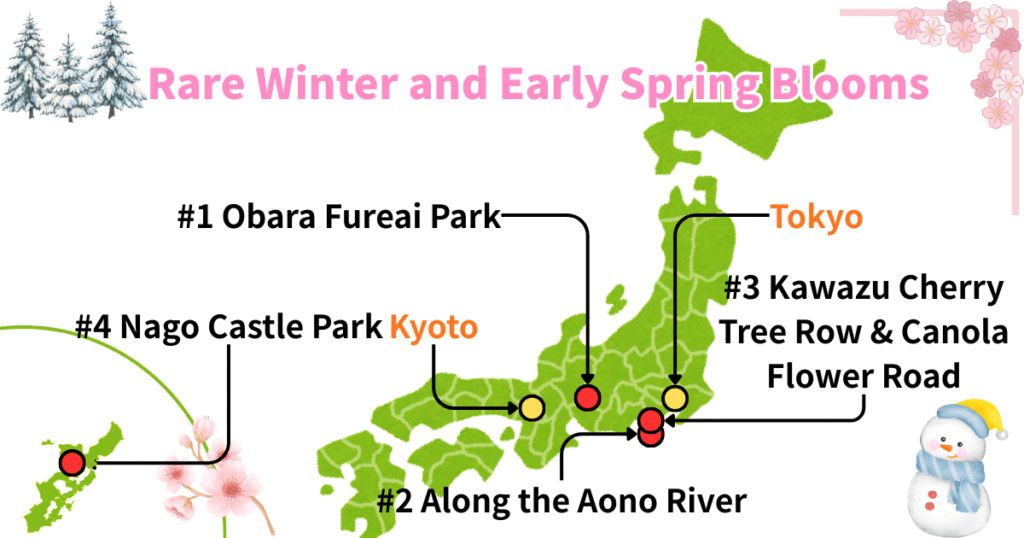
Japanese cherry blossoms aren’t just for spring. In this section, you can find unique cherry blossoms that bloom with autumn leaves or start flowering in the middle of winter. It is perfect for travelers visiting Japan outside the typical cherry blossom season.
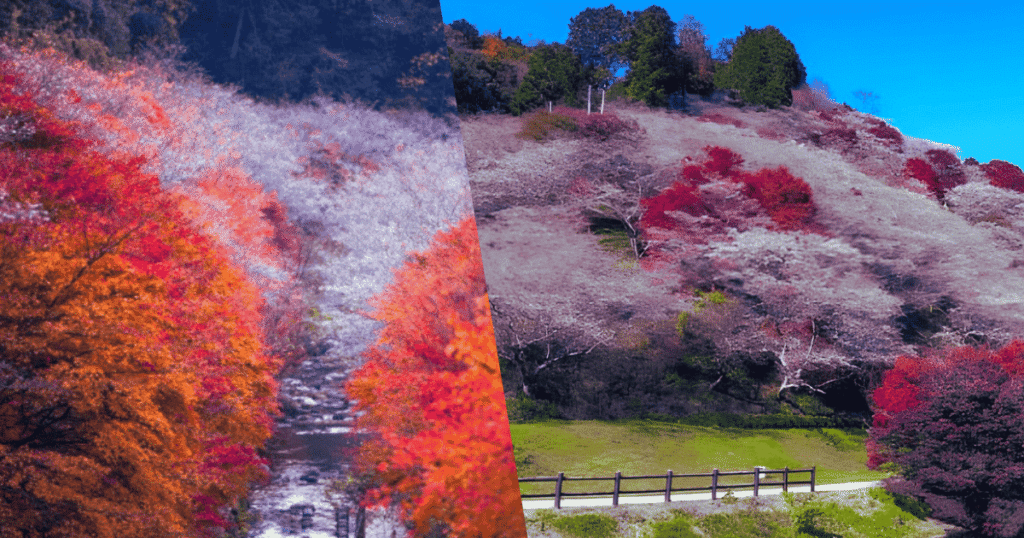
– Photo: No.1 Obara Fureai Park –
- Number of Trees: 10,000
- Access: About 1 hour by bus from Umetsubo Station on the Meitetsu Line (Total: approx. 2 hours from JR Nagoya Station)
- Best Time: Mid-Nov to Late Nov
- Location: Toyota City, Aichi [View on Google Maps]
- Description: Located in the Obara district, this rare spot features cherry blossoms that bloom twice a year. In the fall, you can enjoy a stunning contrast between the pink blossoms and fiery red autumn leaves. Please note that the flowers in spring are more subtle compared to the autumn season.
- Number of Trees: Approx. 800
- Access: About 40 mins by bus and walking from Izukyu-Shimoda Station (Total: approx. 2 hours from JR Atami Station)
- Best Time: Mid-Feb to Early Mar
- Location: Minami-izu Town, Shizuoka [View on Google Maps]
- Description: A 4.2km stretch of about 800 cherry trees lines both banks of the Aono River. Visitors can enjoy the early arrival of spring with the unique sight of steam rising from nearby hot springs and the vibrant contrast of yellow canola flowers in the background.
- Number of Trees: Approx. 800
- Access: 5 min walk from Kawazu Station on the Izukyu Line (Total: approx. 1 hour 5 mins from JR Atami Station)
- Best Time: Mid-Feb to Early Mar
- Location: Kawazu Town, Shizuoka [View on Google Maps]
- Description: These famous early-blooming cherry blossoms reach their peak in February. Along the 4km riverside path, the deep pink blossoms are paired with bright yellow canola flowers, creating a vivid and beautiful landscape that signals the start of spring.
- Number of Trees: Approx. 20,000
- Access: About 2 hours by bus from Naha Airport (Total: approx. 2 hours from Naha Airport)
- Best Time: Late Jan to Early Feb
- Location: Nago City, Okinawa [View on Google Maps]
- Description: A UNESCO World Heritage site and the former residence of the Hokuzan Kings, where historic stone walls still remain. During the blooming season, the walls and cherry blossoms are lit up at night, transforming the entire heritage site into a massive and magical light art installation.
2. Beyond Imagination: Japan's Most Massive "Seas of Pink" (#5–#9)
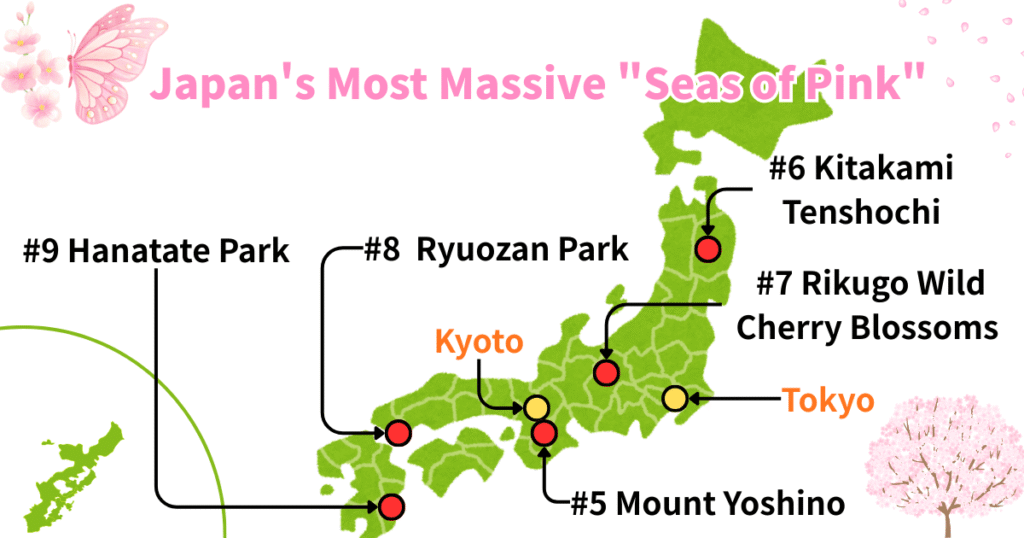
If you want to witness a “sea of pink” that stretches as far as the eye can see, this section is for you. These spots are world-famous for their overwhelming scale, offering a level of breathtaking intensity that you won’t find anywhere else. You can enjoy the amazing view of thousands of cherry blossoms blooming all at once during the peak spring season.
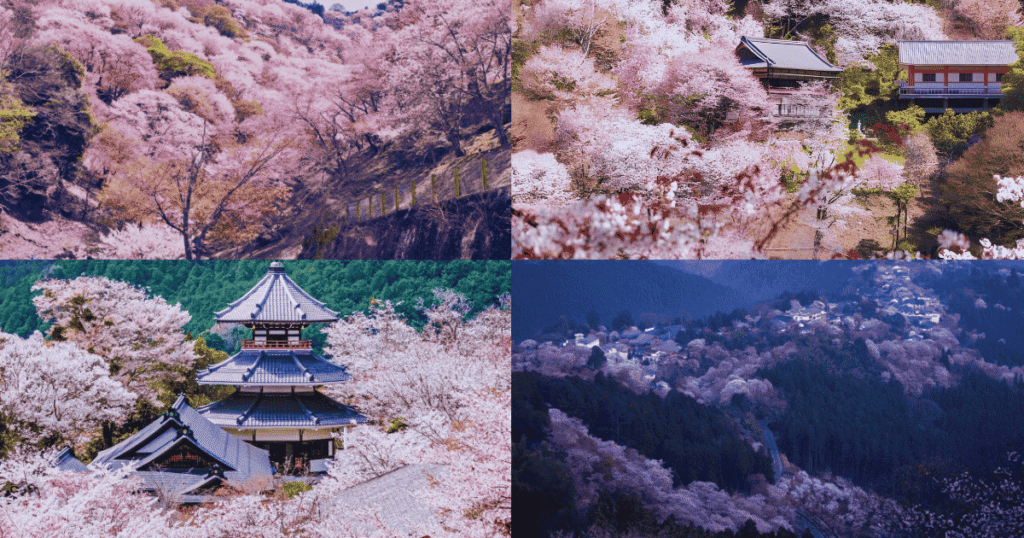
– Photo: No.5 Mount Yoshino –
- Number of Trees: Approx. 30,000
- Access: Ropeway or walking from Yoshino Station on the Kintetsu Line (Total: approx. 1 hour 45 mins from JR Kyoto Station)
- Best Time: Early Apr to Mid-Apr
- Location: Yoshino Town, Nara [View on Google Maps]
- Description: The heart of the UNESCO World Heritage site “Sacred Sites and Pilgrimage Routes in the Kii Mountain Range.” The entire mountain is covered with 30,000 cherry trees, which bloom in stages starting from the base and gradually moving up to the peak.
- Number of Trees: Approx. 10,000
- Access: About 30 mins walk from JR Kitakami Station (Total: approx. 30 mins from JR Kitakami Station)
- Best Time: Mid-Apr to Late Apr
- Location: Kitakami City, Iwate [View on Google Maps]
- Description: A stunning 2km row of Yoshino cherry trees stretches along the Kitakami River, featuring about 10,000 trees in total. The night-time illumination is a must-see, as the blossoms reflect beautifully on the river’s surface.
- Number of Trees: Several thousand
- Access: About 20 mins by taxi from JR Akashina Station (Total: approx. 1 hour 30 mins from JR Nagano Station)
- Best Time: Mid-Apr to Late Apr
- Location: Omachi City, Nagano [View on Google Maps]
- Description: When spring arrives, wild cherry blossoms (Yamazakura) dot the entire mountainside in shades of pink. Visitors can enjoy a breathtaking 360-degree panoramic view of the natural landscape.
- Number of Trees: Approx. 10,000
- Access: About 1 hour by bus and walking from JR Onoda Station (Total: approx. 1 hour 5 mins from JR Asa Station)
- Best Time: Late Mar to Early Apr
- Location: Sanyo-Onoda City, Yamaguchi [View on Google Maps]
- Description: Facing the Seto Inland Sea, this park offers a magnificent 360-degree view where you can see the Kanmon Bridge, Shikoku, Kyushu, and the Kunisaki Peninsula. You can feel the refreshing spring air while walking through a “sakura tunnel” created by 10,000 cherry trees.
- Number of Trees: Approx. 10,000
- Access: About 15 mins by taxi from JR Kitago Station (Total: approx. 1 hour 35 mins from Miyazaki Airport)
- Best Time: Late Mar to Early Apr
- Location: Nichinan City, Miyazaki [View on Google Maps]
- Description: The entire mountain area is vividly covered by 10,000 cherry trees. With well-maintained walking paths, rest areas, and observation decks, it is an ideal spot for hiking and enjoying a peaceful walk in nature.
3. The Peak Bloom: Japan’s Golden Season of Sakura (Late March to Mid-April)
From late March to mid-April, Japan’s cherry blossoms reach their spectacular climax. As the central region—including major cities like Tokyo, Kyoto, and Osaka—is painted in shades of pink, the ways to enjoy them are endless. In this section, we present the best of this peak season through four unique perspectives: “Harmony with Nature,” “Majestic Ancient Trees,” “Historic Castles,” and “Traditional Culture.” Immerse yourself in the most passionate and breathtaking season of the year.
3-1. Late March to Mid-April: Stunning Harmony of Sakura and Nature (#10–#18)
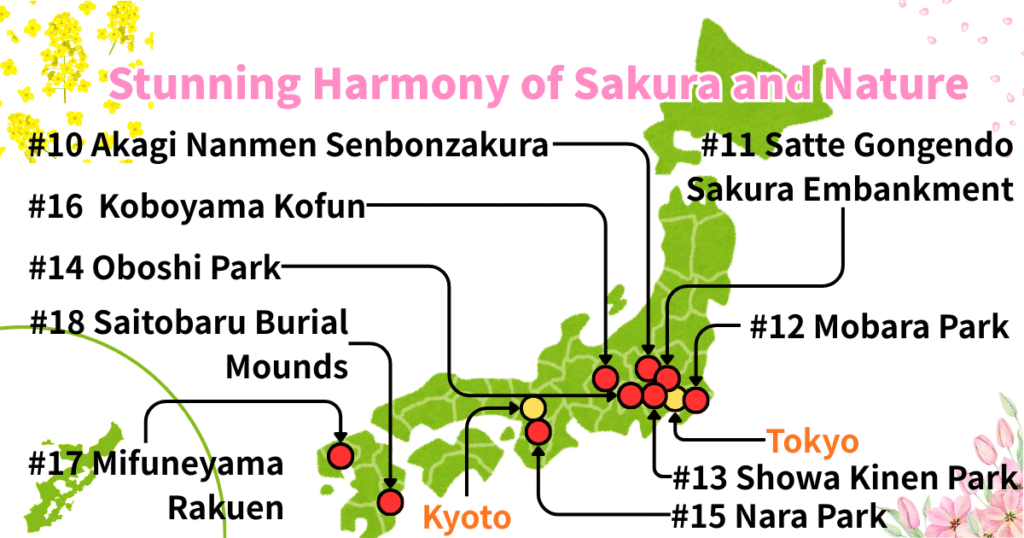
These locations offer more than just cherry blossoms. You can enjoy Japan’s beautiful nature, such as large parks, ancient tombs, and great ocean views. This section is ideal for those visiting in late March to early April.
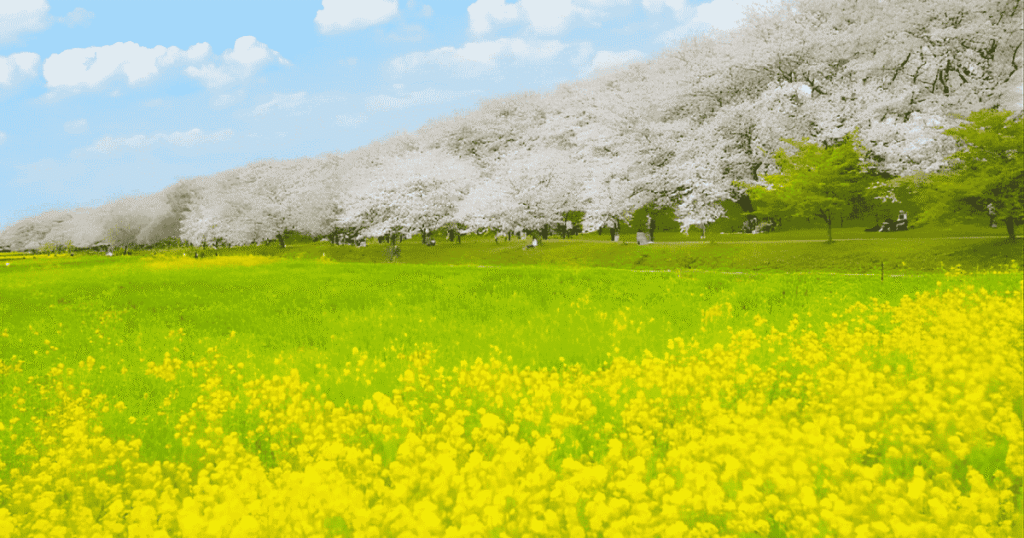
– Photo: No.11 Satte Gongedo Sakura Embankment –
- Number of Trees: Approx. 1,000
- Access: 20 mins by taxi from Ogo Station on the Jomo Electric Railway (Total: approx. 1 hour 20 mins from JR Takasaki Station)
- Best Time: Early Apr to Mid-Apr
- Location: Maebashi City, Gunma [View on Google Maps]
- Description: This 1.3km city road transforms into a stunning “sakura tunnel” at full bloom. The adjacent “Miyagi Senbonzakura Forest” also features moss phlox and canola flowers, offering an incredible floral density that is perfect for social media.
- Number of Trees: Approx. 1,000
- Access: 15 mins by bus and walking from Satte Station on the Tobu Railway (Total: approx. 55 mins from JR Omiya Station)
- Best Time: Early Apr to Early Apr
- Location: Satte City, Saitama [View on Google Maps]
- Description: A 1km tunnel of about 1,000 cherry trees runs alongside a vast field of canola flowers. The beautiful contrast between the soft pink of the sakura and the vibrant yellow of the canola flowers is the highlight of this park.
- Number of Trees: Approx. 2,850
- Access: 15 mins by bus and walking from JR Mobara Station (Total: approx. 55 mins from JR Chiba Station)
- Best Time: Late Mar to Early Apr
- Location: Mobara City, Chiba [View on Google Maps]
- Description: This nature-rich park features well-maintained walking paths where cherry blossoms surround Benten Lake. The harmony between the vermilion-colored Bentendo Temple reflected on the water and the surrounding pink blossoms is truly iconic.
- Number of Trees: Approx. 1,500
- Access: 15 min walk from JR Tachikawa Station (Total: approx. 55 mins from JR Tokyo Station)
- Best Time: Late Mar to Early Apr
- Location: Tachikawa City, Tokyo [View on Google Maps]
- Description: A park where various flowers bloom throughout the seasons. In spring, the combination of cherry blossoms and canola flowers across its vast grounds creates an incredibly vivid and colorful landscape.
- Number of Trees: Approx. 2,000
- Access: 10 mins by taxi from JR Kajikazawaguchi Station (Total: approx. 1 hour 10 mins from JR Shizuoka Station)
- Best Time: Late Mar to Early Apr
- Location: Fujikawa Town, Yamanashi [View on Google Maps]
- Description: Located on a mountainside, this park offers a panoramic view of the Kofu Basin. In spring, visitors can enjoy about 2,000 cherry trees set against the backdrop of the beautiful surrounding mountains.
- Number of Trees: Approx. 1,700
- Access: 10 min walk from Kintetsu-Nara Station (Total: approx. 45 mins from JR Kyoto Station)
- Best Time: Early Apr to Mid-Apr
- Location: Nara City, Nara [View on Google Maps]
- Description: A place where you can find the highlights of Japan tourism—wild deer, cherry blossoms, and Todai-ji Temple—all in one spot. It is a globally rare historical park where visitors can interact with 1,200 wild deer.
- Number of Trees: Approx. 4,000
- Access: 35 mins by bus and walking from JR Matsumoto Station (Total: approx. 1 hour 25 mins from JR Nagano Station)
- Best Time: Early Apr to Mid-Apr
- Location: Matsumoto City, Nagano [View on Google Maps]
- Description: One of the oldest burial mounds in eastern Japan, dating back to the 3rd or 4th century. About 4,000 cherry trees surround the mound, creating a sea of pink. From the top, you can enjoy a spectacular view of Matsumoto City and the Northern Alps through the blossoms.
- Number of Trees: Approx. 2,000
- Access: 5 mins by taxi from JR Takeo-Onsen Station (Total: approx. 5 mins from JR Takeo-Onsen Station)
- Best Time: Late Mar to Early Apr
- Location: Takeo City, Saga [View on Google Maps]
- Description: A vast garden covering 500,000 square meters that dates back to the late Edo period. In spring, 2,000 cherry trees line the pond, and it hosts one of the largest night-time sakura light-ups in Kyushu.
- Number of Trees: Approx. 2,000
- Access: 40 mins by bus and walking from JR Sadowara Station (Total: approx. 1 hour 5 mins from Miyazaki Airport)
- Best Time: Early Apr to Early Apr
- Location: Saito City, Miyazaki [View on Google Maps]
- Description: A historic site featuring 319 burial mounds built between the 3rd and 7th centuries. In spring, the collaboration between 2,000 cherry trees and 300,000 blooming canola flowers is a magnificent sight.
3-2. Early to Mid-April: Behold the Majestic Ancient Single Trees (#19–#23)
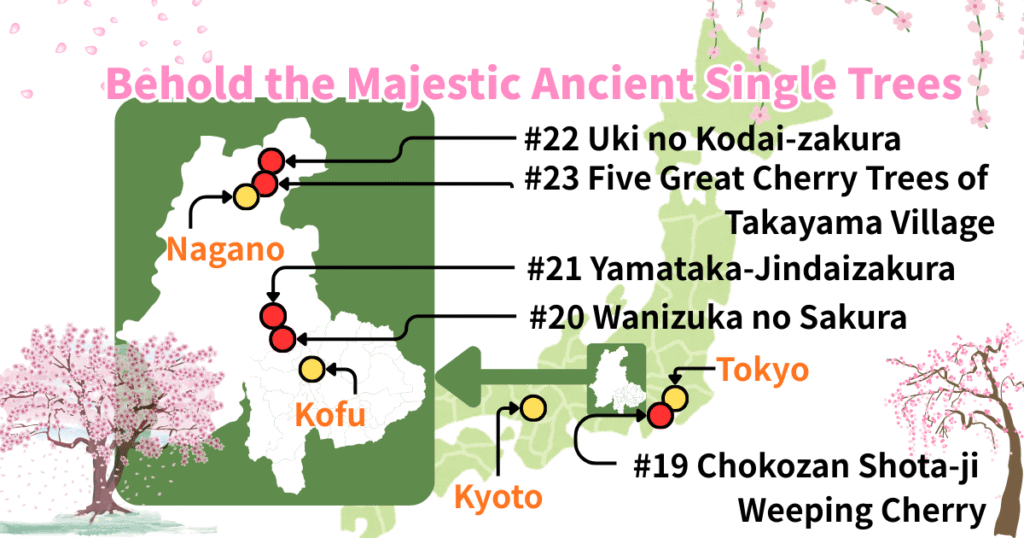
Some cherry trees in Japan are hundreds or even thousands of years old. These “ancient trees” have a very special and powerful atmosphere. If you want to feel the long history of Japan through a single, majestic tree in April, visit these spots.
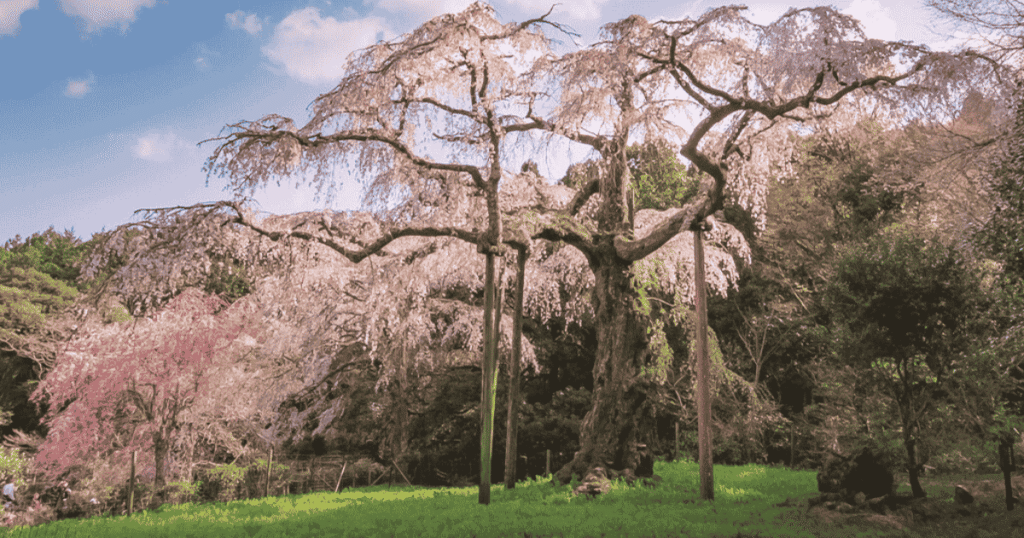
– Photo: No.19 Chokozan Shota-ji Weeping Cherry –
- Age of Tree: Approx. 350 years
- Access: 20 min walk from Iriuda Station on the Hakone Tozan Railway (Total: approx. 30 mins from JR Odawara Station)
- Best Time: Late Mar to Early Apr
- Location: Odawara City, Kanagawa [View on Google Maps]
- Description: Standing about 13m tall, this 350-year-old weeping cherry tree is a sight to behold. It blooms in an open area within the mountains, where a nearby tea house allows visitors to sit and enjoy the majestic view at a leisurely pace.
- Age of Tree: Approx. 330 years
- Access: 20 mins by bus and walking from JR Nirasaki Station (Total: approx. 35 mins from JR Kofu Station)
- Best Time: Early Apr to Early Apr
- Location: Nirasaki City, Yamanashi [View on Google Maps]
- Description: A 300-year-old tree standing in an open field, famous as a filming location for many TV dramas and commercials. The collaboration of the cherry blossoms with Mt. Yatsugatake or Mt. Fuji attracts many photographers. The changing scenes at sunset, under night-time illumination, and beneath a starry sky are also must-sees.
- Age of Tree: Approx. 2,000 years
- Access: 15 mins by taxi from JR Hinoharu Station (Total: approx. 45 mins from JR Kofu Station)
- Best Time: Early Apr to Early Apr
- Location: Hokuto City, Yamanashi [View on Google Maps]
- Description: Located on the grounds of Jisso-ji Temple, this is Japan’s oldest cherry tree and a National Natural Treasure. With an estimated age of 2,000 years, its massive scale—standing 10.3m tall with a trunk circumference of nearly 11.8m—is truly overwhelming.
- Age of Tree: 100 to 850 years
- Access: 35 min walk from Yomase Station on the Nagano Electric Railway (Total: approx. 1 hour 40 mins from JR Nagano Station)
- Best Time: Early Apr to Mid-Apr
- Location: Yamanouchi Town, Nagano [View on Google Maps]
- Description: An extraordinary area where five famous ancient trees, ranging from 100 to 850 years old, are dotted throughout a single village. Collectively known as the “Ancient Cherry Trees of Uki,” they can be toured on foot in about an hour on a pleasant day.
- Age of Tree: Up to 600 years
- Access: 20–40 mins by bus and walking from Suzaka Station (Total: approx. 45 mins to 1 hour from JR Nagano Station)
- Best Time: Mid-Apr to Mid-Apr
- Location: Takayama Village, Nagano [View on Google Maps]
- Description: Takayama is known as the “Village of Weeping Cherry Trees,” with over 20 such trees, half of which are more than 200 years old. The most ancient is estimated to be 600 years old, making the village a highly popular destination for photographers.
3-3. Late March to Mid-April: Historic Castles Surrounded by Sakura (#24–#30)
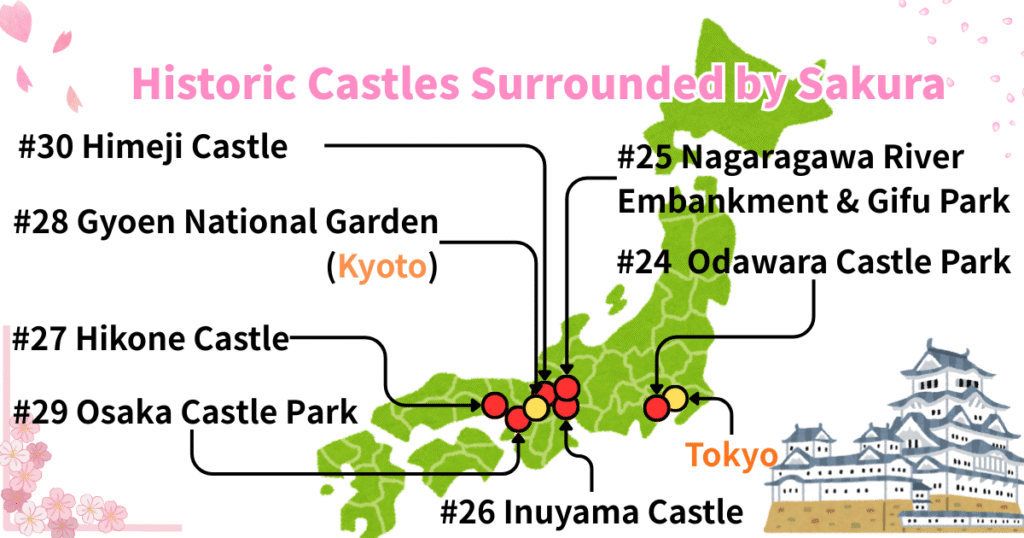
The combination of Japanese castles and cherry blossoms is the most popular view for many tourists. You can enjoy the beautiful contrast between white castle walls and pink flowers. This section is perfect for people who love Japanese history and architecture.
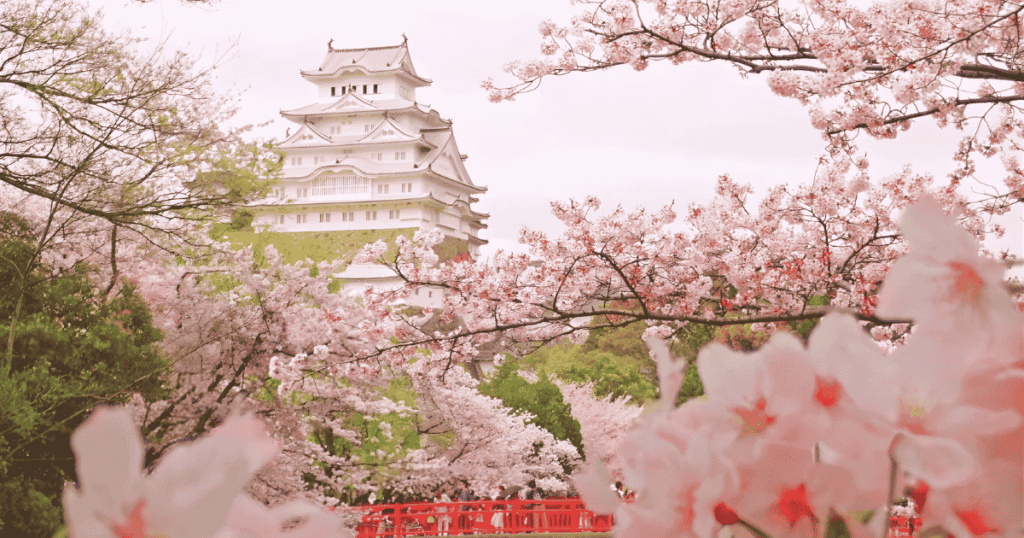
– Photo: No.30 Himeji Castle –
- Number of Trees: Approx. 300
- Access: 10 min walk from JR Odawara Station (Total: approx. 10 mins from JR Odawara Station)
- Best Time: Late Mar to Early Apr
- Location: Odawara City, Kanagawa [View on Google Maps]
- Description: A park featuring the majestic castle tower. Approximately 300 cherry trees surround the main tower and the moats, adding a brilliant touch of color to the historic fortifications.
- Number of Trees: Approx. 400
- Access: 40 mins by bus and walking from Meitetsu Gifu Station (Total: approx. 1 hour 20 mins from JR Gifu-Hashima Station)
- Best Time: Early Apr to Early Apr
- Location: Gifu City, Gifu [View on Google Maps]
- Description: Located at the foot of the mountain where Gifu Castle stands, this area along the Nagara River is a prime sakura spot. It is close to the Gifu City Museum of History and the Museum of Fine Arts, Gifu. In early April, the historic “Dosan Festival” is held in the city center.
- Number of Trees: Approx. 400
- Access: 15 min walk from Inuyamayuen Station on the Meitetsu Line (Total: approx. 45 mins from JR Nagoya Station)
- Best Time: Early Apr to Early Apr
- Location: Inuyama City, Aichi [View on Google Maps]
- Description: A beautiful spot where a designated National Treasure castle is surrounded by blooming cherry blossoms. On the first Saturday and Sunday of April, the Inuyama Festival (a UNESCO Intangible Cultural Heritage) takes place, featuring the parade of spectacular “Yama” floats.
- Number of Trees: Approx. 1,100
- Access: 15 min walk from JR Hikone Station (Total: approx. 20 mins from JR Maibara Station)
- Best Time: Early Apr to Early Apr
- Location: Hikone City, Shiga [View on Google Maps]
- Description: The cherry blossoms reflecting on the surface of the double moats and against the white walls of the castle turrets are breathtakingly beautiful.
- Number of Trees: Approx. 1,000
- Access: 10 min walk from Imadegawa Subway Station (Total: approx. 20 mins from JR Kyoto Station)
- Best Time: Late Mar to Early Apr
- Location: Kyoto City, Kyoto [View on Google Maps]
- Description: The former residence of the Japanese Emperors. The nearby Kyoto State Guest House is also open for tours (advance reservation required). Different varieties of cherry blossoms bloom here throughout March and April.
- Number of Trees: Approx. 3,000
- Access: Short walk from JR Osakajokoen Station (Total: approx. 15 mins from JR Shin-Osaka Station)
- Best Time: Early Apr to Early Apr
- Location: Osaka City, Osaka [View on Google Maps]
- Description: A stunning location where the massive castle tower, stone walls, and moats harmonize with cherry blossoms. You can experience looking up at the flowers from a “Gozabune” (traditional boat) in the moat. The illuminated tower and blossoms create a magical scene from late March to early April.
- Number of Trees: Approx. 1,000
- Access: 20 min walk from JR Himeji Station (Total: approx. 20 mins from JR Himeji Station)
- Best Time: Early Apr to Early Apr
- Location: Himeji City, Hyogo [View on Google Maps]
- Description: A UNESCO World Heritage site where the brilliant white castle and pink blossoms create a perfect match. The adjacent Himeji City Museum of Art (a historic red-brick building) houses a world-class collection of Belgian Symbolism and sculptures by the renowned artist Richard Serra.
3-4. Late March to Mid-April: Traditional Temples and Cultural Heritage (#31–#38)
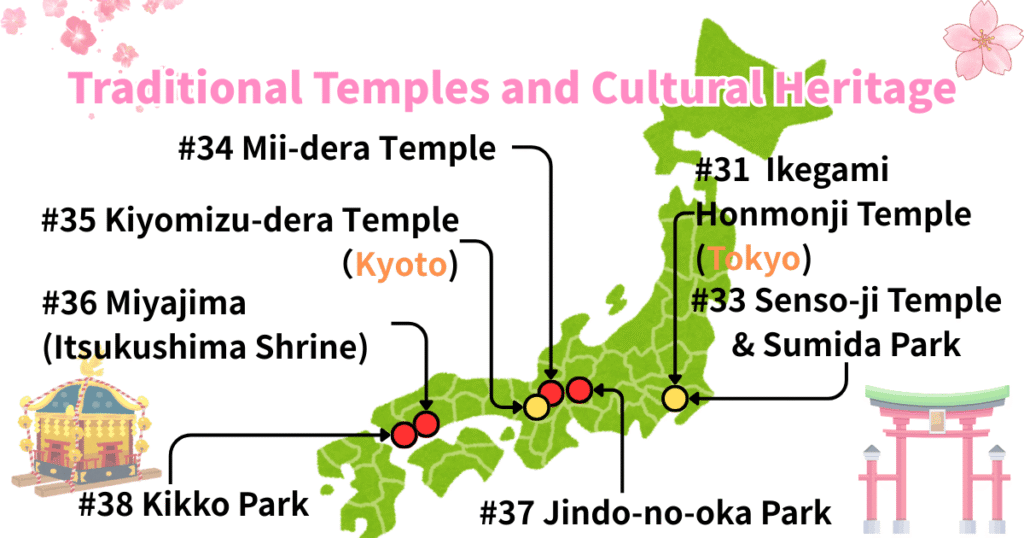
This section introduces cherry blossoms at famous temples, shrines, and historic townscapes. In Japan, looking at cherry blossoms is more than just a picnic; it is a deep cultural tradition. You can experience the spiritual side of Japanese spring here.
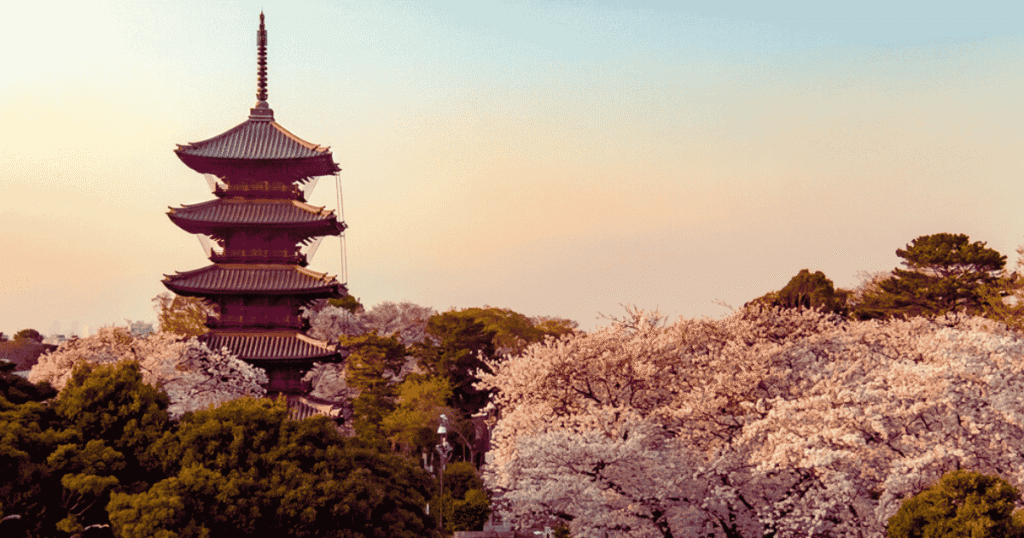
– Photo: No.31 Ikegami Honmonji Temple –
- Number of Trees: Approx. 400
- Access: 10 min walk from Ikegami Station on the Tokyu Ikegami Line (Total: approx. 30 mins from JR Shinagawa Station)
- Best Time: Late Mar to Early Apr
- Location: Ota City, Tokyo [View on Google Maps]
- Description: Stroll under a canopy of cherry blossoms around the Five-Story Pagoda and enjoy the view from the observation deck. A permanent live camera allows you to check the blooming status in real-time.
- Live Camera: 池上本門寺Now!
- Number of Trees: Approx. 1,000
- Access: 20 min walk from JR Omiya Station (Total: approx. 20 mins from JR Omiya Station)
- Best Time: Late Mar to Early Apr
- Location: Saitama City, Saitama [View on Google Maps]
- Description: Located adjacent to Hikawa Shrine. The park houses the Saitama Prefectural Museum of History and Folklore, which exhibits National Treasures, including swords, ancient documents, and folk artifacts.
- Number of Trees: Approx. 1,000
- Access: 5 min walk from Asakusa Subway Station (Total: approx. 15 mins from JR Ueno Station)
- Best Time: Early Apr to Early Apr
- Location: Taito City, Tokyo [View on Google Maps]
- Description: Located near the famous Senso-ji Temple, about 1,000 cherry trees line both banks of the Sumida River. It is a perfect spot to photograph the Tokyo Skytree and cherry blossoms together, and viewing from a Yakatabune boat is also popular.
- Number of Trees: Approx. 1,300
- Access: 20 min walk from JR Otsukyo Station (Total: approx. 30 mins from JR Kyoto Station)
- Best Time: Early Apr to Early Apr
- Location: Otsu City, Shiga [View on Google Maps]
- Description: Built on a slope overlooking Lake Biwa and the city of Otsu. In spring, a special stage covered with acrylic boards creates a stunning reflection of the blossoms, which has become a popular subject for photography. The night-time illumination is one of the most magical spots in the Kansai region.
- Number of Trees: Approx. 1,500
- Access: 30 mins by bus and walking from JR Kyoto Station (Total: approx. 30 mins from JR Kyoto Station)
- Best Time: Early Apr to Early Apr
- Location: Kyoto City, Kyoto [View on Google Maps] Description: A UNESCO World Heritage site and a massive piece of wooden architectural art. The cherry blossoms surrounding the famous main hall are breathtaking. The Kyoto National Museum is also located nearby.
- Number of Trees: Approx. 1,900
- Access: 25 mins by ferry and walking from JR Miyajimaguchi Station (Total: approx. 55 mins from JR Hiroshima Station)
- Best Time: Early Apr to Early Apr
- Location: Hatsukaichi City, Hiroshima [View on Google Maps]
- Description: A beautiful scene featuring the iconic Torii gate of the UNESCO World Heritage site Itsukushima Shrine and cherry blossoms blooming along the mountainside.
- Number of Trees: Approx. 1,000
- Access: 30 mins by taxi from JR Kani Station (Total: approx. 1 hour 30 mins from JR Nagoya Station)
- Best Time: Late Mar to Early Apr
- Location: Yaotsu Town, Gifu [View on Google Maps]
- Description: Built to honor Chiune Sugihara, the Japanese diplomat known for “Visas for Life.” If the blossoms coincide with the second Sunday of April (April 12, 2026) and the day before, you can also experience a 300-year-old festival featuring massive, boat-shaped festival floats parading through the town.
- Number of Trees: Approx. 1,500
- Access: 20 mins by bus and walking from JR Shin-Iwakuni Station (Total: approx. 20 mins from JR Shin-Iwakuni Station)
- Best Time: Early Apr to Early Apr
- Location: Iwakuni City, Yamaguchi [View on Google Maps]
- Description: A prime location to photograph a rare wooden arch bridge through the cherry blossoms. The collaboration between the National Scenic Spot, Kintai Bridge, and about 1,500 cherry trees is magnificent. Lanterns are lit from sunset until 10 PM for night viewing.
4. Mid to Late April: Chasing the Peak in Northern Japan (#39–#44)
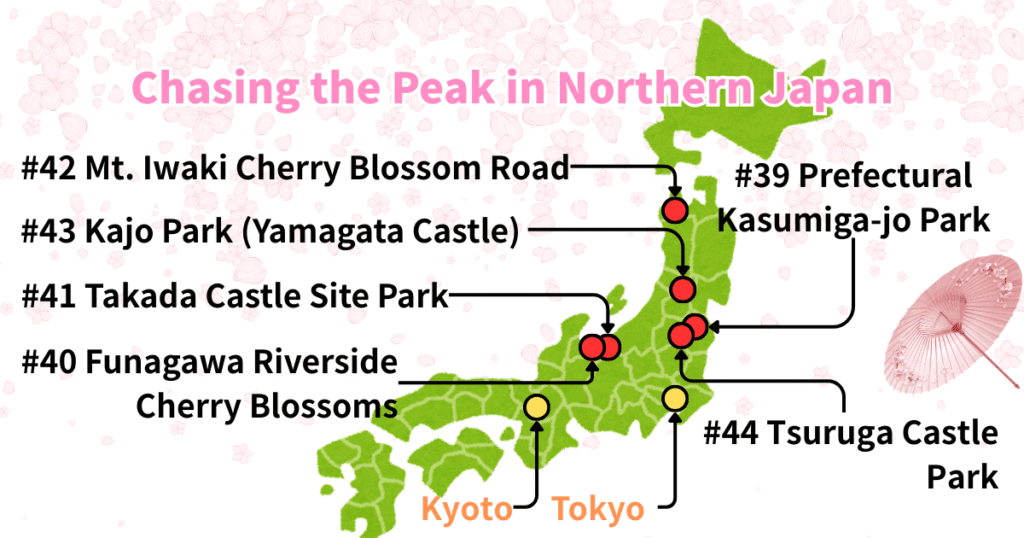
Did you miss the cherry blossoms in Tokyo? Don’t worry! If you travel north or to higher areas in mid-April, you can still find beautiful blossoms. This section is for people who arrive in Japan a little later than the peak season in central cities.
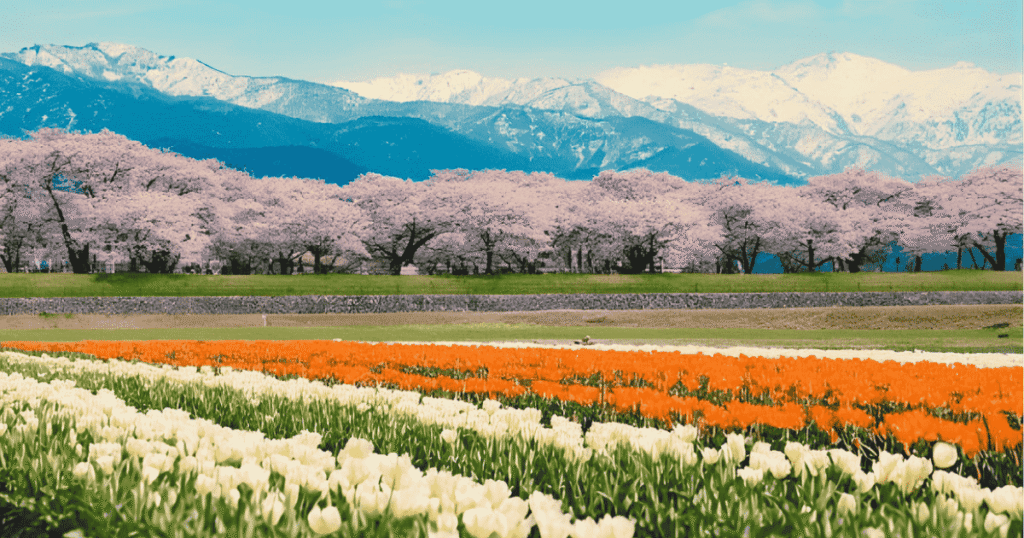
– Photo: No.40 Funagawa Riverside Cherry Blossoms –
- Number of Trees: Approx. 4,500
- Access: 20 min walk from JR Nihonmatsu Station (Total: approx. 45 mins from JR Koriyama Station)
- Best Time: Mid-Apr to Mid-Apr
- Location: Nihonmatsu City, Fukushima [View on Google Maps]
- Description: About 4,500 cherry trees cover the entire castle site. The park’s name, “Kasumiga-jo” (Mist Castle), comes from the way the blooming blossoms envelop the ruins like a pink mist.
- Number of Trees: Approx. 280
- Access: 20 mins by taxi from JR Kurobe-Unazukionsen Station (Total: approx. 20 mins from JR Kurobe-Unazukionsen Station)
- Best Time: Mid-Apr to Mid-Apr
- Location: Asahi Town, Toyama [View on Google Maps]
- Description: Experience the “Spring Quartet”—a breathtaking collaboration of pink cherry blossoms, colorful tulips, and yellow canola flowers, all set against the majestic backdrop of the snow-capped Northern Alps.
- Number of Trees: Approx. 4,000
- Access: 20 min walk from Takada Station on the Echigo Tokimeki Railway (Total: approx. 30 mins from JR Joetsu-Myoko Station)
- Best Time: Mid-Apr to Mid-Apr
- Location: Joetsu City, Niigata [View on Google Maps]
- Description: Famous for the view of 4,000 cherry trees reflected beside the castle’s three-story turret. The park also features the former residence and museum of Kokei Kobayashi, a world-renowned artist known as the “Rousseau of the East.”
- Number of Trees: Approx. 6,500
- Access: 1 hour by bus and walking from JR Hirosaki Station (Total: approx. 1 hour 40 mins from JR Shin-Aomori Station)
- Best Time: Mid-Apr to Mid-Apr
- Location: Hirosaki City, Aomori [View on Google Maps]
- Description: A spectacular 20km-long road lined with approximately 6,500 Oyama-zakura (wild cherry trees). Thanks to the difference in altitude, the bloom starts at the lower Hyakuzawa area and moves up the mountain.
- Number of Trees: Approx. 1,500
- Access: 10 min walk from JR Yamagata Station (Total: approx. 10 mins from JR Yamagata Station)
- Best Time: Mid-Apr to Late Apr
- Location: Yamagata City, Yamagata [View on Google Maps]
- Description: The site of Yamagata Castle, featuring massive ancient trees over 600 years old. Adjacent to the park is the Yamagata Museum of Art, which houses a permanent collection of world masters like Monet, Renoir, and Picasso. During the peak bloom weekend, the “Kajo Kan-o-kai” event features elegant tea ceremonies.
- Number of Trees: Approx. 1,000
- Access: 30 mins by bus and walking from JR Aizu-Wakamatsu Station (Total: approx. 1 hour 40 mins from JR Koriyama Station)
- Best Time: Mid-Apr to Late Apr
- Location: Aizu-Wakamatsu City, Fukushima [View on Google Maps]
- Description: About 1,000 cherry trees of various species bloom at different times around the castle. The park houses the Aizu-Wakamatsu City Museum and is adjacent to the Fukushima Prefectural Museum (History and Art). The night-time illumination creates a truly magical atmosphere.
5. Late April to May: The Final Sakura Frontier in Hokkaido and Beyond (#45–#50)
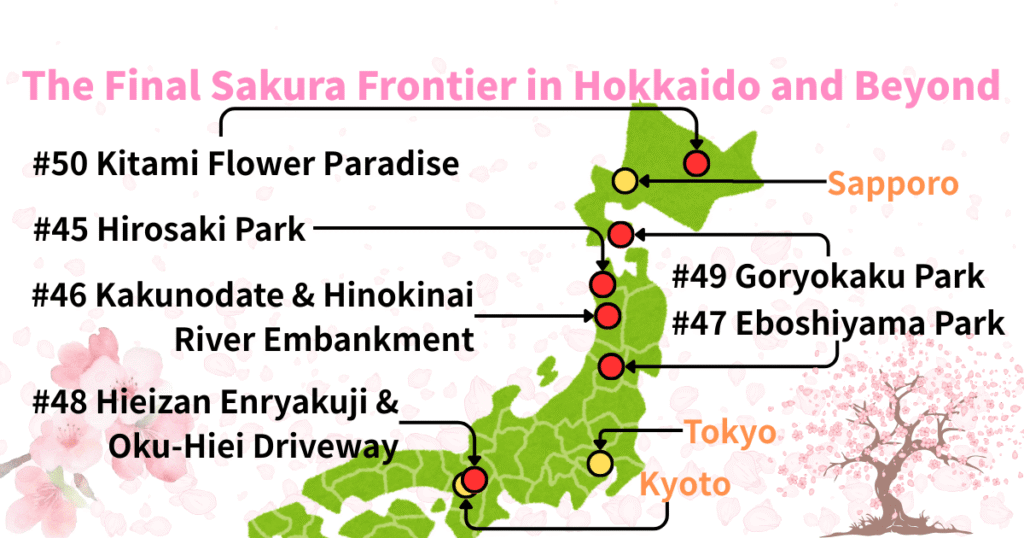
If you visit Japan in late April or May, head to northern Japan or Hokkaido. This final section introduces spots where spring arrives the latest. You can enjoy the last cherry blossoms of the year even during the Golden Week holidays.
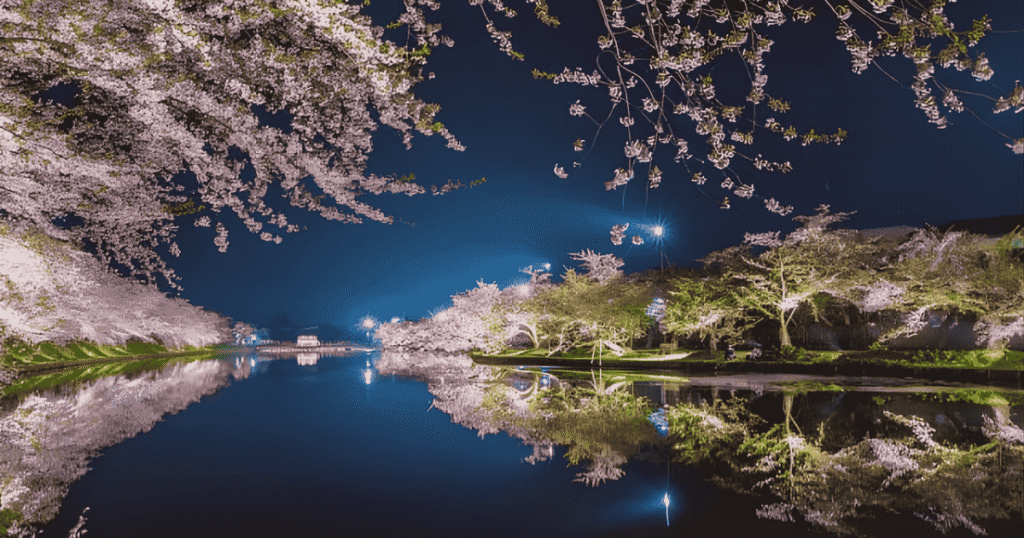
– Photo: No.45 Hirosaki Park –
- Number of Trees: Approx. 2,600
- Access: 15 mins by bus and walking from JR Hirosaki Station (Total: approx. 45 mins from JR Shin-Aomori Station)
- Best Time: Late Apr to Late Apr
- Location: Hirosaki City, Aomori [View on Google Maps]
- Description: A representative spot for Japanese cherry blossoms, famous for the “Hana-ikada” (flower carpet) that dyes the castle moats pink. It is home to over 400 Yoshino cherry trees that are more than 100 years old. There are also several art spots located in the vicinity.
- Number of Trees: Approx. 450
- Access: 20 min walk from JR Kakunodate Station (Total: approx. 20 mins from JR Kakunodate Station)
- Best Time: Late Apr to Late Apr
- Location: Semboku City, Akita [View on Google Maps]
- Description: The Samurai District is a designated Important Preservation District for Groups of Traditional Buildings. Among the weeping cherry trees here, 162 are designated as National Natural Treasures, many of which were planted 350 years ago. The contrast between the black wooden fences and the weeping blossoms creates an elegant Edo-period atmosphere.
- Number of Trees: Approx. 1,000
- Access: 20 min walk or 5 mins by taxi from JR Akayu Station (Total: approx. 5–20 mins from JR Akayu Station)
- Best Time: Late Apr to Late Apr
- Location: Nanyo City, Yamagata [View on Google Maps]
- Description: A park located within the grounds of Eboshiyama Hachiman-gu Shrine. From mid to late April, visitors can experience traditional lion dance performances (Shishimai) and the lively “Akayu Onsen Sakura Festival.”
- Number of Trees: Approx. 1,000
- Access: 30 mins by cable car and walking from JR Hieizan-Sakamoto Station (Total: approx. 45 mins from JR Kyoto Station)
- Best Time: Late Apr to Early May
- Location: Otsu City, Shiga [View on Google Maps]
- Description: A UNESCO World Cultural Heritage site. Architectural religious art, including the National Treasure Konpon Chudo, is scattered throughout the mountain. Due to the high altitude, about 1,000 Yaezakura (double-layered cherry blossoms) can be enjoyed from late April to early May.
- Number of Trees: Approx. 1,500
- Access: 30 mins by bus and walking from JR Goryokaku Station (Total: approx. 40 mins from JR Shin-Hakodate-Hokuto Station)
- Best Time: Early May to Early May
- Location: Hakodate City, Hokkaido [View on Google Maps]
- Description: Approximately 1,500 Yoshino cherry trees line the perimeter of this star-shaped fort. From the adjacent Goryokaku Tower, you can enjoy a complete view of the star tinted in beautiful pink.
- Number of Trees: Approx. 1,000
- Access: 1 hour 50 mins by bus and walking from Memanbetsu Airport (Total: approx. 1 hour 50 mins from Memanbetsu Airport)
- Best Time: Early May to Early May
- Location: Kitami City, Hokkaido [View on Google Maps]
- Description: A vast 28-hectare mountainside park perfect for hiking. In early May, the Ezo-yamazakura (wild cherry blossoms) and Ezo-murasaki-tsutsuji (azaleas) reach full bloom, followed by tulips and patches of moss phlox.
6. FAQ: Where is Cherry Blossom in Japan Now?
Q1: I’m in Japan right now (early April). Where is the best place to see sakura?
A1: During early April, central Japan including Kyoto, Osaka, and Tokyo is usually at its peak. To find the best historic and nature spots, please check the categories under Section 3 (3-1 to 3-4), which cover everything from majestic castles to scenic natural parks.
Q2: It’s already May. Is there any cherry blossom left in Japan now?
A2: Yes! Head north to Hokkaido. Goryokaku Park in Hakodate (#49) and Hirosaki Park in Aomori (#45) are famous for their beautiful late blossoms in May.
Q3: How do weather conditions affect where blossoms are now?
A3: Warm weather can speed up the bloom, while cold snaps can delay it. Always check the “Best Time” in this guide and cross-reference with real-time bloom forecasts.
7. Conclusion
“Where is cherry blossom in Japan now?”—the answer moves from south to north as the months progress. Whether you are visiting in the heart of spring or late May, Japan offers a diverse range of sakura experiences. Use this guide to find the perfect blooming spot for your current travel dates.