(Updated March 24, 2026)
If you are wondering what time of the year is cherry blossom season in Japan, you are not alone. Seeing the Japan cherry blossoms is a dream for many, but planning your trip can be a difficult puzzle to solve. You might be asking, “When is the full bloom?” “Am I too late for the Sakura?” or “Where should I book my hotel to see the flowers?”
As a photographer who follows the weather and cherry blossom blooming dates every year, I have some special advice for you. The secret to a perfect Sakura trip is not finding a better forecast—it is having a better strategy. Our guide uses real-time data and official 2026 actual blooming dates from the Japan Meteorological Agency (JMA) to explain why “flexibility” is the key to your schedule. Additionally, a detailed FAQ is included to help you enjoy the 2026 cherry blossom season to the fullest.
Table of Contents
Toggle1. Understanding the Sakura Rhythm: "Opening" vs. "Full Bloom"
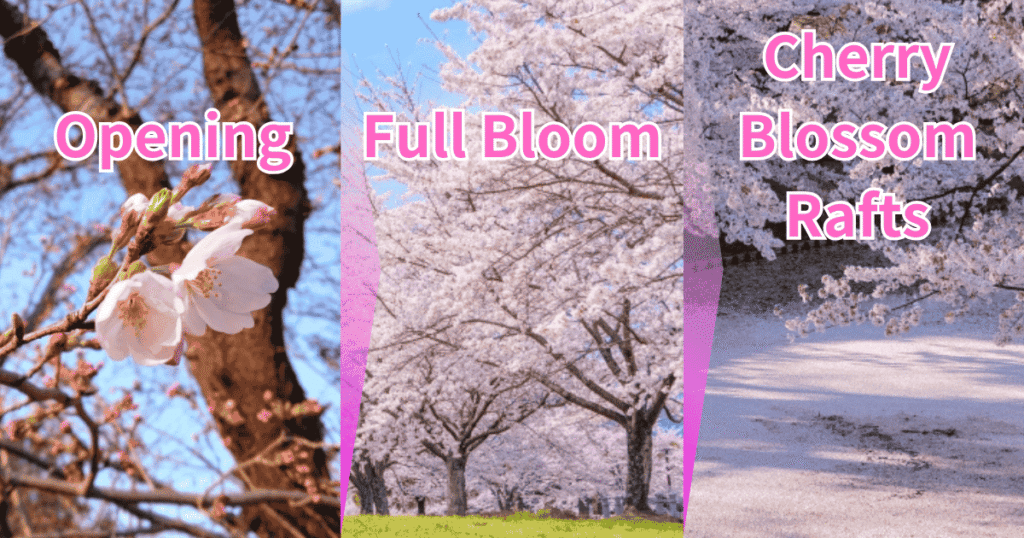
Before you look at dates, you must understand two important terms used in Japan:
- Kaika (Opening): The official start of the season. It means 5–6 flowers have opened on a specific tree. From a distance, the trees still look mostly brown.
- Mankai (Full Bloom): This is the “peak.” About 80% or more of the flowers are open. Parks look like they are covered in pink clouds.
Usually, it takes 7 to 10 days to go from Opening to Full Bloom. After that, you have about 5 to 7 days to see them before the petals fall—unless it rains.
Need more details on the timeline?
If you’re worried about missing the peak, check out our in-depth guide: How Long Do Japan’s Cherry Blossoms Last? (The 7-Day Rule Explained). It explains exactly how many days you have from the first bud to the “Sakura blizzard.”
2. 2026 Sakura Watch: Forecasts vs. Actual Blooming Dates
Why is it so hard to predict? Our analysis shows that Sakura depends on two things: a cold winter and a warm spring. If the weather changes, the dates can shift by weeks.
LATEST UPDATE: March 2026 Forecast
According to the most recent data (updated mid-March 2026), the Sakura season is arriving much earlier than average due to an exceptionally warm late February and early March.
Here are the currently predicted dates for the 2026 First Bloom (Kaika):
| City | Kaika (Opening) | Difference from Average | Mankai (Full Bloom) | Difference from Average | Average First Bloom |
|---|---|---|---|---|---|
| Sapporo | Pred:Apr 25 Actual:— |
-6 days (Earlier) | Pred:Apr 28 Actual:— |
-8 days | May 1 |
| Aomori | Pred:Apr 18 Actual:— |
-4 days (Earlier) | Pred:Apr 22 Actual:— |
-4 days | Apr 22 |
| Sendai | Pred:Apr 3 Actual:— |
-5 days (Earlier) | Pred:Apr 8 Actual:— |
-5 days | Apr 8 |
| Tokyo | Pred:Mar 19 ✅Actual:Mar 19 |
-5 days (Earlier) | Pred:Mar 27 Actual:— |
-4 days | Mar 24 |
| Kanazawa | Pred:Apr 1 Actual:— |
-2 days (Average) | Pred:Apr 6 Actual:— |
-2 days | Apr 3 |
| Nagano | Pred:Apr 4 Actual:— |
-7 days (Much Earlier) | Pred:Apr 10 Actual:— |
-6 days | Apr 11 |
| Nagoya | Pred:Mar 17 ✅Actual:Mar 17 |
-7 days (Much Earlier) | Pred:Mar 28 Actual:— |
-5 days | Mar 24 |
| Kyoto | Pred:Mar 23 ✅Actual:Mar 23 |
-3 days (Earlier) | Pred:Apr 1 Actual:— |
-3 days | Mar 26 |
| Osaka | Pred:Mar 24 ✅Actual:Mar 26 |
-3 days (Earlier) | Pred:Mar 31 Actual:— |
-4 days | Mar 27 |
| Wakayama | Pred:Mar 26 ✅Actual:Mar 24 |
+2 days (Average) | Pred:Apr 3 Actual:— |
0 days | Mar 24 |
| Hiroshima | Pred:Mar 21 ✅Actual:Mar 19 |
-4 days (Earlier) | Pred:Mar 30 Actual:— |
-4 days | Mar 25 |
| Kochi | Pred:Mar 19 ✅Actual:Mar 16 |
-3 days (Earlier) | Pred:Mar 27 Actual:— |
-3 days | Mar 22 |
| Fukuoka | Pred:Mar 20 ✅Actual:Mar 24 |
-2 days (Average) | Pred:Mar 29 Actual:— |
-2 days | Mar 22 |
| Kagoshima | Pred:Mar 26 ✅Actual:Mar 27 |
0 days (Average) | Pred:Apr 6 Actual:— |
+1 day | Mar 26 |
- Note: Full bloom (Mankai) typically occurs about 7–10 days after these dates.
- ⚠️Important: If you are visiting Tokyo or Nagoya, prepare for peak viewing as early as March 25th!
- How to read this table:
Pred: Predicted date based on the latest forecast.
✅Actual: Official date announced by the Japan Meteorological Agency (JMA).
“—”: We are still waiting for the flowers to open. Check back daily!
Historical Data Table & 15-Day Gap Explanation
Look at how much the dates change every year:
| City | 2021 | 2022 | 2023 | 2024 | 2025 | Average |
|---|---|---|---|---|---|---|
| Tokyo | Mar 14 | Mar 20 | Mar 14 | Mar 29 | Mar 24 | Mar 24 |
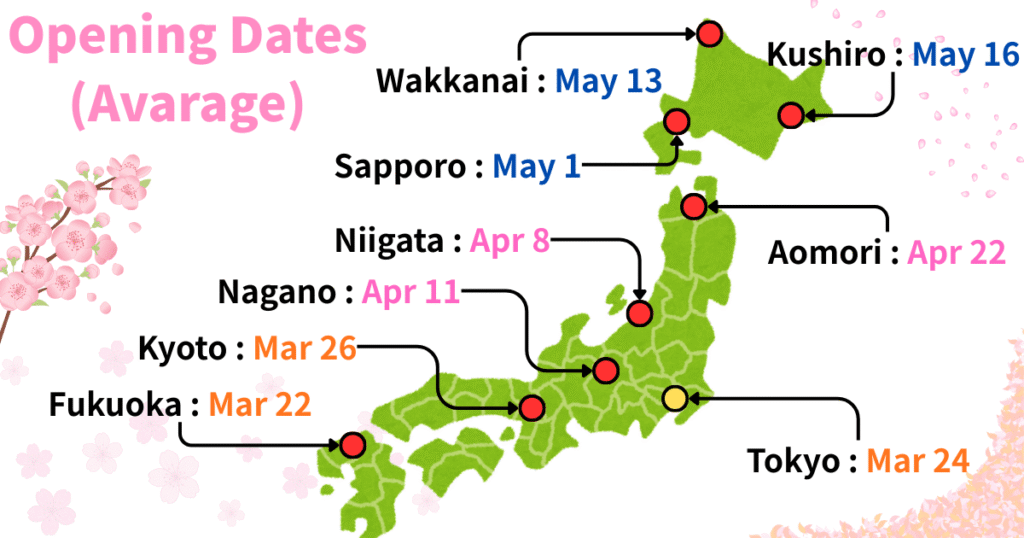
| Wakkanai | May 8 | May 6 | May 3 | May 1 | May 7 | May 13 |
| Kushiro | May 8 | May 8 | May 1 | May 3 | May 7 | May 16 |
| Sapporo | Apr 22 | Apr 23 | Apr 15 | Apr 18 | Apr 23 | May 1 |
| Aomori | Apr 13 | Apr 16 | Apr 7 | Apr 15 | Apr 17 | Apr 22 |
| Niigata | Mar 29 | Apr 8 | Mar 27 | Apr 6 | Apr 6 | Apr 8 |
| Nagano | Mar 29 | Apr 9 | Mar 28 | Apr 8 | Apr 8 | Apr 11 |
| Kyoto | Mar 16 | Mar 24 | Mar 17 | Mar 29 | Mar 27 | Mar 26 |
| Fukuoka | Mar 12 | Mar 17 | Mar 18 | Mar 27 | Mar 25 | Mar 22 |
Data Source: JMA
The “15-Day Gap”
Look at Tokyo. In 2021 and 2023, it opened on March 14th. In 2024, it was March 29th.
There is a 15-day difference! If you book a “non-refundable” hotel based on last year’s dates, you might miss the flowers completely.
3. How to Plan Your Flexible Cherry Blossom Strategy
I have chased Sakura for many years, and I have failed many times. Sometimes, I prepared everything, but it rained for three days straight. Nature does not follow our schedules, which is why our strategy focuses on a backup plan.
Our Advice for You:
Do Not Overplan: Choose the cities you want to stay in (like Tokyo or Osaka), but avoid filling every minute of your day. This gives you the freedom to change your destination if the bloom is early or late.
Leave “Open Days”: Keep 2–3 days completely empty in your itinerary. Having these “gap days” allows you to take a train to another city where the flowers are reaching their peak today.
Go to Colder Areas: If Tokyo is already finished, do not worry. Our recommendation is to head to mountainous areas (like Nagano) or the northern regions (Tohoku or Hokkaido). The temperature is lower there, so the Sakura usually bloom much later than in the big cities.
Case Study: Chasing Late Cherry Blossoms in Hakodate
If you are in Tokyo in early May and the cherry blossoms are already gone, don’t worry. With a JR Pass, you can take the Hokkaido Shinkansen to Hakodate for “0 yen” (at no extra cost)!
The Hayabusa Shinkansen is an all-reserved train. Fortunately, with a JR Pass, your seat reservation is also free. Just remember to book your seat at a ticket machine before you get on.
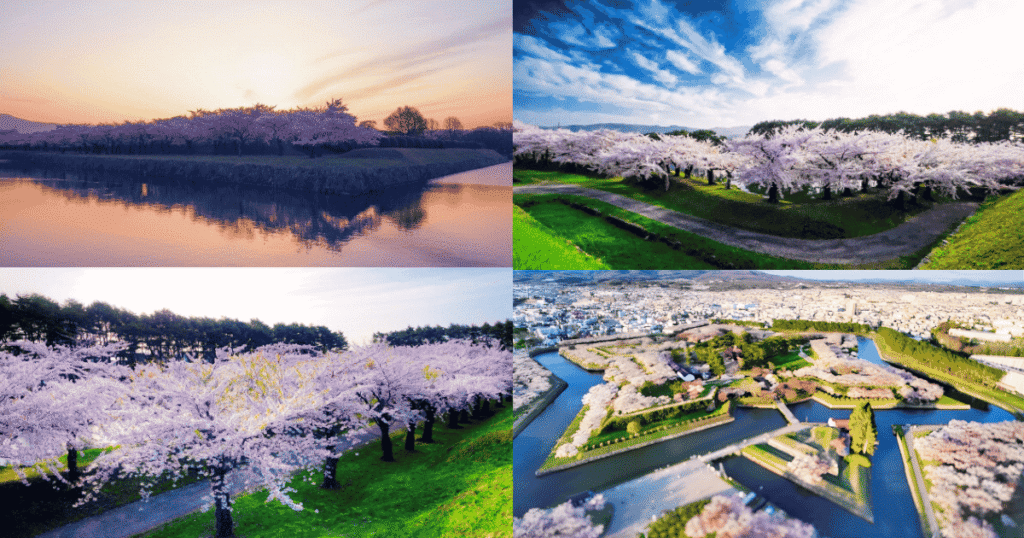
(A giant pink star: The stunning view of Goryokaku Fortress in Hakodate.)
2-Day “Sakura Rescue” Itinerary:
- Day 1: Tokyo to Hakodate (The Pink Sunset)
- Morning: Take the Hayabusa Shinkansen from Tokyo Station. In about 4 hours, you will cross under the sea and arrive in Hokkaido.
- Late Afternoon: Head to Goryokaku Tower. From 107 meters up, you can see the famous star-shaped fortress turned completely pink by 1,500 cherry trees.
- Sunset: Watching the pink star under the sunset is a magical view you will never forget.
- Day 2: Walking Under the Petals
- Morning: Walk inside Goryokaku Park. Experience the “Sakura Tunnel” and see the petals floating in the moat.
- Afternoon: Enjoy fresh seafood at the Hakodate Morning Market before taking the Shinkansen back south.
Is it worth it?
A round-trip ticket from Tokyo to Hakodate costs about ¥46,000. Since a 7-day JR Pass costs around ¥50,000, this one trip pays for almost the entire pass! If you plan to travel long distances by Shinkansen, the JR Pass is a great deal.
4. Top Tools to Track the Cherry Blossom Status in Real-Time
Do not rely only on global news. Use the same tools as the locals:
- WeatherNews (Sakura Ch.): This is the most famous weather site in Japan. It is based on thousands of local reports. You can use your browser’s “Translate” feature to check the latest information.
- Search Social Media: Go to Instagram or X (Twitter), search for a place (e.g., “Shinjuku Gyoen”), and look at the “Recent” posts. A photo from 2 hours ago will show you the real situation.
Our Real-Time Tracking Page:
We also maintain a dedicated, daily-updated page that simplifies data from multiple local sources into one easy-to-read map.
👉 Check the Status: Where are the Cherry Blossoms Blooming in Japan Right Now?
5. FAQ: Planning Your Cherry Blossom Trip
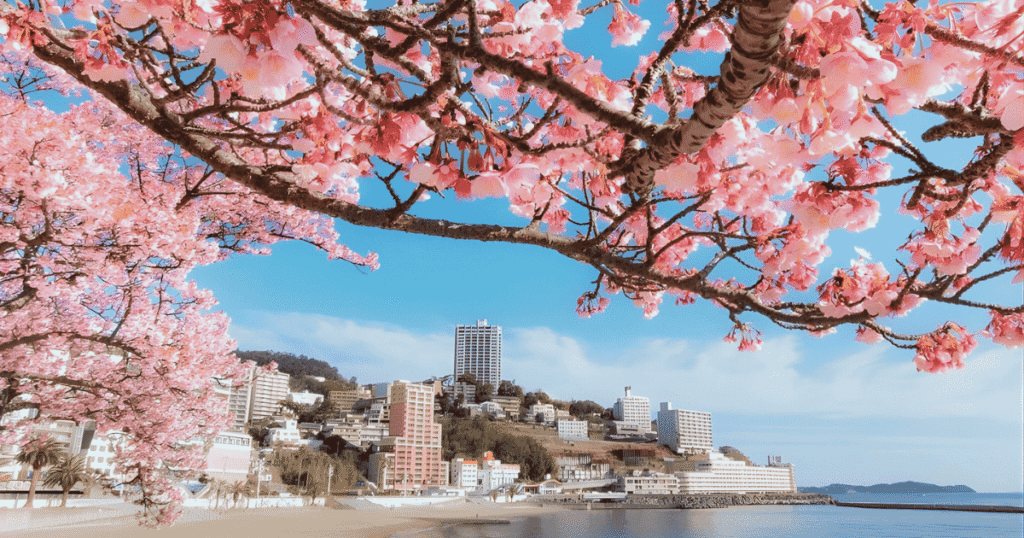
(Caption for image: Atami Sakura: Cherry blossoms that bloom in January)
Q: When is the best time to see Sakura?
A: Late March to early April is common for Tokyo and Kyoto. If you are traveling at a different time, try late January (Atami), late February (Kawazu), mid-April (Tohoku), or early May (Hokkaido).
Q: Can I see Sakura in May?
A: Yes! Hokkaido reaches its peak in early May. Also, there are several places in colder regions from Niigata to Aomori that peak in late April. Examples include Nikko, the Omachi and Iida areas in Nagano (near ski resorts), the Hakusan area in Ishikawa (near the mountains), Shokawa (near Shirakawa-go), and Mt. Hiei (famous for its temples).
Q: Should I buy a JR Pass?
A: If you stay in one area, it is usually cheaper to buy a “Regional Pass” or single tickets. However, if you plan to use the Shinkansen for long round trips to find Sakura, it can be a good deal.
Q: What if it rains during my trip?
A: Sakura flowers are very weak. If the flowers are at their peak and the forecast says “rain tomorrow,” go today. Do not wait. If you cannot go today, find a different spot where it is not raining tomorrow and change your schedule.
Q: How can I find “Hidden Gems” without crowds?
A: Instead of famous parks, look for “Ippon-zakura” (large, single trees) or ancient temples. These places are usually quiet and very peaceful. (Check our Live Sakura Tracker: Where is it Blooming Now?).
Q: Why did the flowers disappear so quickly?
A: Strong spring storms (wind and rain) can take all the flowers away in just one day. This is why you must stay flexible. If one place is finished, another place nearby might still be beautiful.
6. Summary: Your Strategy for a Perfect Sakura Trip
To see the cherry blossoms in Japan, you don’t need to be a weather expert. You just need a smart plan. Here is the summary of our strategy:
- Don’t trust fixed dates: Sakura dates change every year by as much as 15 days.
- Plan for “Open Days”: Keep your schedule flexible so you can travel to where the flowers are currently at their peak.
- Use the “Colder Area” Rescue: If you miss the bloom in the city, head to mountainous areas like Nagano or northern regions like Tohoku.
- Watch the Sky: If rain is coming, go see the flowers today.
The most beautiful Sakura experience is often the one you find by being flexible. Relax, follow the local reports, and enjoy the magic of the Japanese spring!
Your Next Steps for a Perfect Trip
Now that you have a strategy, it’s time to double-check your dates and stay updated as the season begins! Here are the two most important tools for your final preparation:
Check the Duration: Read my detailed guide, How Long Do Japan’s Cherry Blossoms Last? (2026 Ultimate Guide), to see the full “Sakura Calendar” and understand how many days you truly have at each spot.
Track the Bloom in Real-Time: Bookmark our Live Sakura Tracker: Where is it Blooming Now? to see daily updates and live reports from across Japan.
By using these resources together, you can adjust your plans on the fly and ensure you never miss the perfect pink view.