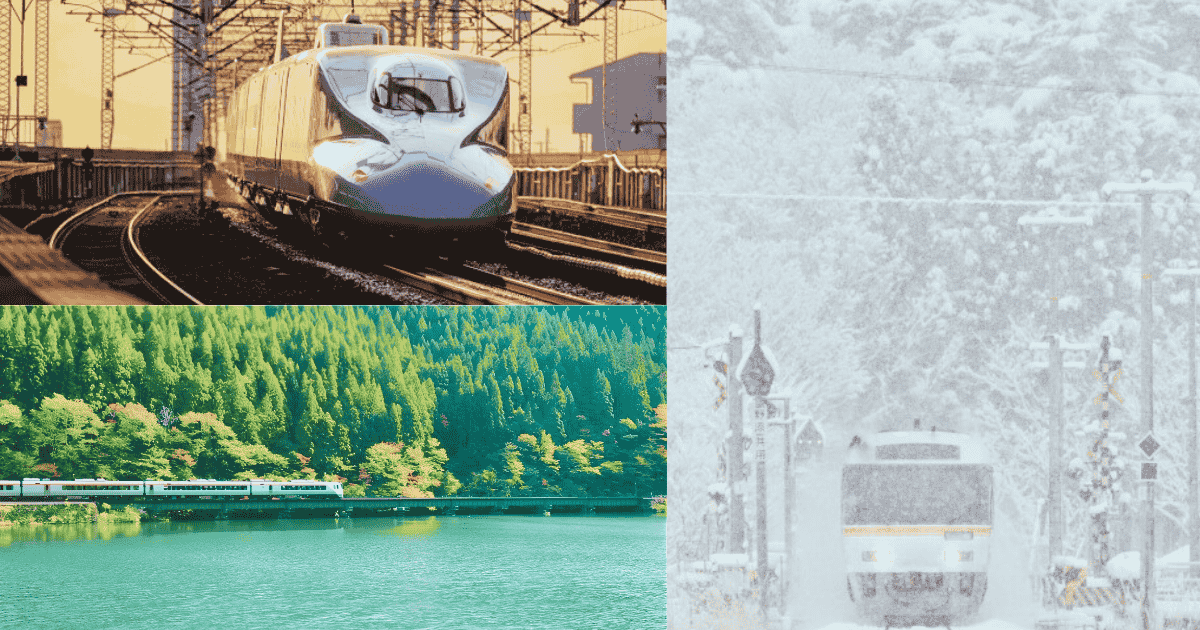
There is something special about watching the Japanese countryside from a train window. For many travelers, taking the JR (Japan Rail) is the best way to get to Takayama. It is fast, comfortable, and offers some of the most beautiful river views in Japan.
However, since the JR Pass price increased a lot in 2023, choosing the right ticket can be difficult. Also, walking through huge stations like Nagoya or Shin-Osaka with heavy bags can be stressful if you don’t have a plan. Should you go through Nagoya to see the famous “Hida River,” or travel through the mountains of Kanazawa?
In this guide, I will show you how to travel smoothly by rail based on my 5 years of living in the Hida region. If you are still comparing the train with other options like the bus or a rental car, please check our [How to Get to Takayama (2026): The Ultimate Transport Guide] first.
Here is what we will cover in this rail-specific guide:
- The best JR passes to save you money in 2026.
- Which seats to book for the best “river views.”
- Step-by-step tips for a smooth transfer at Nagoya or Toyama Station.
- New rules for large luggage on the Shinkansen.
Let’s make sure your train journey to the Alps is as perfect as the destination itself!
Table of Contents
Toggle1. The Two Main Rail Routes to Takayama
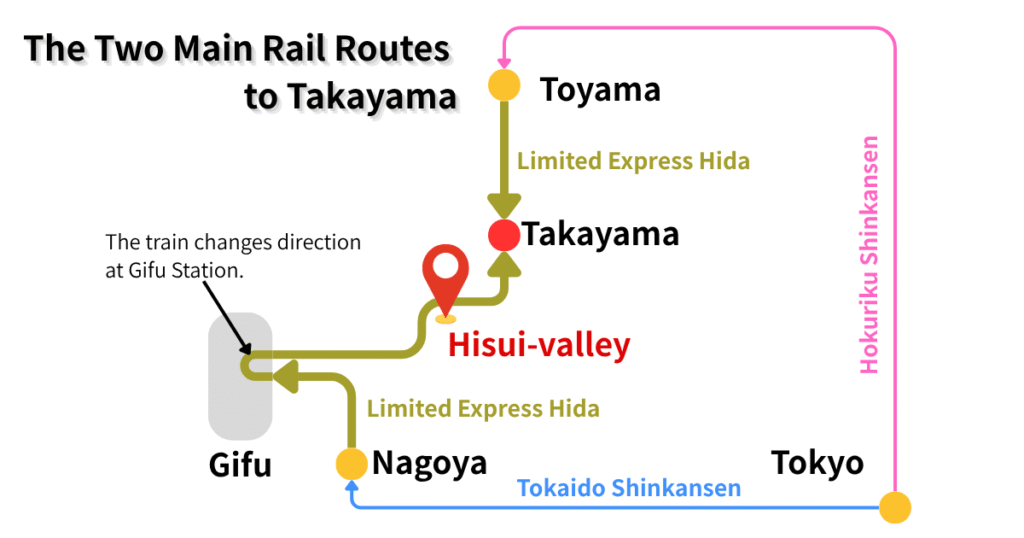
There are two “Golden Routes” to reach the Hida region, depending on where you start and what you want to see. One route takes you through a green river valley, and the other offers a modern journey through the north.
The “Limited Express Hida” Route via Nagoya
This is the “Classic Route” and the most popular choice for travelers coming from Tokyo or Osaka.
- The Experience: After a fast Shinkansen ride to Nagoya, you board the Limited Express Hida. This train is famous for its huge windows—which is why its nickname is the “Wide View.”
- The Highlight: For about 2.5 hours, the train winds along the Hida River. You will see emerald-green water, deep canyons, and tiny mountain villages. It is one of the most beautiful train rides in all of Japan.
- Best For: Travelers who want to see the best nature views and don’t mind a quick transfer at Nagoya Station.
The “Hokuriku Shinkansen” Route via Kanazawa or Toyama
This is the “Culture & Scenery Route” that is becoming popular, especially for travelers from Tokyo.
- The Experience: You take the fast and modern Hokuriku Shinkansen from Tokyo to Toyama, and then travel south to Takayama.
- The Food Highlight (Toyama): Traveling through the north lets you eat the freshest seafood in Japan. Toyama Bay is famous for its “Toyama Bay Sushi,” white shrimp, and firefly squid. It is a dream come true for food lovers.
- Art & Culture (Kanazawa): If you stop in Kanazawa, you can see Japan’s best gold leaf crafts and traditional silk dyeing. You can also visit Kenrokuen, which is one of the three most beautiful gardens in Japan.
- Amazing Nature: This route is also the gateway to the Kurobe Gorge (famous for its sightseeing train) and the Tateyama Kurobe Alpine Route. It is perfect for travelers who want to see both the wild Sea of Japan and the high Japanese Alps.
- Best For: Travelers who want to enjoy world-class seafood, traditional Japanese arts, and beautiful nature all in one trip.
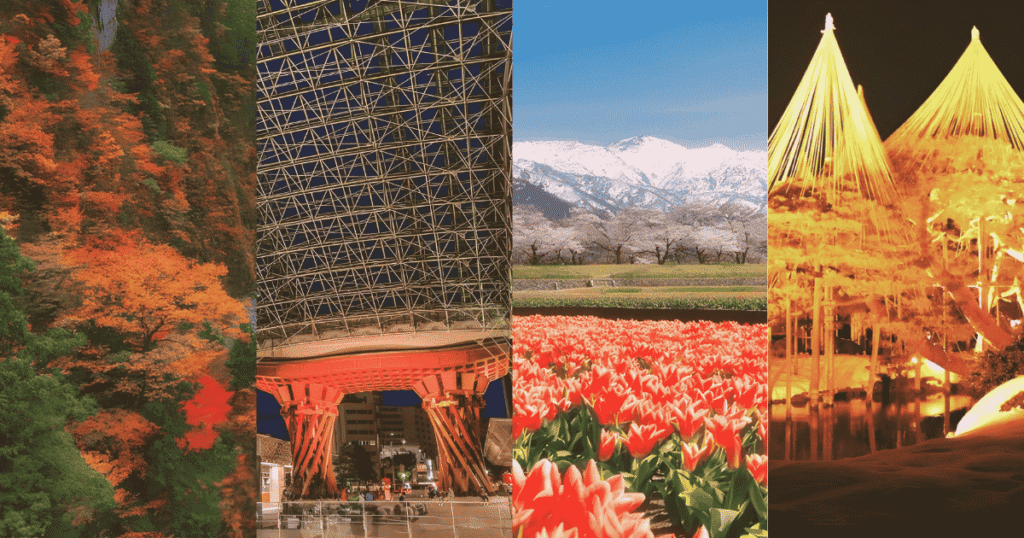
A four-panel photo collage featuring top Hokuriku sightseeing spots: Kurobe Gorge, Kenrokuen Garden, Asahi Town, and Kanazawa Station.
2. JR Pass Strategy: Is it Still the Best Option?
Since the big price increase in late 2023, the “Japan Rail Pass” is no longer a “magic ticket” that saves everyone money. In 2026, you need to do a little math before you buy. If you only visit Tokyo and Takayama, the national pass will actually cost you more than buying regular tickets!
Comparing the National JR Pass vs. Regional Passes
The secret to saving money in the Japanese Alps is looking at Regional Passes. These are smaller, cheaper, and often include bus routes that the national pass does not cover.
- The National JR Pass (7-Day: ¥50,000)
- Best For: Travelers visiting at least 3 far-away cities (for example: Tokyo → Takayama → Hiroshima → Tokyo) in one week.
- The Catch: If you only go from Tokyo to Takayama and back, it costs about ¥31,000. Buying the ¥50,000 pass would be a ¥19,000 mistake!
- The Takayama-Hokuriku Area Tourist Pass (5-Day: ~¥19,800)
- Best For: Travelers starting in Osaka or Nagoya and visiting Kanazawa, Shirakawa-go, and Takayama.
- The Huge Plus: Unlike the national pass, this one includes the bus to Shirakawa-go. This saves you even more money and time!
How to Reserve Seats Online Before You Arrive in Japan
You don’t need to wait in long lines at the station anymore! In 2026, you should book your seats online to make sure you get a window view—especially for the Limited Express Hida.
If you buy your JR Pass (National or Regional) directly from the official JR-West or JR-East websites, you can reserve your seats online up to one month in advance. You can do this even before you exchange your confirmation email for the real pass in Japan.
- Note: This service is usually not available if you buy your pass from a travel agency.
- If you are buying individual tickets: Use the “Smart EX” app (for the Shinkansen) or the JR-West website.
- The “Golden Rule” for Takayama: The Limited Express Hida is a very popular train. During busy seasons—especially for the Takayama Festival (held in both April and October) and the autumn colors in October—seats can sell out weeks in advance. Book your seat as soon as your travel dates are fixed!
3. Inside the "Limited Express Hida": Making the Most of the Ride
The journey to Takayama is not just a way to move; it is a highlight of your trip. Since 2022, JR has introduced the new “HC85 series” hybrid trains. These trains are quiet, smooth, and designed to help you enjoy the mountain scenery.
To make your ride perfect, you need to know a few “local secrets” about where to sit and what to expect on the train.
Which Side Has the Best View? (The River View Seats)
This is one of the most common questions online! For much of the trip, the Limited Express Hida travels through the beautiful valley of the Hida River. Since the train crosses the river many times, you can enjoy the bridges, the deep valley, and the changing seasons from both sides of the train.
However, we recommend booking a seat to see the famous “Hisui-kyo Gorge” (Hida Sui-kyo), which appears about one hour after leaving Nagoya.
- Heading TO Takayama (Northbound): Book Seats A & B. You will have a “front-row seat” to the emerald-green river and the deep rocky gorge.
- Heading FROM Takayama (Southbound): Book Seats A & B.
Important Note for Hisui-kyo View: Always book Seats A & B for the best view of the gorge. When you leave Nagoya Station, the right side is Seats C & D. However, the train changes its direction at the first stop, Gifu Station.
Facilities on Board: Wi-Fi, Outlets, and Luggage Space
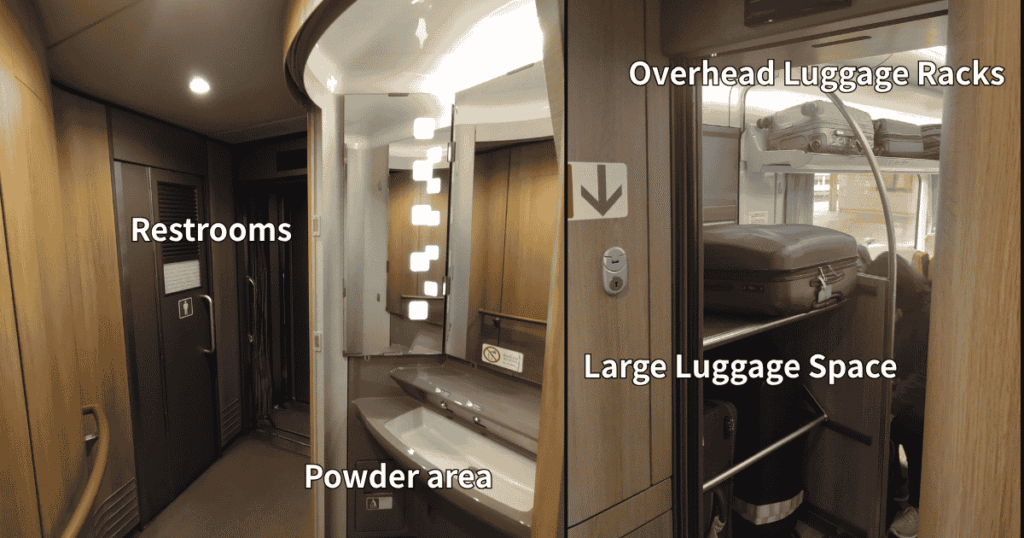
The new trains are very modern and feel like a high-end hotel. Here is what you will find:
- Free Wi-Fi & Outlets: Every seat has its own power outlet (usually in the armrest or under the window). The “JR-FREE Wi-Fi” is generally stable, but it can cut out for a short time when the train goes through long tunnels in the mountains.
- Overhead Luggage Racks: There are luggage racks above every seat. They are made of plastic and have dividers for each seat. These racks are perfect for small suitcases, similar to the size of an airplane carry-on bag (around 55cm x 40cm x 25cm).
- Large Luggage Space: There are special luggage racks at the end of each car for big suitcases.
- Important: Unlike the Shinkansen, you currently do not need a special reservation for the luggage rack on the Limited Express Hida. However, space is limited and is first-come, first-served.
- Universal Design: The restrooms in the odd-numbered cars (Cars 1, 3, etc.) are large and clean. One of these cars also has a wheelchair-accessible restroom. If you have a lot of bags, please check Chapter 6 for more advice.
- Local Pro Tip: There is no food or drink trolley on most Limited Express Hida trains. Make sure to buy your “Ekiben” (train lunch box) and drinks at Nagoya or Toyama Station before you board!
4. Nagoya Station "Transfer" Masterclass
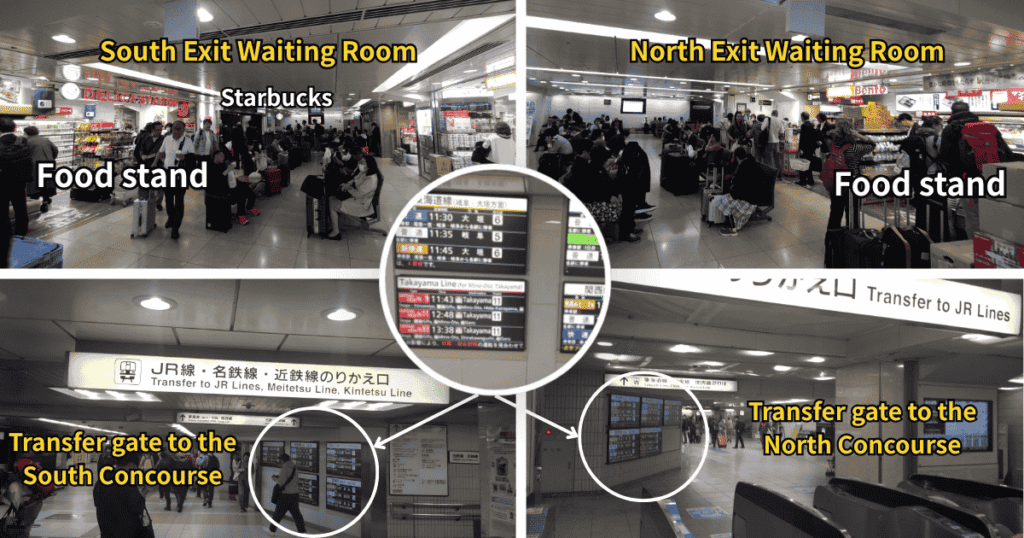
Nagoya Station is the gateway to Japan’s third-largest city. Since many different train lines meet here, it can be very confusing, and many international travelers get lost. However, moving from the Shinkansen to the Limited Express Hida is simple if you know the basic layout of the station.
Estimated Transfer Time and Navigating the Crowds
How much time do you really need to change trains?
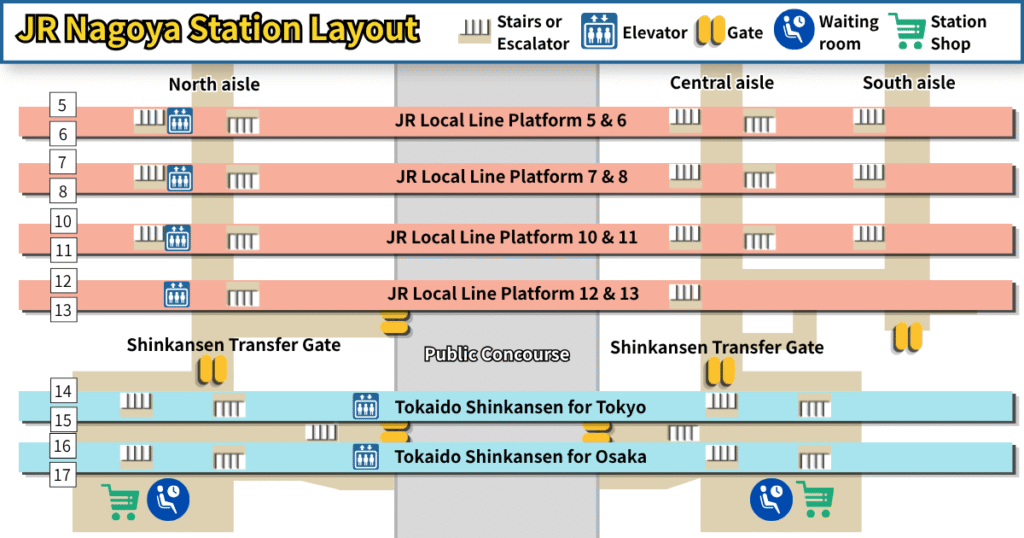
The Reality Check: Google Maps might say you can transfer in 10 minutes. This is physically possible because you just take the escalator down from the Shinkansen platforms (Platforms 14–17), go through the transfer gate, and walk a short distance to the Limited Express Hida platforms (usually Platforms 10 or 11).
However, I recommend leaving at least 30 minutes for two important reasons:
- Shopping: There is no food or drink service on the 2.5-hour Limited Express Hida ride. You should buy snacks, bento boxes, and drinks at the shops on the Shinkansen platform or inside the station before you board.
- Saving Space: The large luggage racks on the Limited Express Hida are limited and first-come, first-served. Arriving early helps you find a spot for your bags.
The “Magic” Gate: If you don’t need to leave the station for shopping, do NOT go through the regular “Exit” gates to the street after you get off the Shinkansen. Look for the bright yellow signs that say “JR Lines Transfer (Shinkansen Transfer Gate)” . Using this special gate keeps you inside the station. It saves you about 10 minutes of walking and prevents you from getting lost in the huge station building!
Watch the Signs: As soon as you pass through the “JR Lines Transfer” gate, you will see electronic signs. Check these signs immediately to confirm the departure time and platform number for your “Limited Express Hida.”
Last-Minute Gourmet: Best Ekiben to Buy at Nagoya Station
Since there is no food service on the train to Takayama, you must buy your lunch at Nagoya Station. Nagoya is famous for its local soul food called “Nagoya Meshi,” and the Ekiben (station lunch boxes) are fantastic.
- Hitsumabushi Bento (Grilled Eel): This is the king of Nagoya gourmet. It features grilled eel over rice with a sweet soy sauce. It is a bit expensive, but it is a great treat for your 2.5-hour train ride.
- Miso-Katsu Bento: This is a famous local food you can only find in this area. It features a thick, sweet, and salty red miso sauce poured over a filling pork cutlet.
- Tenmusu: Small rice balls with fried shrimp inside. They are easy to eat with one hand and perfect if you are not very hungry.
Where to Buy? You can find these shops on the Shinkansen platforms or in the waiting rooms inside the Shinkansen South Gates.
Important Advice: If you are transferring: If you take the North escalator from the Shinkansen platform or go through the “JR Lines Transfer” gate, it will be hard to find these shops. In this case, please go through the regular “Exit” gate first to find the shops in the main station area.
- If you are starting from Nagoya: There are many shops around the Shinkansen and local train gates. However, the shops inside the station building are very busy. It takes a long time to buy anything, so please make sure you have enough time before your train leaves!
5. The "Toyama Transfer" Masterclass
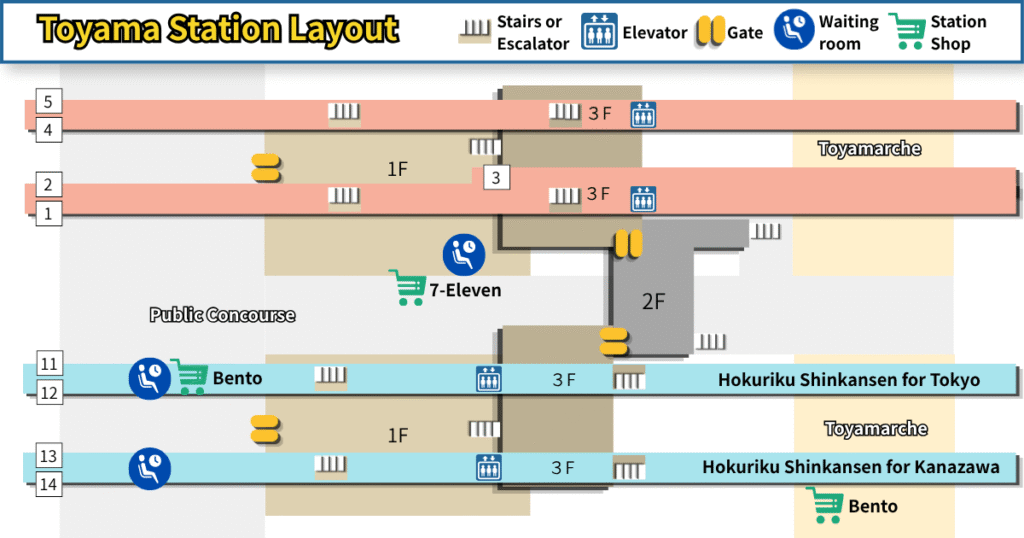
Toyama Station was rebuilt in 2015 when the Hokuriku Shinkansen opened. It is now a “modern and comfortable” gateway to Takayama. It is a compact station in a local city with only a few platforms.
However, it can still be confusing for travelers. The station building is large with many restaurants and shops. Also, Toyama has a unique rule: to transfer from the Shinkansen to the Limited Express Hida (JR Takayama Line), you must go through the “Exit” gate and leave the ticket area once.
To save your time and avoid walking in circles, here are a few “local secrets” you should know.
Efficient Transfer: From Shinkansen to the Alps
The transfer distance at Toyama Station is similar to Nagoya, but you must watch the signs carefully.
Estimated Transfer Time: It only takes about 10 minutes to walk between trains. However, I recommend having 30 minutes of extra time, just like at Nagoya Station.
Understanding the Station Structure: It is much easier to move smoothly if you know these 5 things about Toyama Station:
- Two Separate Areas: The station building is divided into the Local Train Area and the Shinkansen Area.
- Floors: In both areas, the ticket gates are on the 1st and 2nd floors. The train platforms are on the 3rd floor.
- Moving Between Floors: There are escalators between the 3rd and 1st floors, and stairs between the 3rd and 2nd floors. You can also use elevators on every floor.
- Shared Tracks: The Local Train Area is shared by two companies: Ainokaze Toyama Railway and JR. You will use the JR Takayama Line for the Limited Express Hida.
- The Unique Rule: To move between the Shinkansen and Local areas, you must go out of one ticket gate and enter the other.
Recommended Gate & Shopping: To transfer from the Shinkansen to the Limited Express Hida, look for the “Transfer Exit” or “Takayama Line” signs on the 2nd floor. Look for the bright yellow signs.
This gate leads directly to “Toyamarche.” This is a wonderful shopping area where you can find the best Toyama souvenirs and local food. Since there are no shops on the platforms or inside the Limited Express Hida, please stop at “Toyamarche” to buy your bento, snacks, and drinks!
Finding Your Train: After entering the Local Train Area and going up to the 3rd floor, you will find Platforms 1 to 5. Please check the electronic signs to confirm which platform your “Limited Express Hida” departs from.
Toyama’s Ocean Gourmet: The Best “White Shrimp Tempura”
Toyama is famous for its fresh seafood from the Sea of Japan. Since there is no food service on the train to Takayama, this is your last chance to grab a world-class meal!
- White Shrimp (Shiro-ebi) Tempura: Known as the “Jewel of Toyama Bay,” these tiny, sweet shrimps are fried into crispy tempura. They are a must-try in Toyama.
- Echizen Kani-meshi (Crab Rice): The rice is cooked with rich crab miso, filling your mouth with a deep, savory flavor. It is a luxury treat for your train ride.
Where to Buy? You can buy these at “Omiyage-dokoro Toyama,” located at the end of the Shinkansen platform (for trains heading toward Tokyo). You can also find them at “Toyamarche,” which you can reach from the 2nd-floor ticket gate.
6. Luggage Strategy: How to Handle Big Bags

Japanese trains are clean and fast, but they have one weak point: space for large suitcases is limited. If you have extra-large bags, you need a plan. Don’t let heavy luggage ruin your beautiful trip to the Alps!
The 160cm Rule: Essential Shinkansen Knowledge
If you bring your suitcase on the Shinkansen, you must know the “Oversized Baggage” rule.
- The Size: If the total size (Length + Width + Height) is over 160cm, you MUST book a “Seat with an Oversized Baggage Area.”
- The Penalty: If you don’t have a reservation, the conductor will ask you to pay a ¥1,000 fee.
- Hida Train Tip: The Shinkansen has strict rules, but the Limited Express Hida currently does NOT require a reservation. However, remember that space is limited!
Master Class: Using Luggage Forwarding (Ta-Q-Bin)
To avoid the Shinkansen rules and travel comfortably, using a delivery service is the best option!
- Limits: You can send bags up to 30kg and 180cm (total size).
- Timeline: Usually, your bags arrive within 24 hours.
- Tip: Pack a small “overnight bag” with things you need for your first night in Takayama.
- Please note: Delivery may take longer if you are sending bags from a far-away city or if there is heavy snow or bad weather. Please check the delivery date when you send your bags.
- How to Ask: Simply say to the hotel front desk: “Can I send this to my hotel in Takayama?”
- Cost: Around ¥2,500 to ¥8,000 for one standard large suitcase. (The price changes depending on the weight and the distance.)
7. Summary: Why Choosing the Train is the Ultimate Alpine Experience
Choosing the train to Takayama is about more than just getting from A to B. It is about the excitement of the Shinkansen, the delicious Ekiben at Nagoya or Toyama Station, and that special moment you see the crystal-clear Hida River for the first time from your “Wide View” window.
By following these tips—booking Seats A & B, using Ta-Q-Bin (delivery service) for your heavy bags, and allowing 30 minutes for your transfer—you are ready for a stress-free adventure.
The mountains are waiting for you. Are you ready to book your seat?
Still Deciding on Your Transport?
If you want to compare other ways to get to Takayama, check out our other deep-dive guides:
Back to the Main Guide: Not sure if this is the right route for you? Go back to our [How to Get to Takayama (2026): The Ultimate Transport Guide] to compare all transport methods at a glance.