Planning a day trip from Tokyo to Kamakura requires choosing the right train route. For the most direct and reliable experience, the JR Yokosuka Line is the gold standard. While other options exist, understanding the JR Yokosuka Line time and fare is essential for a smooth journey. This guide provides a factual breakdown of the major train lines, with a primary focus on why the Yokosuka Line is the most efficient route for your 2026 trip.
Quick Summary: Tokyo Station to Kamakura Station Before diving into the details, here is the essential data for your trip:
- Train Line: JR Yokosuka Line (Direct)
- Travel Time: Approx. 57 minutes from Tokyo Station
- Fare: 950 yen (One-way)
- JR Pass / Tokyo Wide Pass: Covered (¥0 / Free of charge)
- Train Tickets: Suica, PASMO, and JR Pass are all accepted.
- Frequency: Every 10–15 minutes.
Table of Contents
Toggle1. Tokyo to Kamakura: Direct Comparison of 3 Main Routes
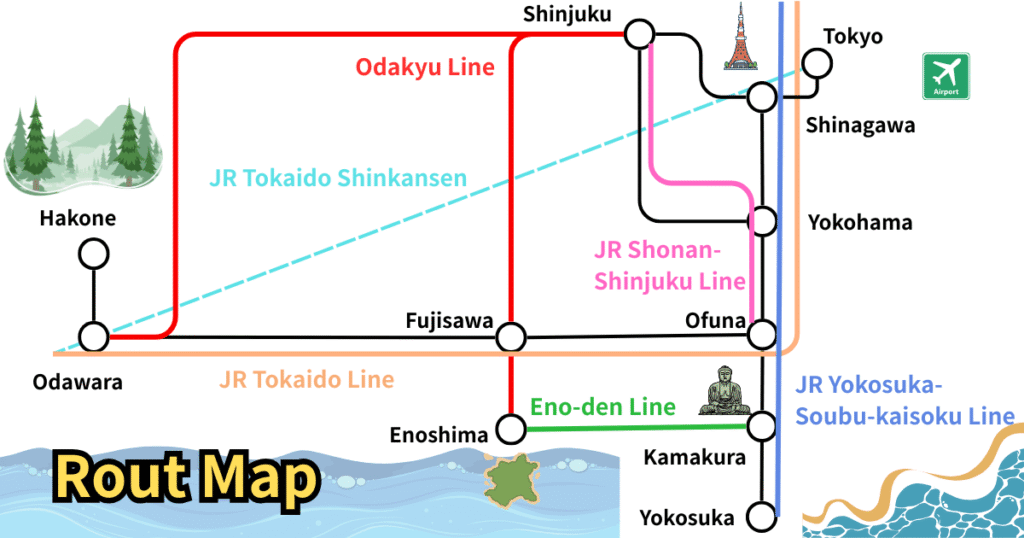
The journey from Tokyo to Kamakura is primarily serviced by JR (Japan Railways) and Odakyu Railway. However, the JR Yokosuka Line is the most reliable direct route for those starting in central Tokyo.
Which Route Should You Actually Choose?
While the Odakyu Line is the cheapest at ¥920, “best” depends on your priorities:
- If you value Time & Speed: Take the JR Yokosuka Line or JR Tokaido Line. It’s direct and much faster than the standard Odakyu commute.
- If you value Comfort: Upgrade to the Odakyu Romancecar (approx. +¥750). You get a reserved seat, huge windows, and a more “holiday” feel.
- If you plan to explore Enoshima too: The Enoshima-Kamakura Freepass (¥1,640) is unbeatable. It covers your round trip from Shinjuku AND unlimited rides on the Enoden, making it the most cost-effective for a full day of sightseeing.
Quick Comparison Table
| Route | JR Yokosuka Line(Direct) | JR Shonan-Shinjuku Line | Odakyu Line |
|---|---|---|---|
| Main Stations | Tokyo, Shinagawa | Shinjuku, Shibuya | Shinjuku |
| Travel Time | Approx. 57 min | 50-65 min | 90-110 min |
| One-Way Fare | ¥950 | ¥950 | ¥920 |
| Direct? | YES | Check Destination | No (Transfer at Fujisawa) |
| JR Pass Coverage | Covered (¥0) | Covered (¥0) | NOT Covered |
JR Yokosuka Line (Via Tokyo/Shinagawa): The Most Reliable Direct Route
This line runs directly from major hubs like Tokyo Station (deep underground platforms) and Shinagawa Station (ground-level platforms) to Kamakura. This makes it the ideal choice for JR Pass holders. It is also ideal for those starting near Tokyo Station.
Note on Seating: Most trains are through-services originating far outside Tokyo. Because these stations are not starting points, it can be difficult to find a seat.
- Green Car Position and Tip: For a guaranteed seat and a more relaxing journey, you can upgrade to a Green Car. Note that you should tap your IC card on the reader above your seat after boarding. This costs approximately ¥1,260 extra. On JR lines like the Yokosuka and Shonan Shinjuku, the Green Cars are usually located at the 4th and 5th cars.
- Crucial Tip for Yokosuka Line: While Green Cars are generally in cars 4 and 5, the train length can change. Specifically, 10-car vs. 15-car formations can cause numbering shifts. Consequently, you should always check the electronic platform indicators to verify the precise boarding position.
- For JR Pass Holders: This line is the most cost-effective and seamless way to reach Kamakura from Tokyo. Simply show your pass at the manned gate or use the automatic gates. Please note that while the base fare is covered, the Green Car (First Class) requires an additional surcharge.
JR Shonan Shinjuku Line (Via Shinjuku/Shibuya): Fastest Shinjuku to Kamakura Train
This route offers the quickest access from the western side of Tokyo. However, you must pay strict attention to the train’s final destination.
- Limited Direct Services: Only about two trains per hour run directly to Kamakura via the Yokosuka Line.
- Essential Check: The majority of trains are bound for Hiratsuka or Odawara via the Tokaido Line. Therefore, these will require a transfer at Ofuna Station. You must confirm Zushi, Yokosuka, or Kurihama as the final destination on the electronic sign.
Odakyu Line (Rapid/Express) Use: Free Passes and Limited Express Options
The Odakyu Line requires a mandatory transfer to the local Enoden Line at Fujisawa Station. This route is strategically beneficial if you are using the Enoshima-Kamakura Free Pass.
- Recommended Train Type: You must use the Rapid Express or Express trains for the Shinjuku to Fujisawa segment. In contrast, local trains (Futsu) make all stops. As a result, they are unsuitable for a day trip due to the excessive travel time.
- Limited Express Romancecar: For premium comfort, the “Enoshima” Limited Express (Tokkyu) train runs about once an hour. However, this requires an additional Limited Express Surcharge of approximately ¥750 extra. This fee is separate from the base fare covered by the Free Pass.
- Crucial Pass Restriction: The Enoshima-Kamakura Free Pass covers the Odakyu Line between Shinjuku and Fujisawa Station as one round trip only. Hence, free stopovers in this section are not permitted.
- Stopover Policy: If you wish to stop over at an intermediate station, you must inform a station staff member at the gate upon exiting. Then, they will mark your ticket accordingly or advise you on the procedure. Source: ODAKYU ELECTRIC RAILWAY Co.,Ltd.
2. The Best Way to Get to Kamakura Depending on Your Location
Choosing the best train to Kamakura from Tokyo is less about the line and more about where your day begins. To ensure a smooth journey, follow these recommendations based on your starting point.
Starting from Tokyo Station, Shinagawa, or Yokohama
Choose the Tokyo Station to Kamakura Station route via the JR Yokosuka Line. This is the most direct and reliable option for those staying in the eastern or central parts of the city.
- Why it’s the best: It’s a straightforward route with minimal risk of taking the wrong train, as almost every train on this platform stops at Kamakura.
- Travel Tip: As mentioned, remember to allow extra time at Tokyo Station to navigate to the deep underground Yokosuka platforms.
Starting from Shinjuku, Shibuya, or Ikebukuro
Choose the Shinjuku to Kamakura train (JR Shonan Shinjuku Line). This is the fastest way from Tokyo’s western hubs.
- The “Ofuna” Fix: If you accidentally board a Tokaido Line train (bound for Odawara), don’t panic—it’s an easy fix. Simply disembark at Ofuna Station. After that, transfer to the next available JR Yokosuka Line train heading to Zushi or Kamakura from the adjacent platform. This ensures you still reach your destination with minimal delay.
3. Tokyo to Kamakura Train Cost & Pass Coverage
Train to Kamakura from Tokyo Price & Fare Breakdown
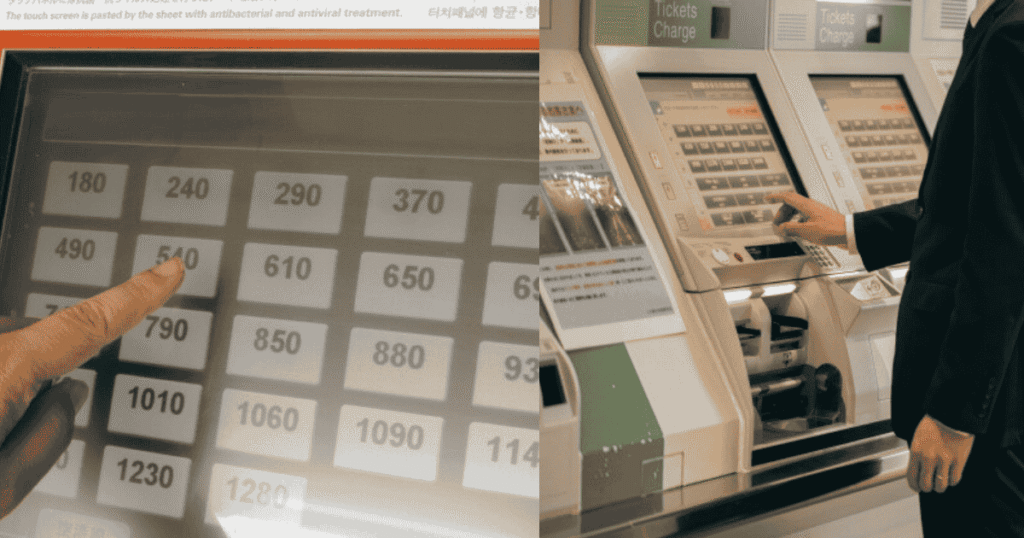
- JR Lines: A one-way trip on JR lines (like the JR Yokosuka Line) is ¥950. If using an IC card like Suica or PASMO, the fare is slightly discounted to ¥945. Because ticket lines can be time-consuming, using an IC card is highly recommended for your trip.
- Odakyu Route: The base Tokyo to Kamakura train cost via the Odakyu Line is approximately ¥920.
Cost Simulation: Is a Kamakura Day Pass Worth It?
For a simple round-trip, the cost is roughly ¥1,900 via JR or ¥1,640 via Odakyu. If the price of a day pass is greater than this amount plus your local travel expenses, the pass is not worth the cost. Therefore, please consult our related article on passes for a detailed simulation to see which option fits your budget.
How to use the JR Pass from Tokyo to Kamakura: Coverage & Tips
If you are traveling with a Japan Rail Pass (JR Pass) or the JR Tokyo Wide Pass, the journey from Tokyo to Kamakura is fully covered. You can take either the JR Yokosuka Line or the JR Shonan-Shinjuku Line at no extra cost.
However, it is important to remember that the Enoden Line (the scenic local train) and the Odakyu Line are private railways and are not covered by any JR Pass. If you plan to use these, ensure you have a Suica, PASMO, or cash ready for the separate fare.
4. Traveler's FAQ: Tokyo to Kamakura Train Schedule & Tips
What is the Train to Kamakura from Tokyo Schedule?
The Tokyo to Kamakura train schedule for the JR Yokosuka Line is very frequent. Trains run throughout the day, typically every 10–15 minutes. No advance reservation is required, as trains run frequently enough that you can simply show up at the station.
Is there a Tokyo to Kamakura Bullet Train?
There is no direct Tokyo to Kamakura bullet train. While the Shinkansen stops at nearby Shin-Yokohama, the local JR Yokosuka Line is much more convenient and direct for this specific trip.
Alternative Route: Can I Use the JR Tokaido Line?
Yes, you can use it as an alternative route via transfer. The JR Tokaido Line runs parallel to the Yokosuka Line between Tokyo and Ofuna. If a direct train is not available, take the Tokaido Line to Ofuna Station. Then, transfer to the JR Yokosuka Line (bound for Zushi) to reach Kamakura.
Best Times to Travel to Kamakura and Avoid Crowds
To ensure a smooth journey, you should avoid departing from Tokyo between 7:30 AM and 9:00 AM on weekdays. This is because of the peak commuter rush hour. During this time, trains are extremely crowded with workers and students. Instead, aim to travel after 9:00 AM for a more relaxing experience and a better chance of finding a seat.
Essential Travel Tips: Luggage and IC Card Charging
- Luggage Lockers: Kamakura Station offers large and medium-sized coin lockers. These are primarily near the East Exit.
- Pro Tip: An extra set of large lockers is available inside “Aiza Kamakura” (Shopping Complex/3rd floor). This is located immediately to the left upon exiting the East Gate and entering Komachi Street. Because there is limited English information for this location, checking the official Japanese website is recommended.
Even Better: Official Luggage Storage Service If the lockers are full, don’t worry! The Kamakura City Tourist Association offers a convenient staffed luggage storage service right outside the West Exit. It’s a great alternative for those with oversized suitcases or when you want to avoid the “locker hunt.”
Location: 4th Floor, Enoden Building (right outside the West Exit).
Hours: 9:00 AM – 5:00 PM.
Details & Pricing: Official Luggage Storage Service
- IC Card Charging: If your Suica or Pasmo card is low, you can easily top it up. You can use any ticket machine or convenience store inside the station before heading out.
Where is the JR Pass platform for Kamakura at Tokyo Station?
To catch the direct train to Kamakura using your JR Pass, head to the Sobu/Yokosuka Line underground platforms (Platforms 1-4). These are located deep below the main Tokyo Station complex, so allow at least 10–15 minutes for the walk from the Shinkansen or other JR lines.
5. Arriving at Kamakura Station: Essential Logistical Connections
Shortest Transfer to the Enoden Line at Kamakura Station
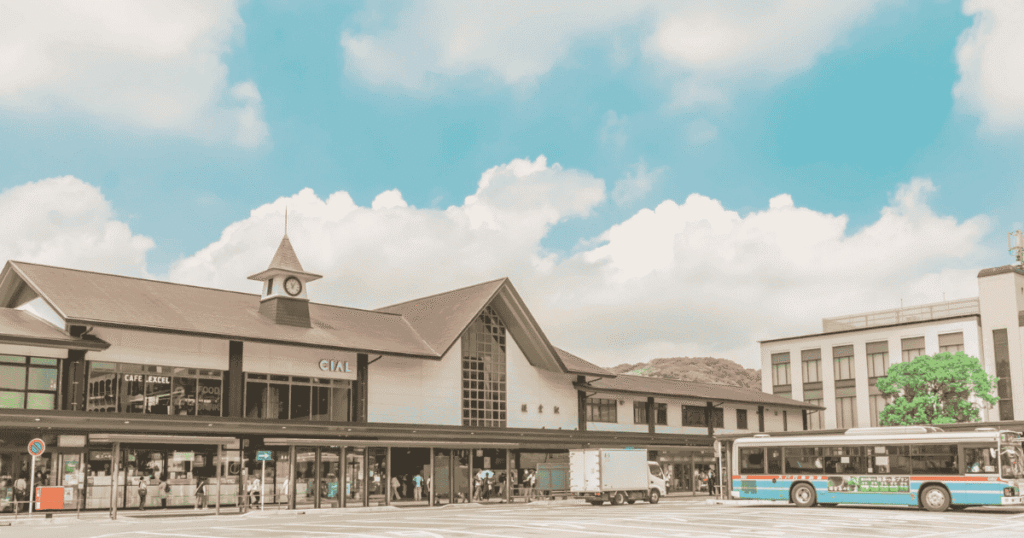
The Enoden platform is on the ground floor, right next to the JR platforms. Simply follow the yellow overhead signs for the Enoshima Electric Railway (Enoden). The total transfer time is approximately 3–5 minutes.
Which Exit to Use for Komachi Street?
For JR Users: Use the East Exit. Once outside, Komachi Street is immediately to your front-left. This path leads straight to the major Tsurugaoka Hachimangu Shrine. Therefore, this is the fastest way to get oriented.
For Enoden Users: Use the West Exit. To reach Komachi Street, proceed along the park and take the underpass beneath the JR tracks to reach the East Exit area. Once you emerge on the East side, Komachi Street will be clearly visible to your front-left.
6. Optional: Scenic Side Trip via Shonan Monorail
While the JR Yokosuka Line is the most direct route, some travelers prefer a scenic detour using the Shonan Monorail from Ofuna Station. The monorail runs 8.9 km from Ofuna to Shonan-Enoshima Station.
- Thrill Zones: Immediately after departing Ofuna, the Monorail makes several sharp curves and steep inclines. The most thrilling section is near Shonan-Fukasawa Station, where the line ascends a steep gradient into a tunnel and then descends.
- Scenic Views: After Shonan-Machiya Station, look to the right for distant mountains and potentially Mt. Fuji on clear winter days. After Kataseyama Station, the beautiful blue ocean comes into view.
- Seating Recommendation: For the best possible experience, ride in the very front seat of the leading carriage. (Please refer to the “Practical Transit Costs and Passes” section in Section 3 for ticket details.)
- Note: The Shonan Monorail is a private line and is NOT covered by the JR Pass.
7. Conclusion: Planning Your Kamakura Trip
Selecting the optimal train route is the first step; now it’s time to build your itinerary and decide on local travel passes.
Based on the transport route you have selected:
- If you chose the Odakyu Line: The Essential Guide to the Enoshima-Kamakura Freepass: Price, Benefits, and Assessment is the next logical step. This pass maximizes the value of your round trip and covers local transport.
- If you chose the JR Line: You should now focus on planning your day in the area. Our Kamakura & Enoshima in One Day Itinerary: The Optimized Guide (Freepass Cost & Route) will help you make the most of your trip.
- Need Local Transport Only? If you are using a JR Pass or are staying locally, the Enoden 1-Day Pass (Noriorikun) may be your best bet for local travel.
Your next steps should focus on finalizing the details of your itinerary: