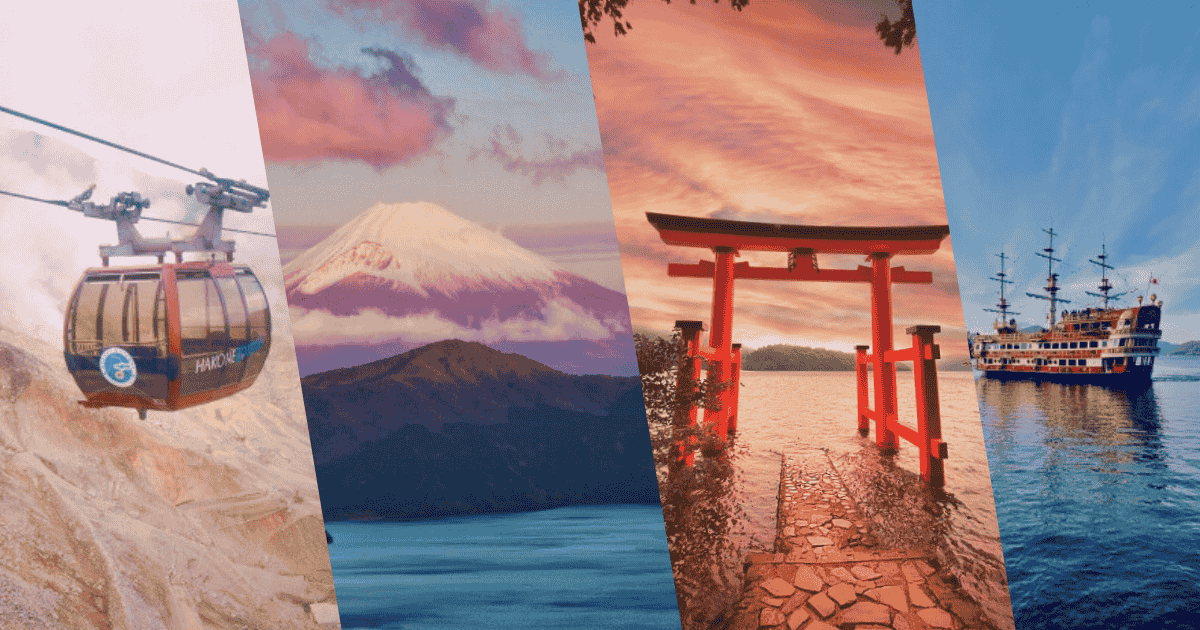
You’ve planned your trip to Hakone, the picturesque hot spring town near Mount Fuji, and you’re ready to experience the iconic “Golden Loop” of trains, ropeways, and pirate ships. But before you buy your first ticket, one crucial question looms:
“Is the Hakone Freepass worth the cost, or is it cheaper to buy tickets individually?”
The answer is a resounding YES—but not just because of the transport savings. The Hakone Freepass is the foundational piece of a stress-free, cost-effective trip.
What sets this guide apart is our “Clockwise Strategy.” While most travelers struggle with timing, we reveal why traveling clockwise is the only way to beat the limited Lake Ashi cruise schedules and ensure you reach the iconic Hakone Shrine before sunset—avoiding the common mistake of arriving at a dark, deserted shrine in the winter months.
This ultimate guide breaks down the math using 2026 prices, offers the optimal 1-day itinerary proven to maximize value, and provides expert tips on upgrades and which direction to travel.
Table of Contents
ToggleIn this guide, we’ll answer every common question:
- The Math: A transparent comparison of Pass vs. Individual tickets.
- 1-Day Strategy: Why the 2-day pass is still your best bet for a day trip.
- Odawara & JR Pass Holders: Essential savings tips for those starting mid-route.
Digital vs. Physical: Which version is best for your travel style in 2026?
1. The Core Question: Is the Hakone Freepass Worth It? (Cost Breakdown)
The short answer is: Yes, the Hakone Freepass is worth it for anyone completing the full Golden Loop from Tokyo (Shinjuku). The data clearly shows a minimum saving on transportation alone.
The Break-Even Point: Pass vs. Individual Tickets
The “Golden Loop” is the standard circuit covering the Odakyu Train (from Shinjuku), Hakone Tozan Train, Cable Car, Ropeway, Sightseeing Cruise (Pirate Ship), and Bus.
Here is the financial breakdown for an adult traveling from Shinjuku:
| Item | Cost (JPY) | Notes |
|---|---|---|
| Individual Tickets Total | ¥8,240 | Total cost for 8 one-way segments of the full loop, without Romancecar surcharge. |
| Hakone Freepass (2-Day from Shinjuku) | ¥7,100 | Covers all 8 segments and unlimited local transport. |
| Minimum Savings | ¥1,140 | You save ¥1,140 on transport alone. |
The YouTube channel “Omoroi Nippon” features great videos showcasing the charm of Hakone. You should definitely check it out!
The Hakone Freepass Price List (2026)
The pass is available for 2 or 3 days, and the price varies based on your starting point.
| Starting Station | 2-Day Pass (Adult) | 3-Day Pass (Adult) |
|---|---|---|
| Shinjuku | ¥7,100 | ¥7,500 |
| Odawara | ¥6,000 | ¥6,400 |
| Machida | ¥6,820 | ¥7,220 |
| Fujisawa | ¥7,050 | ¥7,450 |
Note: These 2026 prices reflect the most recent price adjustment by Odakyu Electric Railway, ensuring you have the most up-to-date budget for your trip.
Is the Freepass Worth It for a One-Way Trip?
If you are not completing the full Golden Loop, the pass is likely NOT worth it. If your plan involves just one or two legs of the journey, buy individual tickets. If you plan to use three or more legs of the journey (e.g., Train + Cable Car + Ropeway), the Freepass becomes essential.
Is there a 1-Day Hakone Freepass?
No, there is no official 1-day Hakone Freepass; it is only available as a 2-day or 3-day pass. However, it is still worth buying even for a 1-day trip. As shown in our cost breakdown, the total cost of the “Golden Loop” individual tickets (¥8,240) significantly exceeds the price of the 2-day pass (¥7,100). You will save at least ¥1,140 by using the pass for your day trip.
Is the Hakone Freepass worth it from Odawara?
Yes. Even if you start from Odawara (e.g., arriving via Shinkansen), the pass costs ¥6,000. For comparison, buying individual tickets for the full Golden Loop from Odawara totals ¥6,440.
While the direct transport saving is modest at ¥440, the pass is still the superior choice. You can easily gain hundreds of yen in additional value by taking a side trip on a local bus or using the discount at just one or two museums. When you add the convenience of skipping ticket lines, the Freepass remains the smartest way to travel.
2. Why You Should Go Clockwise: The Hakone Shrine Sunset Trap
Your trip’s success depends not only on the pass but also on the direction you travel. We recommend the Clockwise route to maximize your time and avoid disappointment.
Clockwise vs. Counter-Clockwise: Which Route Should You Choose?
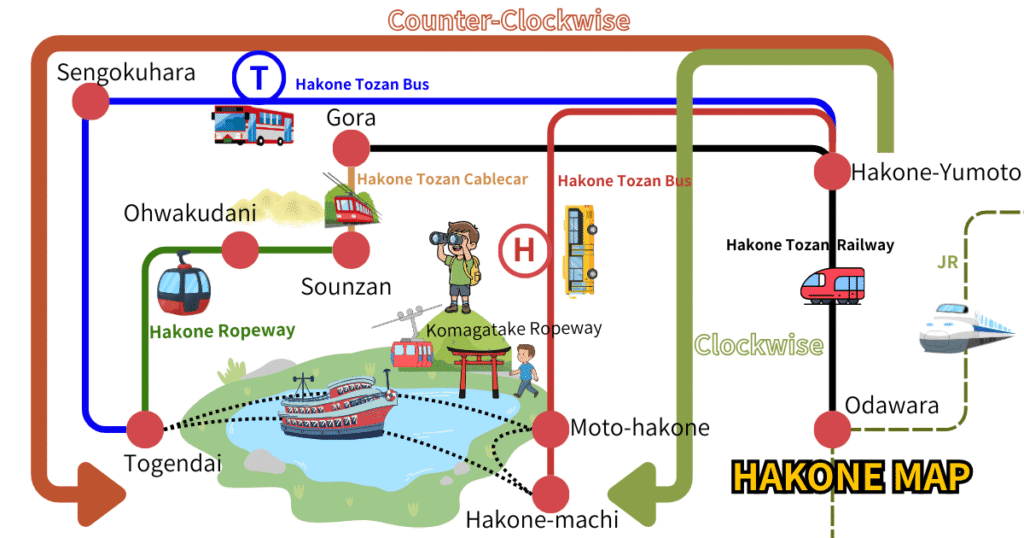
When tackling the Hakone Golden Loop, you have two options: the Clockwise route or the Counter-Clockwise route. While both cover the same sights, your experience will differ significantly based on the direction you travel.
Option 1: The Clockwise Route (Moto-Hakone -> Togendai) — Recommended
This is the route we prioritize in our itinerary, starting with a bus ride directly to the lake.
- Pros: This direction guarantees you meet the limited Pirate Ship schedule and ensures you visit the famous Hakone Shrine’s Gate of Peace (Peace Torii) during peak daylight hours for the best photos. It also allows for a more efficient flow by skipping Hakone-machi Port, leaving more time for major attractions.
- Cons: The main trade-off is that you cannot stop at the sightseeing spots around Hakone-machi Port, such as the Hakone Checkpoint.
Option 2: The Counter-Clockwise Route (Gora -> Sounzan ->Togendai)
This route starts with the Hakone Tozan Train towards Gora.
- Pros: It is often less crowded first thing in the morning as many tourists head towards the lake first.
- Cons: You risk reaching the scenic Lake Ashi area and Hakone Shrine too late. Due to the limited frequency of the Pirate Ship, you might find yourself chasing the clock, potentially arriving after the early winter sunset.
- Verdict: We strongly recommend the Clockwise route. Prioritizing the boat schedule and securing beautiful views of Hakone Shrine before the early sunset is the key to a successful day trip.
The Ultimate 1-Day Hakone Golden Loop Itinerary (Clockwise)
Experience the very best of Hakone in a single, perfectly planned day. This “Clockwise” itinerary is designed for maximum efficiency, covering everything from the iconic lakeside torii gates to active volcanic vents, with five unique ways to tailor your afternoon.
Phase 1: Shinjuku to Moto-Hakone (Morning Access Guide)
Starting your Hakone adventure on the right foot is all about timing. Whether you’re gliding through the countryside on the luxurious Romancecar or navigating the efficient local lines, this guide ensures a smooth journey from the heart of Tokyo to the serene shores of Lake Ashi.
Head to the Odakyu Shinjuku Station. For the ultimate experience, we highly recommend booking a “Front Observation Seat” on the Romancecar to enjoy panoramic views of the Japanese countryside.
- Transport Options:
- Romancecar (Limited Express): Approx. 90 mins / ¥2,470 (or ¥1,110 with Freepass)
- Express Train: Approx. 130 mins / Covered by Hakone Freepass
- Key Notes:
- On Weekends: Take the 07:20 AM Romancecar for a direct, comfortable ride to Hakone-Yumoto. Eating is allowed, making it perfect for an “Ekiben” breakfast.
- On Weekdays: Take the 06:51 AM Express to Odawara, then transfer to the Hakone Tozan Railway. You’ll arrive at Hakone-Yumoto around 08:57 AM.
- Transport Mode: Hakone Tozan Bus (Line H)
- Note: Take the Line H bus from Bus Stop No. 2.
Phase 2: Sightseeing in Moto-Hakone (Shrines & Art)
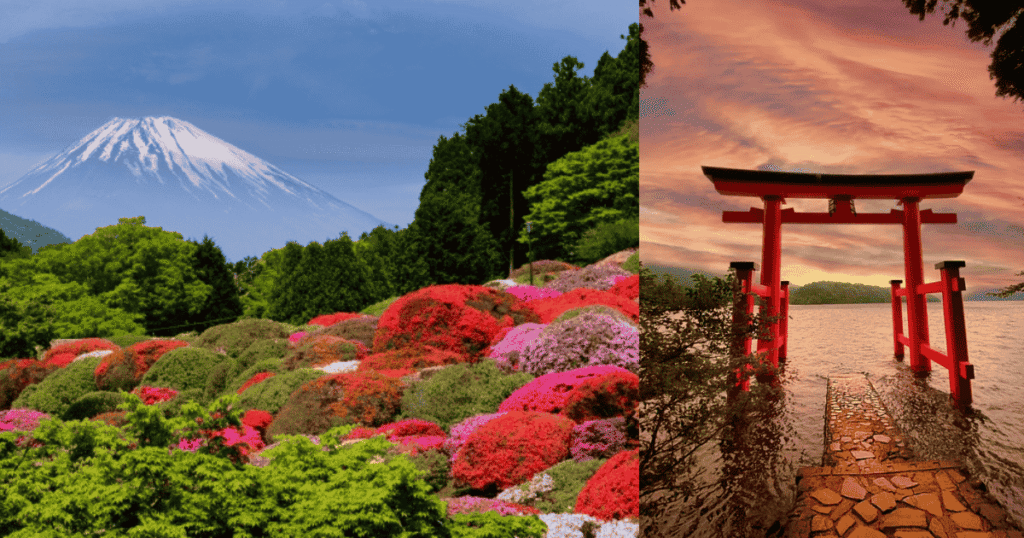
Moto-Hakone is the spiritual and cultural heart of the region. From the iconic lakeside ‘Peace Torii’ of Hakone Shrine to the refined galleries of the Narukawa Art Museum, this area offers a perfect blend of ancient tradition and breathtaking modern views of Mt. Fuji.
10:00 AM | Start Exploring Moto-Hakone: Morning Choice: Spiritual Icons or Seasonal Blooms?
- Activity: Walk to the famous “Torii of Peace” standing in Lake Ashi for the ultimate photo. Then, visit the museum to enjoy modern Japanese paintings with a panoramic view of Mt. Fuji.
- Tip: Show your Hakone Free Pass at the Narukawa Art Museum for a ticket discount.
- Website: Narukawa Art Museum
- Best Season: Late April to Early May.
- Activity: Wander through a historic garden featuring over 3,000 blooming azaleas (Tsutsuji) with the lake and Mt. Fuji in the background.
- Website: Hotel de Yama
Phase 3: Lunch & Lake Ashi Sightseeing Cruise
Take a break and savor the local flavors of Hakone before setting sail. After a lakeside lunch featuring fresh regional specialties, you’ll board a majestic pirate ship for a scenic cruise across Lake Ashi, offering the most famous postcard-perfect views of the mountains.
- Tea Lounge “Kisetsufu” (Best for Fuji Views): Located inside Narukawa Art Museum. Enjoy a light lunch or matcha in front of a 30-meter panoramic window framing Mt. Fuji and the lake.
- Bakery & Table Hakone (Best for Casual Dining): Famous for artisanal pastries. We recommend the outdoor foot-bath counter where you can soak your feet while watching the pirate ships dock.
- Lakeside Eateries (Best for Local Flavors): Try “Wakasagi” (pond smelt) tempura, a fresh specialty harvested directly from Lake Ashi.
- Route: Board the iconic “Pirate Ship” from Moto-Hakone Port to Togendai Port.
- Pro Tip: Head to the top deck immediately for the best breeze and mountain scenery. The 30-minute crossing is fully covered by the Hakone Free Pass.
- Website: Hakone Sightseeing Cruise
Phase 4: Afternoon Custom Routes (Choose Your Path)
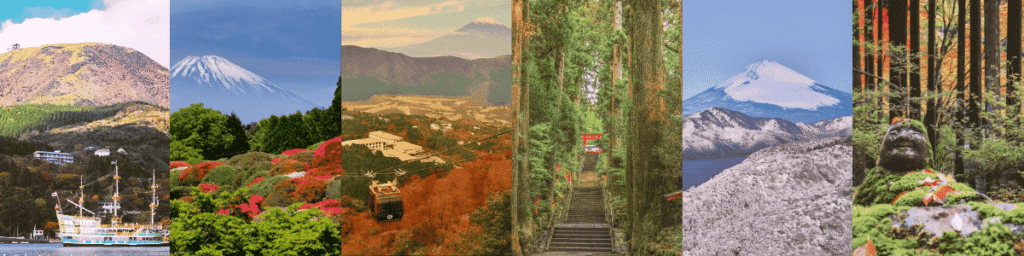
After witnessing the volcanic power of Owakudani, the rest of the day is yours to define. We have designed five distinct pathways.
Important: Check Your Starting Point
- For Option 1: Your adventure begins immediately upon arrival at Togendai Port (01:10 PM).
- For Options 2, 3, 4, & 5: Follow the Common Route below to explore Owakudani first.
[The Common Route] From Togendai to the Volcanic Valley
This route applies to Options 2, 3, 4, and 5.
- Transport: Hakone Ropeway (Togendai Sta. to Owakudani Sta.)
- Website: Hakone Ropeway
- Duration: 20 mins
- Highlight: Look out for the first glimpse of Mt. Fuji over the volcanic valley.
- Activity: Walk among active sulfur vents and taste “Kuro-tamago” (Black Eggs), said to add seven years to your life.
- Website: Owakudani Guide
Option 1: Mt. Fuji & Panoramic Views (The Komagatake Peak Route)
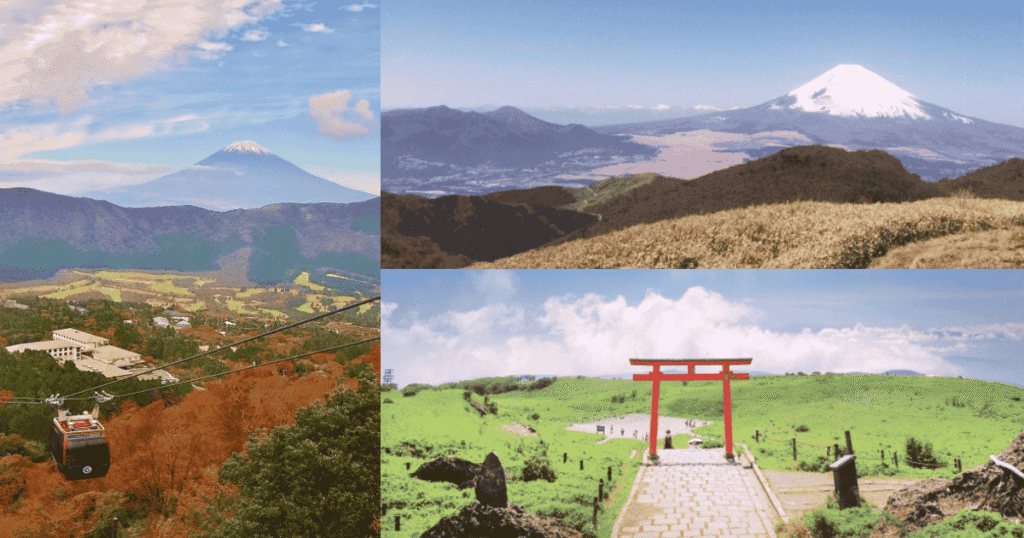
This plan offers the most dramatic 360-degree views. Note: This route departs directly from Togendai Port at 01:10 PM.
- The Transfer: Upon arriving at Togendai Port by pirate ship, you must walk approximately 10–15 minutes along the lakeside path to the Kojiri (湖尻) area.
- Transport: From the Kojiri Bus Stop, board the Izu-Hakone Bus bound for Hakone-en.
- Critical Tip: The bus terminal directly outside the Togendai pirate ship station is only for Hakone Tozan Buses. To reach Hakone-en, you must walk 10–15 minutes along the lake to the dedicated Izu-Hakone bus stop at Kojiri (湖尻).
- Payment: While this bus is operated by a different company and is not covered by the Hakone Free Pass, you can easily pay using your IC Card (Suica/Pasmo).
- Experience: Ascend to the 1,357m summit. Visit the Hakone Mototsumiya, the “Shrine in the Sky,” and enjoy an unobstructed panorama of Mt. Fuji, Lake Ashi, and even the Pacific Ocean.
- Website: Komagatake Ropeway
- Route: Return to Togendai via bus, then take the Hakone Ropeway to see the sulfur vents of Owakudani.
- Route: Take the Hakone Cable Car and the Hakone Tozan Railway (Mountain Train).
Option 2: Hakone Art & Autumn Foliage (The Museum Lover's Route)
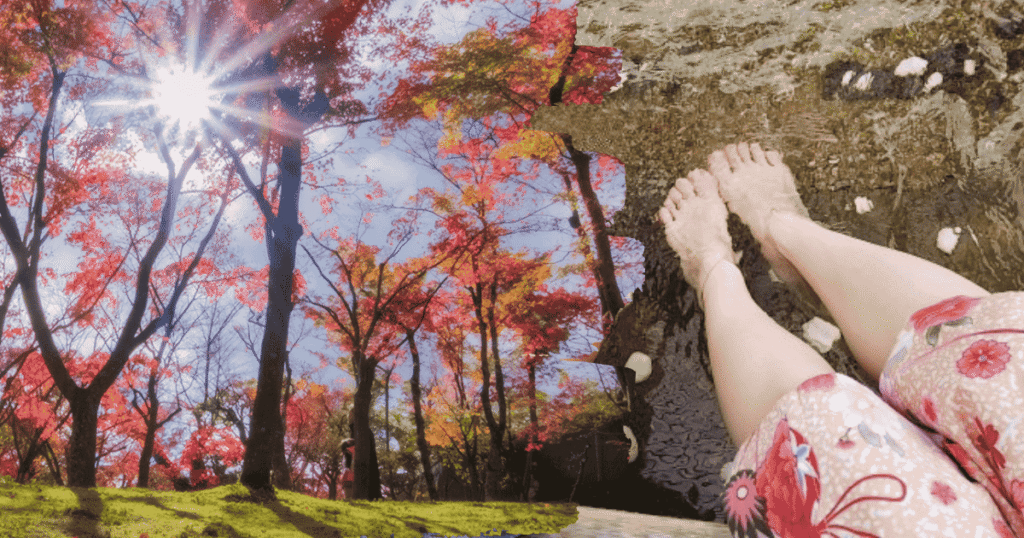
Immerse yourself in world-class art surrounded by nature. This path takes you through the legendary Open-Air Museum and the tranquil Hakone Museum of Art, which becomes a fiery sea of red and gold during the autumn season.
Starts after exploring Owakudani (02:10 PM).
- Activity: Get off at Chokoku-no-Mori Station. Explore massive outdoor sculptures from masters like Moore and Rodin, as well as the world-class Picasso Pavilion.
- The Ultimate Japanese Fusion: The Ultimate Japanese Retreat: After wandering through the artworks, immerse yourself in a true Japanese cultural experience: a natural hot spring foot-bath. Soak your tired feet while taking in the stunning forest views and listening to the soothing sounds of the nearby stream, chirping birds, and the mountain breeze. It’s the perfect transition from dynamic art to deep, natural relaxation.
- Website: https://www.hakone-oam.or.jp/en/
Famous for its moss garden and fiery maple leaves (Best in November).
- Website: https://moaart.or.jp/hakone/en/
- The Dish: Famous for “Tofu-Katsu Ni”—deep-fried tofu stuffed with minced pork, simmered in a savory dashi broth.
- Pro Tip (The “Fast Pass” Strategy): Since this is one of Hakone’s most popular restaurants with wait times often exceeding 90 minutes, we highly recommend their Advance Reservation System.
- How it works: For a small fee (approx. ¥500 for up to 4 people), you can secure a specific time slot in advance. This is a game-changer for keeping your tight schedule on track.
- Alternative: If you don’t book ahead, head to the restaurant to get a numbered ticket as soon as you arrive at Gora Station, then explore the nearby shops until your turn.
- Website: Reservation Details (PDF-See Page 2 for English) / Official Site
Option 3: Hands-on Culture & Local Gourmet (The Craft House Route)
Make your trip memorable by creating something unique. This route is perfect for families and creative souls who want to try traditional glass blowing or pottery, followed by a hearty meal at one of the area’s most famous local eateries.
Starts after exploring Owakudani (02:10 PM).
- Activity: Create your own glass or pottery masterpiece. Located inside the beautiful French-style Gora Park.
- Note: Admission to Gora Park (¥550) is FREE with your Hakone Free Pass.
- Website: Hakone Craft House
- Choice: Head to Tamura Ginkatsu-tei for their signature Tofu-Katsu (See Option 2 for the dining tip), or explore smaller local eateries near Gora Station for a quicker meal before your train.
Option 4: Traditional Onsen & Hot Springs (The Ultimate Relaxation Route)
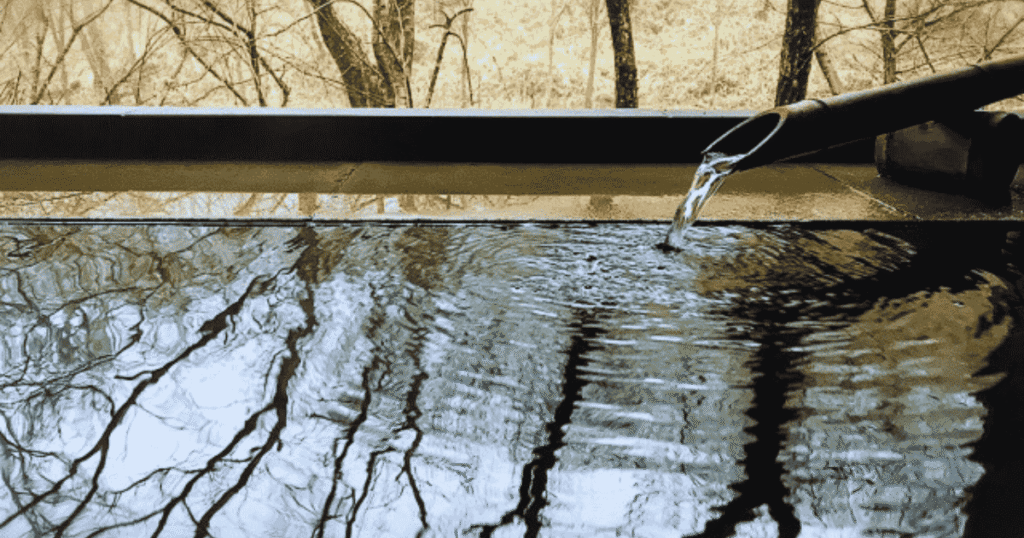
This plan is the perfect reward after a day of exploring. Experience deep relaxation in a forest-side hot spring before a traditional dinner.
Starts after exploring Owakudani (02:10 PM).
- Route: Take the Hakone Cable Car to Gora, then transfer to the Hakone Tozan Railway (Mountain Train) to Hakone-Yumoto.
- Tip: Enjoy the steep zig-zag “switchbacks” as the mountain train descends.
- Activity: Head to the shuttle bus stop located just across the bridge from the station’s main exit.
- Shuttle Info: A free shuttle bus to Hakone Yuryo departs every 10–15 minutes.
- Highlights: Soak in large communal baths or book a private open-air room (Kashikiri) for more privacy.
- Dinner: Enjoy an authentic “Irori” (Charcoal Grill) dinner at the onsite restaurant, Yomon, before heading back to the station.
- Website: Hakone Yuryo
Return to the station with plenty of time for souvenirs.
Option 5: Historic Walk & Retro Cafe (The Miyanoshita Heritage Route)
Step back in time as you wander through Hakone’s most nostalgic district. This route is perfect for those who love vintage architecture, boutique shopping, and a slower pace of travel.
Starts after exploring Owakudani (02:10 PM).
- Arrival: Get off at Miyanoshita Station.
- The Experience: Walk down the “Sepia Street” (Miyanoshita’s main road). Visit the legendary Fujiya Hotel, established in 1878, to admire its fusion of Japanese and Western architecture.
- Hidden Gems: Browse the retro antique shops for unique Japanese curios or enjoy a soothing foot-bath while sipping coffee at NARAYA CAFE.
- Websites: Fujiya Hotel / Naraya Cafe
- Transport: Board the Hakone Tozan Railway from Miyanoshita to Hakone-Yumoto (25 mins).
- Choice: Since you’ve enjoyed a nostalgic afternoon, we recommend an authentic Izakaya experience at Nomidokoro Ishida near the station. (See Phase 5 for details).
Phase 5: Dinner & Shopping at Hakone-Yumoto Station
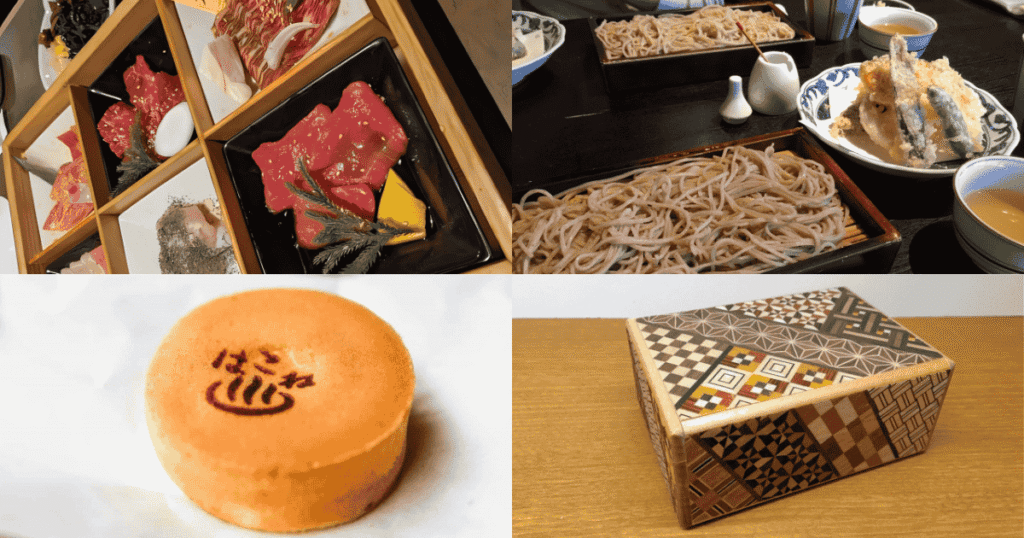
Before heading back to Tokyo, spend your final hours exploring the vibrant gateway to Hakone.
Souvenir Shopping (Must-Buy Items)
- Hakone-no-Ichi (Inside the Station): The most convenient spot for last-minute gifts. Look for “Yosegi-zaiku” (intricate wood mosaic crafts) and fresh “Onsen Manju” (steamed buns).
- Ekidori Shopping Street (Outside): Stroll the lively street in front of the station to sample freshly grilled fish cakes and local sweets.
Top Dining Picks for Your Last Meal
- Hatsuhana Soba (Authentic & Healthy): Famous for their “Jinenjo Soba” (buckwheat noodles made with local mountain yam). A Hakone classic.
- Kinosuke (Charcoal-Grilled Fish): A cozy spot specializing in “Himono” (premium dried fish) grilled over open flames. Perfect with local sake.
- Nomidokoro Ishida (Local Izakaya): An authentic, family-run Japanese pub. Great for those who want home-style cooking in a warm atmosphere.
08:10 PM | Departure: Back to Shinjuku
- Transport: Board the Romancecar for a comfortable, direct ride.
- Tip: Remember that a ¥1,110 surcharge applies to the Free Pass for this limited express service.
Tips: Make the Most of Your Day
- For Overnight Travelers (Hakone Carry Service): While this is a 1-day itinerary, if you plan to stay overnight and have large bags, don’t drag them along! Drop your luggage at Hakone-Yumoto Station before 12:00 PM, and they will deliver it to your hotel for about ¥1,000–¥2,500. This lets you enjoy the Golden Loop completely hands-free.
- Check the Ropeway & Volcanic Status: Owakudani is an active volcanic area, and the Ropeway can occasionally close due to high gas levels or strong winds. Before you head up, check the real-time status and learn about alternative transport options in our detailed guide:
- The “Free” in Free Pass: Your Hakone Free Pass covers the Pirate Ship, Ropeway, Cable Car, and all Hakone Tozan buses/trains. However, it does not cover the Izu-Hakone buses (used in Option 1). Keep your Suica/Pasmo ready for that short trip!
3. Maximize Your Savings: Value Beyond Transport
The ¥1,140 saved on transport is just the start. The true value of the Hakone Freepass lies in the 50+ discounts offered at museums, hot springs, and other attractions.
Examples of Attractions with Free Entry or Discounts
Use these facilities to boost the value you get from your pass.
| Attraction | Benefit | Notes |
|---|---|---|
| Hakone Gora Park | Free Entry | Admission is entirely free with the pass. |
| Hakone Glass Forest Museum | ¥200 Discount (Adult), ¥100 Discount (Child) | A highly popular art museum with a guaranteed saving. |
| The Hakone Open-Air Museum | ¥100 Discount (Adult) | An essential stop on the loop. |
| Narukawa Art Museum | ¥200 Discount (Adult), ¥100 Discount (Child) | Located by Lake Ashi and is included in the recommended itinerary. |
| Hakone Shrine Treasure Museum | ¥100 Discount | Located near the Gate of Peace. |
Tips for Customizing Your Itinerary
The Clockwise Model Course we propose is a baseline schedule for efficiently touring Hakone.
- You can use this schedule as a basis to select and freely adjust the timing of other places you wish to visit, such as hot spring facilities or other museums (e.g.,Okada Museum of Art), to create your own special itinerary.
- [Seasonal Recommendation] If your visit is during mid-to-late November, we recommend disembarking at Kōen-Kami Station on the Cable Car line and visiting the Hakone Museum of Art instead of the Open-Air Museum. It is famous year-round for its beautiful moss garden, but it offers particularly spectacular autumn leaves during this season, making it well worth the visit.
4. How and Where to Buy the Hakone Freepass (Online & Odawara)
You can purchase the pass in several ways depending on your preference for digital or physical tickets.
1. Buy Online (Digital Pass) – Recommended
The easiest way is via the EMot Online Tickets website or app.
- Pros: No waiting in line, skip the ticket office.
- How: Buy on your smartphone, and simply scan the QR code at station gates.
- Note: One phone per person is required.
2. Buy at Shinjuku Station (Physical Pass)
Visit the Odakyu Sightseeing Service Center, Shinjuku West or use the automatic ticket machines (look for the “Discount Pass” button).
3. Can I buy the Hakone Freepass at Odawara Station?
Yes. This is a common question for JR Pass holders or those coming from Kyoto/Osaka via Shinkansen.
- Location: Odakyu Line entrance at Odawara Station. If you arrive by JR Shinkansen, exit the JR gates and follow the signs for the “Odakyu Line.” You will find the ticket machines and the Odakyu Sightseeing Service Center right there.
- Price: The “From Odawara” version is cheaper (¥6,000) because it excludes the round trip from Shinjuku.
5. Expert Tips: Upgrades, Tickets, and Logistics
Is the Romancecar Upgrade Worth the Extra Cost?
To travel quickly and comfortably from Shinjuku to Hakone-Yumoto, you can upgrade to the Romancecar Limited Express.
- Extra Cost: The Limited Express Surcharge is ¥1,110 per person, per one-way trip. Important: This surcharge is not covered by the Hakone Freepass. You must purchase a separate Limited Express ticket (Limited Express Romancecar ticket) in addition to your pass.
- Verdict: Yes, the upgrade is highly recommended. While it adds ¥2,220 (round trip) to your total cost, it cuts travel time and provides a much more comfortable, reserved seat.
Digital vs. Physical Pass: Key Limitations
- No Sharing: If you use the digital pass, one smartphone cannot be used to share the pass among multiple people. Each person needs their own device.
- Connection Issues: Connectivity may be limited indoors or in some remote mountain areas.
6. Hakone Freepass vs. Fuji Hakone Pass: Which to Choose?
If you are only visiting Hakone, get the Hakone Freeass. However, if you plan to visit Kawaguchiko (Five Lakes) and Hakone in one trip, the Fuji Hakone Pass (3 days) is the better option as it covers transport between the two areas and the highway bus back to Shinjuku.
7. Final Verdict: The Hakone Freepass is Worth It
Based on the 2025/2026 data, the Hakone Freepass is an indispensable part of your trip:
- Guaranteed Savings: It saves you a minimum of ¥1,140 on the standard Golden Loop transport alone.
- Added Value: It provides significant discounts at essential tourist sites like the Hakone Open-Air Museum and free entry to Hakone Gora Park.
- Stress Reduction: The pass eliminates the stress of buying 8 separate tickets and waiting in lines at each transit point.
Conclusion: If you plan to complete the full loop—and we highly recommend you do—buy the Hakone Freepass. Use the Clockwise itinerary to maximize your daylight hours and enjoy the magnificent views of Lake Ashi and Mt. Fuji.